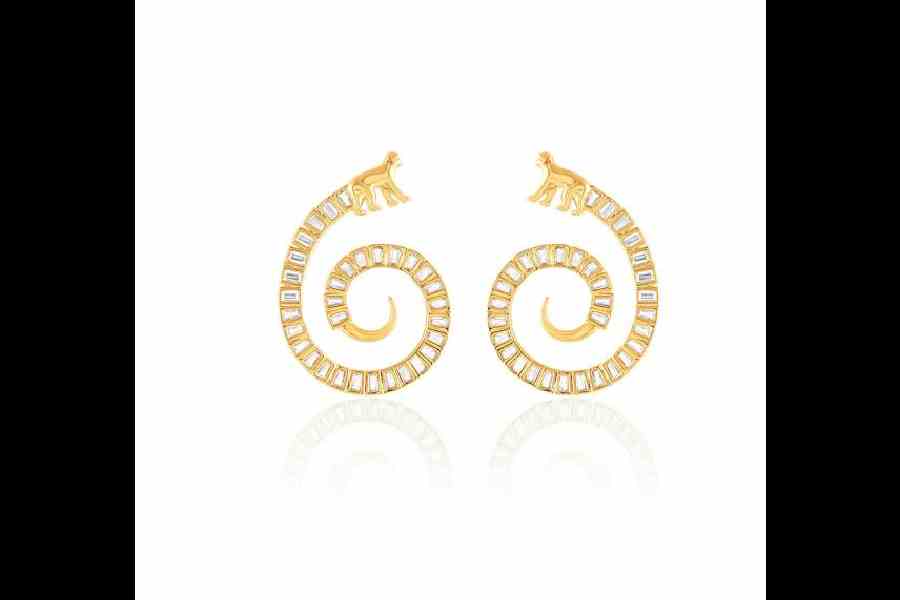
Childhood memories can often resurface well into adulthood, and revisiting them can unveil different layers of interpretation. As happened with Gauri Tandon, co-founder of Isharya. For their latest collection, Gauri went back to the timeless tales of Panchatantra that are often lessons in life. The collection she has put together is called Fables, full of delicate pieces that intertwine design elements from the Panchatantra. In a chat with t2, Gauri looked back at the inspiration, how evolved women are buying jewellery now and exploring jewellery for men.
What about the Panchatantra fascinated you?
I think what fascinates me most is that these stories stay with you long after childhood. We all grew up hearing them, but when you revisit them as an adult, you realise they’re really stories about people — ambition, friendship, cleverness, resilience — just told through animal characters. The lessons are timeless, which is probably why they have survived for centuries. That felt very inspiring from a design perspective.
How did you interpret it in the pieces?
We didn’t want to create jewellery that looked like illustrations from a storybook. The idea was to capture the personality and spirit of the characters in a way that felt modern and wearable. For example, the tortoise isn’t just a tortoise — it’s about perseverance. The monkey represents wit and intelligence. We tried to take those qualities and translate them into motifs, colours and styling moments.
What I love is that most of the pieces from this collection tell a story when they’re layered together. The collection reveals itself the more you play with it.
Do you have a favourite story behind a piece?
I love the rabbit and tortoise pieces. On their own, they’re beautiful, but when you layer them together, it almost feels like the tortoise is ahead of the rabbit, signifying the story. It’s a small detail, but those are the moments I enjoy most as a designer. I love when jewellery rewards curiosity.
Do you have a favourite story from the Panchatantra?
I’ve always loved The Monkey and the Crocodile. As a child, it was simply an entertaining story. As an adult, I appreciate the lesson even more — that intelligence, adaptability and quick thinking can often get you further than brute strength. As an entrepreneur, that’s a lesson I relate to constantly.
How has the demi-fine jewellery industry evolved over the years?
The biggest shift has been in how women relate to jewellery. Earlier, it was tied to occasions, milestones or investment. Today, it’s become an extension of personal style.
Women are building jewellery wardrobes the way they build fashion wardrobes — mixing, layering and curating pieces that reflect who they are. Jewellery is no longer just something women own; it’s something they actively style. That’s why demi-fine jewellery has become so relevant — it sits at the intersection of fashion and fine jewellery, offering the freedom to express yourself every day.
What has your experience taught you?
My experience has taught me that inspiration is everywhere if you’re paying attention. Some of our ideas come from art, architecture or travel, but just as often they come from a childhood memory, a conversation or a story we’ve carried with us for years.
With Fables, for example, the inspiration came from revisiting Panchatantra stories we all grew up with. I’ve realised that the strongest ideas are often the most familiar ones. The magic lies in looking at them through a fresh lens.
What is your personal taste in jewellery like?
My approach to jewellery is simple: more is more. I’m a maximalist at heart and have always been drawn to pieces with character, colour and a story to tell. What excites me most is how jewellery can be transformed through styling. Even the simplest piece can feel entirely different depending on how you wear it. That philosophy naturally finds its way into Isharya. We design pieces that can be layered, stacked and interpreted differently by different women. I don’t believe there’s such a thing as a basic piece of jewellery — only different ways of styling it.
Internationally, do you see any trends emerging?
One trend I’m seeing globally is a growing appetite for jewellery with meaning. People are looking for pieces that feel personal — whether that’s symbolism, spirituality, protection or manifestation. We’ve seen this firsthand with our Juju collection inspired by healing stones. Every time we’ve launched it, it resonates deeply because people aren’t just buying jewellery; they’re connecting with what it represents.
Any thoughts on exploring jewellery for men?
It’s a very interesting space and one that’s evolving rapidly. We’re seeing more men embrace jewellery as an extension of personal style, from everyday chains and rings to more expressive pieces.
At Isharya, we’ve always believed that jewellery is about self-expression, and that’s becoming an increasingly gender-fluid conversation. Many of our designs already have a universal appeal and can be styled in different ways by different people. While our focus today remains on women’s jewellery, it’s definitely a category we’re watching with interest.
Name a personality who wears their jewellery really well.
I’ve always admired the way Coco Chanel wore jewellery. She was unapologetically maximalist, as she famously said, that luxury lies not in richness and ornateness, but in the absence of vulgarity. For her, jewellery was not about excess; it was about attitude and self-expression.
I also love the effortless confidence of Zoë Kravitz and, closer home, the way Sonam Kapoor experiments with jewellery and makes it such an integral part of her style. They remind me that jewellery is most powerful when it doesn’t simply decorate a woman, but reveals something about her.