The Bengal government will “henceforth” not allow liquor shops within a 500m radius of educational institutions, religious places and hospitals in Calcutta.
In the rest of Bengal, the restriction will apply within a 1km radius.
“No licence for a liquor shop shall henceforth be granted if the proposed premises are situated within a radius of 1 kilometer from any educational institution, hospital or religious place. In areas falling within the jurisdiction of the Kolkata Municipal Corporation (KMC), the minimum distance requirement shall be 500 metres,” the BJP government’s first Bengal budget said.
Existing retailers must renew their excise licence annually by paying a fee. They are then issued a fresh licence valid for a financial year beginning on April 1 and ending on March 31 the following year.
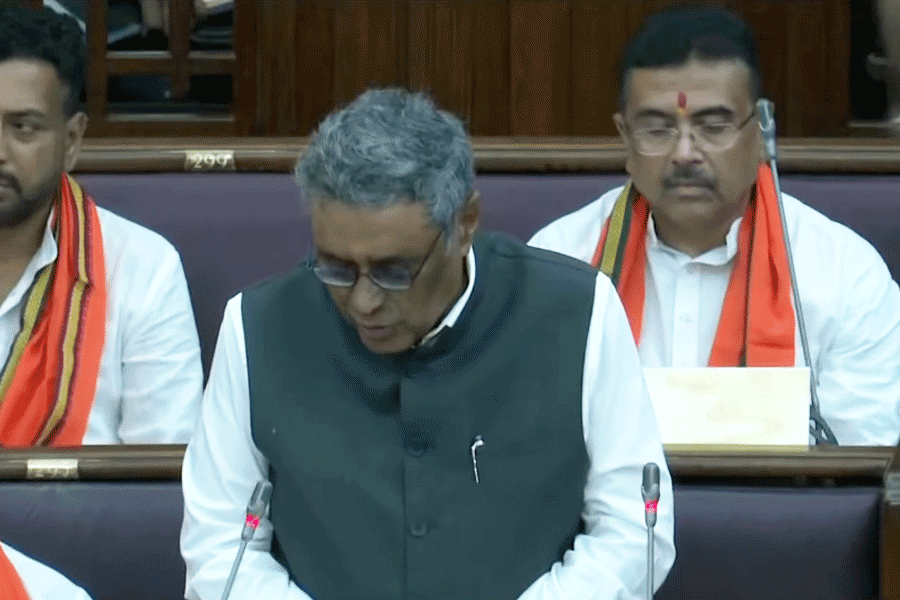
Finance minister Swapan Dasgupta’s budget speech did not clarify whether the restriction would affect existing licence holders or apply only to new licences. It also did not specify whether the curbs would extend to bars operating in restaurants, hotels and social clubs.
A source in the excise department told Metro: “Our understanding is that no new liquor shop will be allowed within the specified boundary. But more clarity will emerge in a few days.”
Most retailers this newspaper spoke to interpreted the measure as applying only to new licences and not to the renewal of existing ones.
“Off-shops that already have a licence can operate as before,” said Bijon Patra, secretary of the Society for Welfare of West Bengal Foreign Liquor Licensees.
A veteran restaurateur on Park Street shared that view. “A blanket ban is not feasible. More than half the bars in Calcutta would have to shut down. Besides, the minister only mentioned liquor shops,” he said.
After an administrative review meeting on May 26, chief minister Suvendu Adhikari had said: “... We have said that a licence for an alcohol shop will not be given within a kilometre of schools, colleges and temples. This government will run differently. There is no reason for any concern.”
Following those remarks, liquor retailers met excise officials seeking clarification and expressing hope that the restriction would apply only to new establishments.
“Back then, we were verbally assured that the bar would apply only to new establishments. Today’s budget speech also used similar language,” said Mihir Chakraborty, assistant general secretary of the West Bengal Foreign Liquor Off and On — Country Spirit and Hotels’ Association.
One thing appears certain: pending applications will undergo fresh scrutiny.
Industry sources said obtaining a fresh licence to sell alcohol was a lengthy and cumbersome process.
An offline application must first be filed, followed by detailed police and excise inquiries. The report is then sent to the excise commissioner. If it is satisfactory, a letter of intent (LoI) is issued to the applicant, who must then submit an online application. Another round of inspections follows before a licence is granted.
“The process may be tedious for ordinary applicants. For VVIPs, it is different. I have seen an application processed in less than two months. But there are also applications pending for six years,” said a veteran retailer. “What happens to applicants who have already received an LoI remains to be seen.”