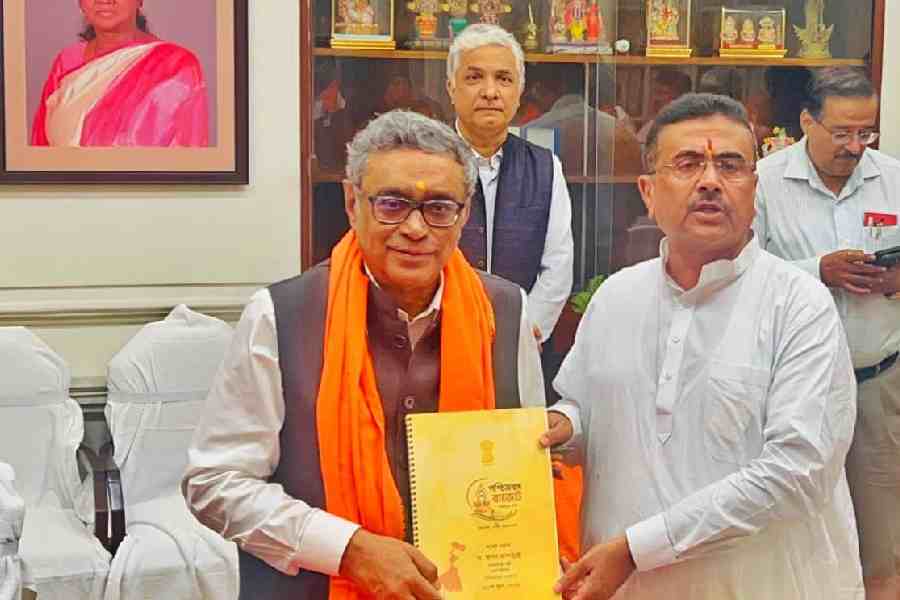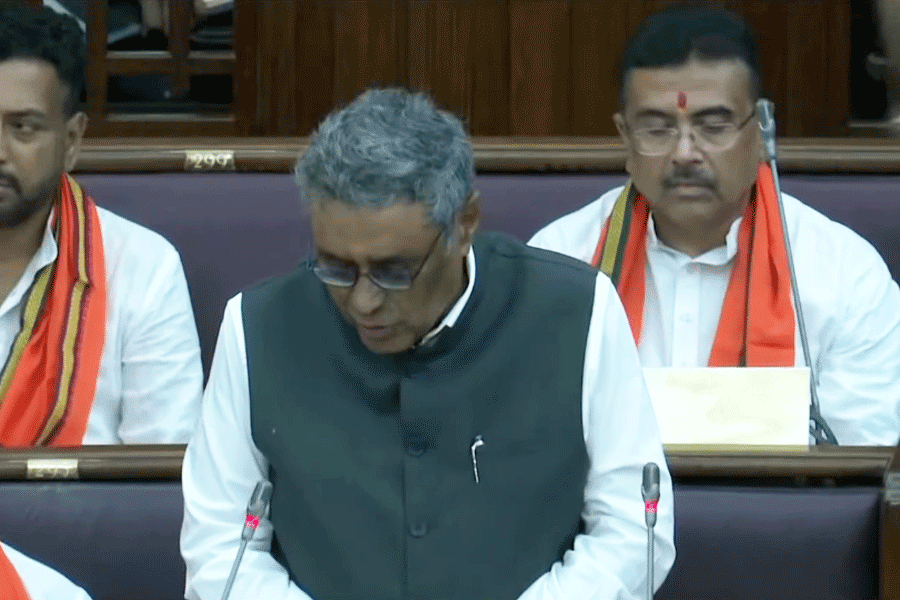
Filling of 1 lakh government vacancies, 20 percentage point hike in dearness allowance (DA) for state government employees, Rs 36,000-crore outlay for the Annapurna Yojana and reducing beneficiaries of the women’s dole by 1.4 crore were some of the highlights as the Bengal finance minister Swapan Dasgupta presented the first budget of the BJP government in Bengal on Monday.
Dasgupta said all existing social welfare schemes would continue.
DA bonanza vow for state govt employees
The DA for state government employees and DR for pensioners would be raised by 20 percentage points from October 1, taking it to 38 per cent.
It narrows the gap between the DA received by state government employees and their central government counterparts by 22 percentage points, a politically significant announcement as government employees had long agitated over the issue under the previous regime.
Dasgupta announced that 1 lakh vacancies, including 20,000 posts in the police and 50,000 teaching and non-teaching positions in schools, would be filled in phases.
He said 33 per cent of the jobs would be reserved for women, while 10 per cent reservation would be provided for Agniveers wherever applicable.
"The upper age limit for government recruitment, already relaxed by five years, would continue for the next two years," he added.
Annapurna Yojana slashes beneficiaries
Dasgupta announced an allocation of Rs 36,000 crore for the Annapurna Yojana, under which women in the 25-60 age group will receive financial assistance of Rs 3,000 per month directly in their bank accounts.
The budget estimates indicate coverage of 1 crore women beneficiaries, substantially lower than the around 2.4 crore beneficiaries under the Trinamool’s flagship welfare programme.
Dasgupta announced the allocation, describing the scheme as a major component of the government's welfare agenda.
Introduced in 2021, Lakshmir Bhandar emerged as one of the most popular welfare schemes of the Mamata Banerjee government, providing monthly financial assistance to women from eligible households. The scheme was subsequently expanded, and the TMC government had claimed that around 2.4 crore women were receiving benefits.
After assuming office, the BJP government has renamed the programme as Annapurna Yojana.
Government sources said the scheme has been designed with revised eligibility norms and enhanced verification mechanisms aimed at ensuring that benefits reach intended recipients and eliminating alleged duplication.
The state government has said it already weeded out 30 lakh beneficiaries based on verification.
The government had sought online applications requiring family details, which has caused concerns and apprehensions about disclosing family income and other household details.
The BJP maintained that the objective is to make welfare delivery more targeted and fiscally sustainable while ensuring support for genuinely eligible beneficiaries.
The budget also earmarked Rs 550 crore for free bus travel for women.
"A 'Pink Card' system will be introduced shortly for availing the benefit," Dasgupta said.
More money for MLAs
The state government has increased the MLA Local Area Development Fund from Rs 70 lakh to Rs 1 crore.
The budget also proposed a monthly pension of Rs 5,000 for retired journalists and Rs 10,000 for persons who had spent time in jail due to what the government described as politically motivated or false cases.
Among welfare measures, the government announced a monthly hike of Rs 5,000 for anganwadi and ASHA workers.
Civic volunteers, Green Police personnel, NVF workers, Prani Bandhu and Prani Mitra workers will receive an additional Rs 2,000 per month from August.
The budget proposed expanding the state's subsidised meal programme by opening additional Maa Aahar centres in urban areas, where meals including fish and rice would be available at nominal rates.
The government increased allocations for the 125-day VB G-Ram-G scheme and announced the addition of 25 lakh new beneficiaries.
Infrastructure focus
The budget also proposed an elevated corridor between Chingrighata and New Town in Kolkata, a deep-sea port at Dadanpatrabar, a four-lane bridge over the Mayurakshi river in Birbhum and a study for metro rail projects in Durgapur, Asansol and Siliguri.
A new unemployment assistance programme, 'Bharosa', was announced, under which unemployed graduates from families with annual incomes below Rs 1 lakh will receive Rs 3,000 per month, while other eligible unemployed persons will get Rs 2,000, provided they are not covered by any other social welfare scheme.
The government enhanced old-age, widow and disability pensions by Rs 500 per month.
In the health sector, the government allocated Rs 3,100 crore for the implementation of Ayushman Bharat, expected to cover nearly seven crore people.
The allocation for mid-day meals was enhanced to Rs 10 per student, with ISKCON expected to assist in food preparation and distribution.
The education sector figured prominently in the budget, with proposals for a Tribal University and two Kendriya Vidyalayas in Jhargram, women's universities in Contai, Kaliachak and Falta, and a one-time grant of Rs 25,000 for students of government and government-aided colleges preparing for competitive exams.
The government announced plans to facilitate the establishment of an IIT and an IIM in north Bengal and launch a state Artificial Intelligence Mission.
It also proposed installing sanitary pad vending machines in schools.
On the sports front, the government announced a Sports University, an “international-standard” stadium in north Bengal and mini indoor stadiums at a cost of Rs 5 crore.
Clubs participating in national games will receive assistance of Rs 1 crore each, while Rs 20 crore has been earmarked for Khelo India activities in the state.
The government allocated Rs 900 crore for the proposed Chingrighata-New Town elevated corridor and Rs 1,200 crore for a new bridge over the Bhagirathi river.
To ease pressure on Kolkata airport, the government will identify 1,000 acres in Kalyani for a greenfield airport. Airports have also been proposed in Purulia and Malda, while land will be earmarked for the expansion of the Hasimara and Kalaikunda airfields.
The budget allocated Rs 100 crore for strengthening communication infrastructure in the Sundarbans and Rs 50 crore for riverbank protection and rehabilitation in the Jangipur region.
Measures aimed at boosting north Bengal's economy included reducing the minimum land requirement for commercial tea estates from 30 acres to 15 acres.
Dasgupta said special facilities, including free charging points and drinking water arrangements, will be created for gig workers.
He said the government's vision was aligned with the national goal of 'Viksit Bharat'.
"People expect transparency about the state's finances. We have to maintain a balance while creating opportunities for employment, industrial growth and a modern, progressive Bengal," he said.
He said his government has inherited a debt burden of Rs 8.15 lakh crore from the previous administration and promised to prioritise restoring fiscal discipline and public confidence in governance.
Before presenting the budget, Dasgupta and Bengal chief minister Suvendu Adhikari participated in a brief prayer ceremony in the Assembly premises.
Health, education, new districts
The government has proposed the creation of five new districts, a subdivision and seven municipalities.
"The proposed districts -- Kolkata, Basirhat, Sundarban, Jangipur and Arambagh -- are being created for administrative convenience and security-related requirements. The move will help bring government services closer to people and ensure more efficient governance," Dasgupta said.
There will be a new police district in Kanthi, he said.
The budget also proposed the creation of a subdivision at Gopiballavpur and new municipalities at Shivmandir, Gazole, Chanchal, Belda, Badhana, Kamarpukur and Kolaghat.
"The new subdivision and municipalities are being proposed to improve civic amenities and make public services more accessible to citizens," the finance minister said.
In the healthcare sector, Dasgupta invited private participation in setting up advanced medical facilities, while laying down conditions to ensure affordable treatment for patients.
"We invite private organisations to establish state-of-the-art hospitals. However, they will have to reserve 50 per cent of their beds for patients referred from government hospitals, either free of cost or at subsidised rates," he said.
The minister also announced plans to assist families travelling outside the state for specialised medical treatment.
"Patients and their relatives travelling to places such as Mumbai and Vellore for treatment will be provided affordable accommodation through government-supported arrangements under the public-private partnership model," he said.
In a major announcement for north Bengal, Dasgupta said the government would establish an AIIMS and a dedicated cancer hospital in the region.
"An AIIMS and a cancer hospital will be set up in north Bengal to strengthen educational and healthcare infrastructure. We are committed to expanding opportunities and improving access to quality healthcare," he said.
To increase the state's medical education capacity, the government proposed adding 650 MBBS seats across 13 medical colleges.