The Bengal government on Monday unveiled an ambitious industrial revival strategy, earmarking ₹5,000 crore towards investment incentives, promising legislation to shield businesses from extortion, and pledging to build a land bank by reclaiming idle plots held by public and private companies while taking a relook at the urban land ceiling law.
It also signalled a push to expand Bengal’s port, road, railway and airport infrastructures, showcasing the benefits of a “double-engine” model aimed at speeding economic growth, drawing fresh capital and creating jobs in a state that has struggled to attract big-ticket investments in manufacturing or services.
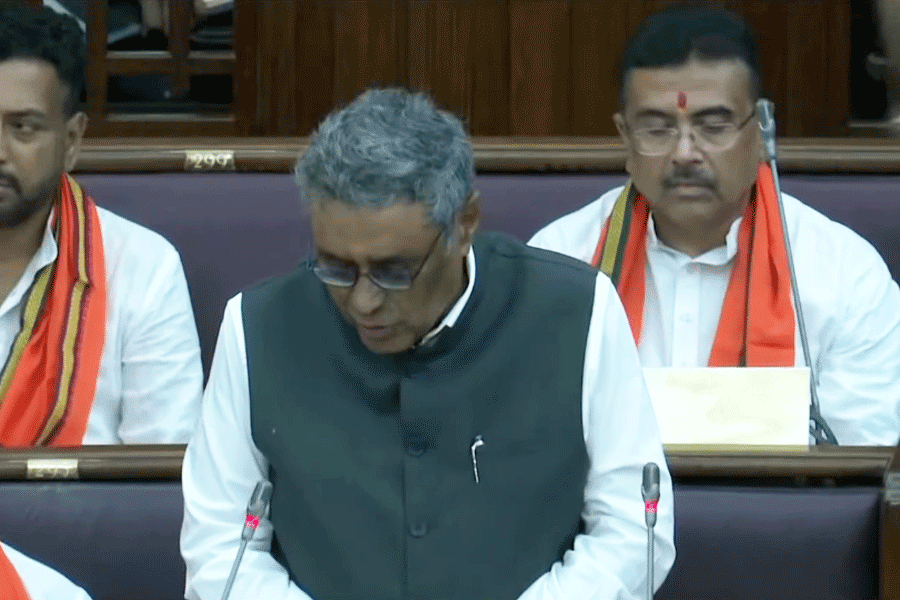
“We have changed the direction of the state policy and given our total support to entrepreneurship, growth, innovation, technology and business,” finance minister Swapan Dasgupta said in his maiden budget speech, adding that his government had put “Bengal back on the map of India”.
The new BJP government’s first budget also promises a policy to attract global capabilities centres — MNC back offices that are driving white-collar job creation in India — and a package of incentives to position Bengal as a destination for AI-oriented data centres and hyperscale cloud computing infrastructure.
In line with the Centre’s promotion of self-reliance and new-age industries, the budget promises a semiconductor unit in Durgapur and defence manufacturing hubs in Bankura and Birbhum as a means to integrate Bengal with the global supply chain.
To support the industry focus, the ₹4.38 lakh crore budget rolls out reforms such as listing profit-making state public sector units in the bourses, signalling non-strategic divestment to unlock value. It speaks of reviving the dormant Calcutta Stock Exchange to “reclaim Kolkata’s place as a financial capital”.
The government also proposes to change the Shop and Establishments Act 1963 to allow round-the-clock operation of shops, restaurants, offices, logistic services and hospitality establishments and introduce Bengal’s urban centres to a “24x7 economy”.
To enhance the ease of doing business and attract large-scale investment, the government has announced that proposed investments of over ₹100 crore will not need separate no-objection certificates and other such approvals from the zilla parishads and panchayat samitis for building plans, trade licences and the like.
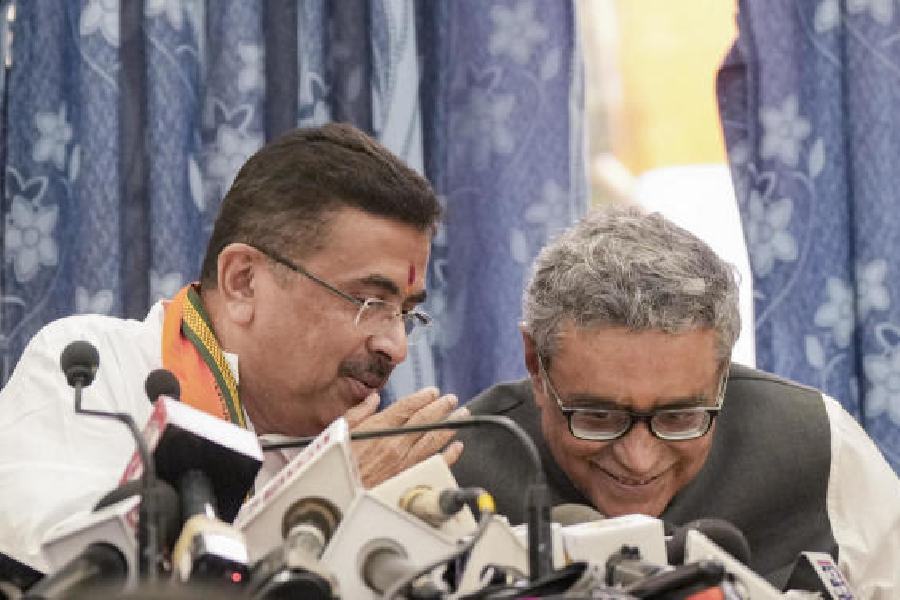
Chief minister Suvendu Adhikari described the budget as one for “vikas and virasat” (development and legacy).
“Special importance has been given to infrastructure development, industry and the agriculture sector,” Suvendu said.
The budget maintains the Mamata Banerjee government’s target of bringing the fiscal deficit down to 2.91 per cent – the lowest in a decade.
Bengal, however, remains under the shadow of a crippling debt burden that is projected to rise to ₹8.15 lakh crore, up from ₹7.62 lakh crore (according to the revised estimate for 2025-26).
But, Dasgupta said, the state has managed to avert a financial collapse by streamlining the architecture of welfare.
Industry welcomed the infrastructure-building drive, the re-introduction of an incentive scheme, and the promised protection from “syndicate” extortion -- a forgettable legacy of the Trinamool government.
“Industry is particularly very hopeful about the removal/ relaxation of the stringent Land Ceiling Act, and the restoration of incentives at least on a par with other states to attract both domestic and international investments,” Sanjay Budhia, managing director of Patton, said.
The details of the incentives scheme are likely to be revealed later.
“The state government will introduce a West Bengal Investment Promotion Framework with the main thrust on industrial development through a cluster approach along with industrial corridors,” Dasgupta said in his budget speech.
He added that emerging sectors such as electric vehicles, semiconductor designs, green hydrogen, and defence manufacturing would be among the target areas.
“This will include a new incentive policy. I propose an allocation of ₹5,000 crore for this purpose in this financial year,” Dasgupta said.
The Mamata Banerjee government had in 2025 revoked the incentive policy retrospectively, striking a body blow to Bengal’s image among investors and industry in India and beyond.
Prashant Modi, vice-chairman and managing director of the coal-bed methane producer Great Eastern Energy Corporation, said the budget was “extremely encouraging”.
“The real signal is on the ease of doing business -- simpler clearances, a credible land bank and a proposed law against extortion,” Modi said.
Mayank Jalan, managing director of Keventer, highlighted the emphasis on agriculture and food processing.
“The government’s infrastructure push also provides an opportunity to Kulpi port,” he said.
While the budget is heavy on promises, industry representatives cautioned that intent should translate into action.
“The intent is clear. If matched by execution, Bengal can emerge as one of India’s most exciting growth stories,” Sagar Daryani, founder & CEO of Wow! Momo, said.