When Manna Dey sang Shob khelar sera Bangali’r tumi football (Of all games, football, you are the greatest for Bengalis), he was documenting the soul of an entire city. Decades later, his words continue to echo through Calcutta because no matter how many new sports become popular, football continues to occupy a sacred space in every Bengali heart.
Cricket may dominate television screens, tennis may produce international stars, and rugby may slowly gain followers, but football possesses a different kind of magic altogether. Football is emotion. Football is memory. Football is a family tradition. Football is identity. And nowhere is this love story more visible than during the FIFA World Cup.
FOOTBALL FEVER
Every four years, Calcutta transforms into a giant carnival. The biggest football tournament in the world may be taking place thousands of kilometres away, but nobody in the City of Joy allows geography to interfere with passion.
The World Cup does not feel foreign here. Instead, the city adopts it as its own. Streets become fan parks, neighbourhoods become stadiums, and every conversation eventually finds its way back to football. The city undergoes a complete change in personality. For one month, people willingly abandon their original identities and adopt new nationalities. Suddenly, one neighbour becomes Brazilian, another becomes Argentine, and someone else proudly waves the Portuguese flag. There is no confusion and no explanation needed. This is how Calcutta celebrates football.
Walk through any lane, and the evidence is impossible to miss. Giant flags flutter from balconies. Tiny shops are decorated with colourful banners. Tea stalls display posters of football legends. Perhaps that is the best way to explain it.
Sleep schedules completely disappear. People wake up at dawn to watch early kick-offs and stay awake till absurd hours for late-night matches. Entire families gather around televisions, and everybody suddenly becomes a tactical expert. Football turns strangers into friends and friends into rivals.
To celebrate this unique relationship between Calcutta and the beautiful game, t2 spent a sweltering summer day exploring two iconic football destinations with three young stars from Tollywood, Amartya Ray, Aryann Bhowmik and Rohaan Bhattacharjee. The mission is to capture the city’s football fever and pay tribute to an era that is coming to an end.
MAIDAN MARKET
The first stop was the legendary Maidan Market near the Esplanade. If football lovers ever needed proof that heaven exists on earth, this market might be it! Long before one enters the market, one can smell it. The scent of freshly printed jerseys fills the air. It is an oddly comforting smell that every sports enthusiast recognises instantly.
There are no luxurious showrooms here. Instead, there are endless rows of affordable dreams. Argentina jerseys hang beside Brazil jerseys. Portugal shares space with Germany. France competes with Spain. Every participating nation finds a place here. It is a landmark steeped in history.
Established around 1950, the market was originally set up for cloth merchants who migrated after the Partition of Bengal. Over the years, the erstwhile Hawkers Market became BC Roy Market before adopting the nickname Maidan Market. Old timers proudly claim it is the largest sports goods market in Asia. Whether officially true or not hardly matters because emotionally every Calcuttan already believes it.
As Amartya, Aryann and Rohaan entered the narrow corridors, they immediately transformed into children. Football has a magical ability to erase age.
The three youngbloods excitedly explored footballs, jerseys and spikes. They laughed, posed for photographs and soaked in every bit of football fever surrounding them. The colourful flags hanging overhead created a stunning visual.
The buzzing crowd added energy. The smell of rubber printing completed the atmosphere. The heat was unbearable, but nobody cared. Because football has a strange way of making people forget discomfort.\
At one point, the actors looked less like celebrities and more like children visiting Disneyland for the first time. That innocence perfectly captured what football means to Calcutta.
SALT LAKE STADIUM
The second destination was equally iconic. Salt Lake Stadium, officially known as Vivekananda Yuba Bharati Krirangan, remains one of Indian football’s greatest landmarks.
Standing in front of the gigantic arena is an experience in itself. It is a museum of emotions. It has witnessed victories and heartbreaks. It has hosted roaring crowds and unforgettable moments. It serves as the home ground for East Bengal and Mohun Bagan, two clubs whose rivalry defines generations. This is sacred territory!
As Swami Vivekananda once famously said, “You will be nearer to heaven through football than through the study of the Gita.” Could there be a better place for a FIFA-themed photoshoot? Probably not.
Although permission to shoot inside the stadium was unavailable, fate offered an equally exciting alternative. The Stadel’s football turf. With the gigantic stadium serving as the backdrop, the setting could not have been more perfect.
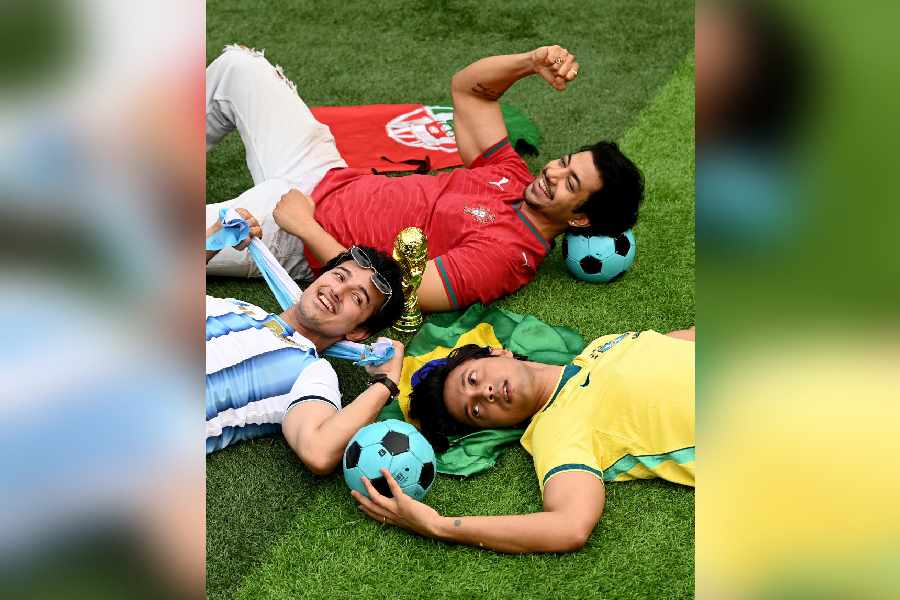
Within minutes, the actors changed into jerseys representing three nations. Brazil. Argentina. Portugal. These choices were deliberate. The shoot was designed to pay tribute to three football icons whose final World Cup journey has arrived. Lionel Messi, Cristiano Ronaldo and Neymar Junior.
Watching Amartya, Aryann and Rohaan run around the turf felt wonderfully genuine. They were not pretending. They were simply being themselves. They chased imaginary trophies, waved giant flags and recreated iconic football celebrations. There was another reason these three young stars were selected. Their football connection.
Amartya portrayed the legend, a young Chuni Goswami, in Maidaan. Aryann portrayed Neville D Souza and also starred in a Bengali film called Messi. Rohaan is an ardent Manchester United supporter and a passionate CR7 fan. Each one represented a different shade of fandom. Together, they embodied the spirit of Calcutta.
FIFA MEMORIES
For many football lovers, the FIFA World Cup is much more than a tournament. It is a collection of emotions, songs, friendships, heartbreaks and unforgettable moments that stay with them for life. Amartya, Aryann and Rohaan looked back on their earliest World Cup memories, iconic anthems and the moments that defined their love for football.
“My first FIFA World Cup was in 2006, and I still remember the excitement that surrounded it. My favourite FIFA anthem has to be Waka Waka, but Wavin’ Flag is right up there too. Both songs instantly transport me back to those incredible World Cup days. One of my fondest memories was when I was studying at FTII during my college years. The FIFA fever on campus was unbelievable,” said Amartya.
“I’m an ardent Argentina and Diego Maradona fan. My first FIFA World Cup was in 2002, and ever since then, it has been a huge part of my life. One of my most memorable FIFA memories has to be the 2014 final when Mario Götze scored the winning goal for Germany, and Argentina lost the trophy.
My cousins, who supported Germany, made endless fun of us, Argentina and Messi fans after that defeat. But football always has a beautiful way of completing its stories. We finally got our redemption when the G.O.A.T., Lionel Messi, lifted the World Cup in 2022. That victory felt personal to so many of us who had patiently waited for years to see him achieve the one thing missing from his extraordinary career.
I also love Waka Waka. Every time I hear it, it brings back a flood of memories,” added Aryann.
While Rohaan said, “Same for me — my first FIFA World Cup was in 2002, and some of my most cherished memories revolve around football and my neighbourhood friends. I still remember how all of us from the para ran down the streets carrying an 80-foot Brazil flag. It was such a joyous and unforgettable sight.
My favourite FIFA memory, however, came in 2022. I was at an outdoor shoot and happened to be running on a treadmill. I jokingly promised myself that I would keep running until Argentina won the final. Thankfully, they did, and it became one of the most memorable experiences ever. As for FIFA anthems, To Brazil by the Vengaboys will always hold a special place in my heart. The moment that song starts playing, it instantly feels like the World Cup season has arrived once again.”
THE LAST DANCE
Lionel Messi. Cristiano Ronaldo. Neymar Jr., these three names have defined an entire generation. Millions grew up copying their hairstyles, celebrations and mannerisms. School notebooks were filled with their names. Arguments about who was the greatest consumed classrooms and family gatherings alike. They shaped modern football. And now their final chapter is unfolding.
Messi enters the tournament as a defending champion and a legend who has already completed football. At 38, he carries no burden anymore. Every moment now feels like a bonus chapter in a masterpiece. Ronaldo arrives with unfinished business. The World Cup remains the only major trophy missing from his extraordinary collection. At 41, he continues to challenge age itself. Then comes Neymar. The prince of Brazil. Brilliant, emotional and endlessly entertaining, his journey has been filled with injuries and heartbreak.
This World Cup represents redemption as the throne awaits the king. Together they symbolise the end of an era. And Calcutta understands emotions better than most cities. That is why this farewell resonates so deeply.
CALCUTTA AND FOOTBALL
Every World Cup becomes unforgettable. People remember where they were when Argentina won. They remember Germany’s dominance. They remember Brazil’s heartbreak. Football creates lifelong memories. Every generation has its own heroes. Grandparents speak about Pele. Parents worship Maradona. Children adore Messi. Teenagers debate Mbappe. Football evolves, but the passion remains constant.
Another unique aspect of Calcutta’s football culture is inheritance. Nobody remembers exactly when they started supporting a team. They simply inherit it. An Argentine flag may have belonged to a grandfather. A Brazil jersey may have come from an uncle. These loyalties pass from generation to generation. This emotional inheritance keeps football alive.
Even heartbreak strengthens devotion. Brazil supporters still remember the 7-1 defeat. Argentina supporters remember years of disappointment and finally redemption. Yet every four years, hope returns. Because football always offers another chance. Perhaps that is its greatest lesson. Hope never expires.
Calcutta understands this philosophy beautifully. The city itself is built on resilience. It has survived change, challenges and reinventions. Football mirrors that spirit. It allows people to dream again.
As the World Cup is on in full force, Calcutta will once again transform. Families will gather around televisions. Social media timelines will explode. The city will temporarily stop sleeping. And nobody will complain. Because this madness is cherished. Football permits Calcutta to become childlike again. For one month, adults become children. Life becomes lighter. That is the true beauty of the tournament.
The World Cup is a global celebration of humanity. And Calcutta happens to be one of its most enthusiastic hosts despite never officially hosting it. The city somehow convinces the world that it belongs at the centre of the action.
Only Calcutta can transform distant matches into local festivals. This relationship defies logic. That is precisely what football is here. Love. Pure, irrational and unconditional love for the sport.
Jersey courtesy: Adidas, Nike and Puma outlets in South City Mall
Aryann Bhowmik’s wardrobe courtesy: The Degree Celsius
Location: The Stadel Sports Arena
Hospitality courtesy: First Innings- The Stadel