 |
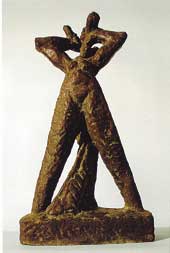
| Tarak Garai’s Fondness II and Ramkinkar’s Harvester (inset) on display at the exhibition |
An exhibition titled Sculptures: The Bengal Connection at Gallery Rasa in New Alipore is a fair attempt to trace the gradual development of the art from the early twentieth century to the present day. The exhibition layout by Radhika Shani and the cataloguing and the documentation by her husband Rakesh and his friends are excellent. However, the thematic conception of the curation is rather loose. Rakesh’s introduction printed in the catalogue is also quite amateurish.
But to the couple’s credit, no one has attempted such a visual anthology of sculptures before. The reason is simple ? sculptures, despite the rich Indian heritage, do not sell.
The show has a rare piece by Jamini Roy in wood, resembling a tree. It’s also an abstraction of a womanly form. The stylised veiled head with triangular shapes in the torso and the tree-trunk shape at the bottom play with cubic elements and pyramidal structures and they are all fused into a magical composition. Of the two works of Debiprasad Roy Chowdhury, the topless woman in wet clothes has a vibrant vitality of its own. The old man smoking a hookah proves that the artist was restlessly looking for an expressive form.
The two works of Bhabesh Sanyal are simplistic. Winter is expressed through the obese form of a heavily draped woman while the Shrouded Woman encases paralysed motion. The sheer strength of Ramkinkar’s Harvester, Prodosh Dasgupta’s Two Women Gossiping, Kamala Dasgupta’s portraits of a girl and her husband, Prodosh, Chintamoni Kar’s Untitled kissing couple and seated Odilisque, Shankho Chaudhuri’s portrait of Bhabesh Sanyal and the Lady and Probash Sen’s Sleeping Lady recall the slow and steady advancement of the art of sculpture after several centuries of stagnation. There is artistic vigour and refreshing exuberance in these works. Sunil Kumar Paul is one sculptor who has been neglected. His portrait of Abanindranath Tagore is exquisite, expressive and full of subtle refinement.
After the redefinition of sculptural parameters and the measuring of the constants and the variants, the artists went into areas of experimentation. Somnath Hore’s mask-like faces with skeletal bodies of emaciated persons show empathy for the hungry and the sick. Meera Mukherjee has used a folk technique to figure out the vibrant situations of the individual and community life of both rural and urban people.
Sarbari Roychoudhury is inclined to study morphological features on the undulation of the body. Ajit Chakravorty concentrates on modular sequences of planes in figuration while Raghunath Singh glides into the peculiarities of various media.
From Debrata Chakravorti, Biman Das to Phulchand Pyne and Niranjan Pradhan, there is a tendency to explore the realms of tradition and individual talent.
Sometimes, as in the works of Balbir Singh Katt, Madhav Bhattacharya and Uma Siddhanta, the creative spirit discovers imaginative areas that are new and refreshing. Their younger contemporaries like Manik Talukdar, Tarak Garai, Sunil Kumar Das, Gopinath Roy and Bimal Kundu have all found their own styles of expression. Some of them prefer mixed media. Shyamal Ray still experiments with terracotta boldly.photographySujoy Das