
New Delhi, March 18: Over 10 million Indian passport applicants a year may soon have to wait less for the cumbersome and opaque police verification that currently takes three months on an average in Bengal - aided by a combination of texts, tablets and Twitter.
India's passport office is readying a menagerie of manual and technology-driven fixes aimed at whittling down the delays, especially in states like Bengal and Assam that rank among the worst laggards, by handing applicants keys tools to pressure police officials.
Applicants will receive computer-generated text messages with details, including the mobile number, of the policemen handling their verification the moment their applications reach the local police department, allowing them to schedule visits by the officer that are mutually convenient.
Officers in charge of verifying applications will be handed tablets where they can feed in clearances on the spot after their visits, which in turn will be received at passport offices that process the actual passports.
Every regional passport office (RPO) chief will need to create a Twitter account and answer complaints in real-time, monitored by Ramachandran Swaminathan, special secretary in charge of consular, passport and visa-related issues at the foreign office.
"We've never tried something like this before, but we believe this could really cut down the wait for people, especially in states like Bengal," India's chief passport officer, Muktesh Pardeshi, told The Telegraph. "Applicants won't need to run around passport offices or their police station - and they can press the police officer instead of the policeman harassing them."
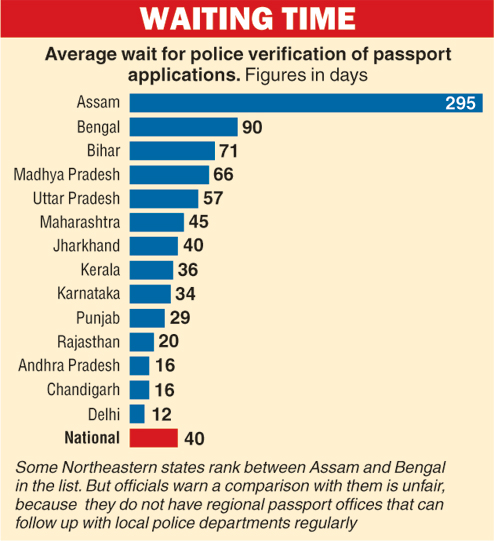
Nationally, the police take 40 days to verify a passport application on an average - down from 51 days in 2013 - but the figure leaps to 90 for Bengal, and a whopping 295 days for Assam, an internal study conducted by the central passport office recently shows. Bihar (71 days) and Uttar Pradesh (57 days), traditionally lampooned for relatively poor governance, boast better records.
When 30-year-old Anindya Ray was offered a project working with his company in Belgium in 2013, the Calcutta-based information technology executive made elaborate plans for a vacation in the Himalayas with his wife before he took up his new assignment.
But Ray eventually had to call off his vacation to shuttle between the regional passport office and the police station, first hearing contradictory details on the status of his application, then pursuing a police officer to visit his home.
Eventually, Ray also had to negotiate with his company to join the Belgium project later than initially planned - the police had taken 157 days or more than five months, to verify his passport application.
"The local police station, it eventually became clear, was misleading me for three months, telling me they hadn't received by application from the passport office - when in fact they had," Ray recalled, speaking on the telephone from Brussels. "It was nightmare - I wouldn't wish it on my worst enemies."
That's the kind of running around applicants may find themselves saved from, if the measures the passport office is fine-tuning work as they are expected to.
A text message, as soon as an application reaches the local police department, will alert the applicant that he or she can pursue verification. The officer's telephone number will allow the applicant to directly dial the policeman and fix a time for the cop's visit - avoiding the familiar story of officers claiming they came home but found no one there.
The second rung of the new bouquet of measures is borrowed from Secundarabad, Hyderabad's tech-savvy twin city, where officers for the past few months have visited homes with tablets that allow them to update approvals on the spot.
Officially, people can trace the status of their applications online - but the updates they see are often outdated because officers take days or even weeks to type in approvals into their database, before forwarding the approval back to the RPO.
In Secundarabad city, police armed with the tablets take less than a week on an average to verify passport applications - and they update the status on the move.
The final layer is already off the ground - over the past few days, Swaminathan surveyed complaints on Twitter, congratulated efficient regional passport officers, but also tried to streamline the mechanism to use the micro-blogging platform to respond to grievances.
On March 2, Jeevan Warker tweeted details of his mother's passport application to P.S. Kartigeyan, the RPO in Bangalore. The police had conducted a physical verification on March 1, Warker said, but online the status still suggested the verification was pending. Kartigeyan responded in two days, and after a week, tweeted to Warker alerting him that his passport had gone for printing.
"Well done Kartigeyan," came the prompt pat from Swaminathan. On other occasions, he has gently nudged RPOs on Twitter to respond promptly.
The measures are a part of India's efforts to bridge a gap between spiralling growth in demand for passports on the one hand, and the experiences of many applicants that have only shown a marginal improvement over the past few years.
In 2014, over 10 million Indians applied for - and received - passports, placing the country behind just China and the US in its tally of annual passports issued. Driving the growth are Bihar, which witnessed a 60 per cent increase in passport applications in 2014, and Uttar Pradesh, where 41 per cent more people applied for passports last year, than in 2013.
But long waiting times for police verification can at least partially offset efforts to keep this growth up.
And even with the new measures in the pipeline, Pardeshi and his team - who in January this year won the government's award for its department best using IT for public services - know they cannot completely eliminate delays.
Last month, Pardeshi sent a team of his officials to Secundarabad to pick up tips from them. But he'll need the police in Bengal and other states to stay in step to maximise the relief the new measures can bring to applicants.