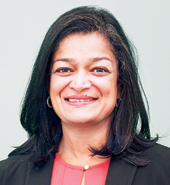

Jan. 19: For this Indian American born into a Malayali family, January 20, 2017, should have been her big day.
When Pramila Jayapal (nee Menon) decided to fight the election to the US House of Representatives from a safe Democratic district in Washington state a year ago, she had little doubt that on this solemn Friday she would proudly take her seat on the west side of the Capitol dome in the national capital and watch the 45th American President being sworn into office.
Jayapal's regretful miscalculation was in presuming that the 45th President would be a woman and a Democrat. Not having bargained for Donald Trump, where she believes Hillary Clinton should have been, Jayapal is now part of a growing boycott of Trump's inauguration as President.
"I will not be attending Trump's inauguration," Jayapal said. She cannot even bring herself to say "President-elect Trump". Just "Trump". Period.
"I will be with the people of my district," the first-term Indian American Congresswoman added.
She has given a pass to what would normally have been a memorable day in the life of anyone elected to the US Congress for the first time, going up and shaking the hand of a new President and attending glittering inaugural balls that will be held all over Washington on Friday night.
At the last count, the "boycott Trump" movement has netted 33 members of the US Congress, all of them Democrats, of course. A few of them had decided soon after the November 8 presidential election that they would not go to Washington this week for Trump's inauguration. But they kept the decision to themselves since the peaceful transfer of power is a solemn occasion and a hallowed American tradition.
Then came along John Lewis. The African American Congressman from Georgia is ranked third among the "Big Six" of the American civil rights movement after Martin Luther King Jr. and James Farmer. Lewis marched shoulder to shoulder with King and was often savagely beaten and repeatedly imprisoned during the black struggle for voting rights. He is a true American icon.
But Trump spoke disrespectfully about Lewis in a week that marked Martin Luther King Day and in the run-up to his inauguration. After Lewis questioned the legitimacy of Trump's election in an NBC interview on Sunday, the President-elect blamed Lewis for the ills of his "crime-infested" electoral district. He also junked the lifetime work of Lewis for civil rights as "all talk, talk, talk, no action or results".
Trump's opponents, including some Republicans, felt the President-elect had crossed a red line. There was disappointment that instead of uniting a divided nation, post-presidential election, Trump was continuing to be divisive. Elected representatives like Jayapal decided that they would not attend Trump's inauguration. The boycott quickly snowballed and is getting more proponents across the US on the eve of the Capitol Hill ceremonies.
A third of the elected representatives boycotting Friday's ceremonies are women. This suggests that women have not yet forgiven the President-elect for his indiscretions involving them and for his sexist remarks and attitude during the year-long presidential campaign.
There are 10 African Americans among the rejectionists, reflecting the mere eight per cent black vote that Trump got in November. The boycott by African American legislators is bound to deepen the alienation of the incoming President from the black community since Trump's prickly nature is unlikely to be forgiving of such a boycott.
Seven of those engaged in the boycott, including Jayapal, are minorities: among them Americans of Japanese, Chinese and Hispanic origin. The story of Trump's relationship with the minorities is the same as that with the black community.
The rejectionists have been careful not to appear to be defying the people's will reflected in Trump's election lest such a negative appearance backfire on them. Brendan Boyle, a Pennsylvania Congressman, said, for instance, that in electing Trump as President, "I accept the decision of the people, I respect it, but I will not celebrate it".
Jared Huffman, representing California, echoed similar views. "I do accept the election results and support the peaceful transfer of power, but it is abundantly clear to me that with Donald Trump as our President, the US is entering a dark and very dangerous political chapter."
Anthony Brown, who was elected to the House of Representatives from Maryland, said: "I respect the office (of the President) and I cannot tolerate disrespect" referring to Trump's attacks on someone like John Lewis.
A veteran Congresswoman, Maxine Waters of California put it bluntly: "I wouldn't waste my time" rubbing shoulders with Trump.
"I respectfully refuse to freeze my a** out there for this particular ceremony," said Kurt Schrader, Congressman from Oregon. A veteran of Capitol Hill, John Conyers who represents Michigan, repeated a quote from Vice President Joe Biden: "It is time for Trump to grow up." He too was referring to the low-level repartees to Congressman Lewis.
All those boycotting the inauguration unambiguously defended Hillary and Bill Clinton's decision to be on Capitol Hill on Friday morning and be with Trump. Robert Reich, who was in Bill Clinton's cabinet as labour secretary, wrote on his Facebook page that "the issue here is how former Presidents and other politicians should respond to someone who has shown himself to be a dangerous demagogue," referring to the incoming President.
Congressman Huffman probably had the best answer: "I believe the antidote to Donald Trump is kindness, thoughtfulness, tolerance and inclusion - and the way to defeat his dark political agenda is not to sit around complaining and criticising. It is through active citizenship, principled resistance and positive counteraction."