The Centre on Tuesday sought to justify the increase in the states’ share of funds under the recently passed VB-G RAM G Act, saying such a model would promote “cooperative federalism”.
The chief ministers of Opposition-ruled states such as Karnataka, Tamil Nadu, Kerala and Himachal Pradesh have criticised the Union government after the passage of the Viksit Bharat Guarantee for Rozgar and Ajeevika Mission (Grameen) Act, saying the law violated cooperative federalism.
The VB-G RAM G Act provides for a 60:40 ratio of funds sharing. The states now bear about 10 per cent of the expenditure under the Mahatma Gandhi National Rural Employment Guarantee Act (MGNREGA), the rural job scheme VB-G RAM G replaces. The new legislation is expected to be rolled out on April 1.
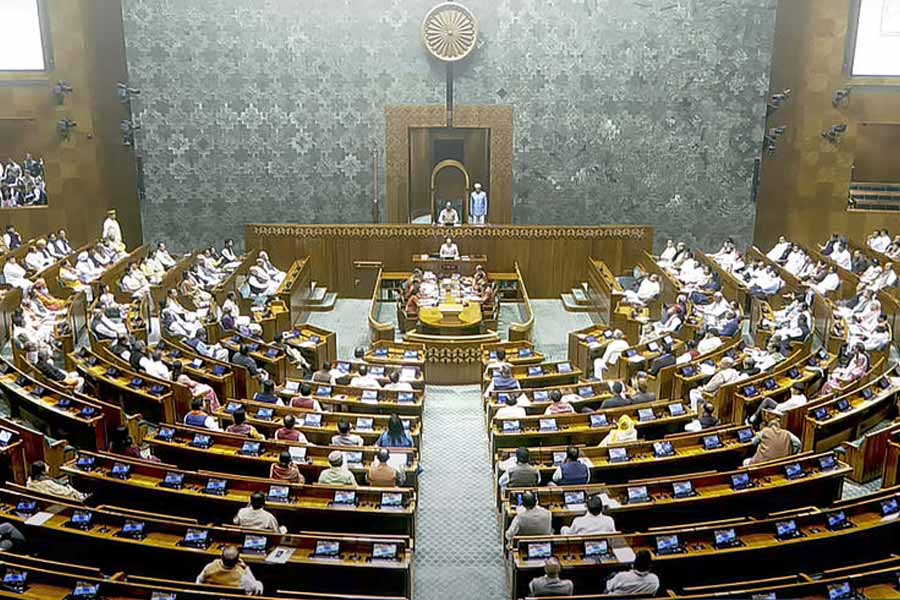
In a written reply in the Lok Sabha, minister of state for rural development Kamlesh Paswan cited other centrally sponsored schemes that continue to share a 60:40 funding pattern, barring in the northeastern and hilly states.
“This model promotes cooperative federalism by making states active partners in rural development. The journey from viksit gram panchayats to a viksit Bharat requires strong state ownership and accountability, and the shared-funding framework reinforces this partnership approach,” Paswan said.
Shiromani Akali Dal MP Harsimrat Kaur Badal wanted to know whether the workers’ organisations have opposed proposals to alter the existing funding ratio.
Paswan said changing the existing funding pattern “would not affect the implementation of the scheme and the guarantee given therein”.
He said several erstwhile rural employment schemes, such as the National Rural Employment Programme, Rural Landless Employment Guarantee Programme,
Jawahar Rozgar Yojana, Sampoorn Grameen Rozgar Yojana and the Employment Assurance Scheme, operated on the shared-funding model.
“Almost all centrally sponsored schemes across sectors are being implemented on a 60:40 sharing model. The 60:40 pattern adopted under this Act is therefore consistent with the broader framework of centrally sponsored schemes,” the minister said.
Chakradhar Buddha, a senior researcher at LibTech India, said the MGNREGA was more successful than earlier employment programmes because the Union government bore most of the expenditure, which ensured that access to work did not depend on the fiscal capacity of individual states.
He said the funding pattern of earlier employment programmes, which had only limited success and carried no guarantees, could not be used to justify the new funding framework under the VB-G RAM G Act.
“The MGNREGA emerged precisely because earlier schemes, which did not
guarantee work as a legal right, were unable to provide reliable livelihood security. Central funding under the MGNREGA helped neutralise differences in states’
fiscal capacities, which is critical for a nationwide employment guarantee,” Buddha said.
Rejecting the government’s claim of cooperative federalism, he said the states were neither consulted during the framing of the law nor empowered to take key policy decisions in its implementation.