
Daughter of a photographer herself, photography had always been a part of Anusha Yadav's life. She says, "My way of reliving my father's memories was to keep looking at the pictures that he had taken and asking my mother to tell me the stories behind them. I knew if there was a photograph, there must be a story."
Anusha is the founder of the Indian Memory Project (IMP), a growing online archive ( www.indianmemoryproject. com), a repository of old photographs, set up with the purpose of chronicling the history of the subcontinent through the lives of its people. And while it may sound very sharp and well thought through, that is not how it started out.
To begin with, Anusha wanted to do a coffee-table book documenting weddings in India. She tells The Telegraph over phone from Mumbai, "Everything was becoming a Karan Johar wedding. If you see how people in Assam or those in tribal areas get married, you will know that this is not true. Apart from the people in Assam, nobody knows how Assamese weddings happen."
Back then, in 2010, crowd-sourcing was still a nascent concept. Anusha created a closed Facebook group and asked her family and friends to send in pictures of family weddings. What started as a trickle, turned into a deluge.
Says Anusha, "They would upload random pictures of grandparents, parents, somebody driving an old car." A year later, when she printed them out and went through them, the penny dropped. "The photo captions or descriptors people sent in - Partition, Lucknow, Kashmir, wedding, blouse, massacre, migration, haircut - all became categories," she says. And that is when she decided to take it out of Facebook and build an online library. The Indian Memory Project was born.
Today, the website has over 850 categories, varied as life itself with its peaks and troughs - rains, summers, dal, dosa, impostor, first of a kind, festivals, murder, gambling, movies, fishing journey, famine, war, Partition, landmarks, epidemics, missing person... Even as we write, newer categories are being added, old categories are branching out.
"From north to south, east to west, nobody knows anything about the other. We live in a bubble and we have no idea what different people have gone through - the good, the bad and the ugly. It occurred to me that this was one way of finding out," says Anusha.

PHOTOGRAPH, COURTESY INDIAN MEMORY PROJECT
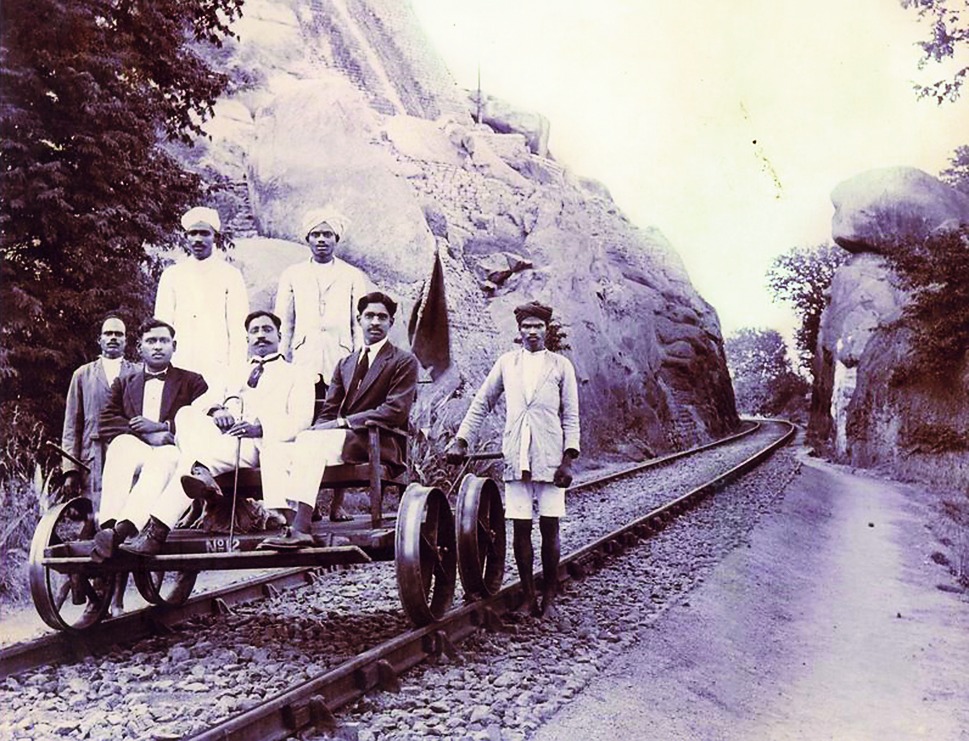
The IMP accepts photographs and letters that belong to the pre-digital era. It puts down parameters that must be met with by contributors. But what possibly sets it apart from any random gallery is the detailed manner in which each entry is contextualised.
A Bhavna Mehta from the US has sent in a photograph of a young couple on either side of a small plant. It is captioned: My parents, Umedrai and Hansa. Village Pravaranagar. Maharashtra. Circa 1963. In the longish text appended with the photograph, she tells the reader about how they had just gotten married at the time the photograph was taken, their life, what happened thereafter.
Each photograph comes with a header and a brief backgrounder. Take this one for instance, titled "The very fashionable soul sisters of the 70s". It shows two girls, Rashmi and Soma, wearing bell-bottoms paired with floral shirts and sandals, posing on a dummy cardboard bike. The photograph was taken at a studio in Etawah, Uttar Pradesh, in 1977. It has been sent in by Soma's daughter, Juhi.
There is another one called "Dapper young men in Bombay". It shows a young man sitting on a chair, legs folded beneath him. Under the chair, there is a cat and it is rubbing itself against one of the curved chair-legs and the man is looking down at it. The sender is Chirodeep Chaudhuri, the son of the man in the photograph. In his entry, he not only calls out the date and place - 1960s, Chembur - but also thinks aloud what might have prompted the photographer, his father's friend, to take this candid shot. He writes, "I can't understand what an amateur would be doing fiddling with a camera at home early in the morning... Was he just trying to take that last picture so he could develop his film?" Then there is that one of a couple doing the foxtrot. "Foxtrotting at the Blue Fox" it is called.
Not everything is about the humdrum. A Jonathan Charles Cracknell from the UK has sent in a photograph of her grandparents, mother, and her then boyfriend celebrating the end of World War II at Calcutta's Great Eastern Hotel.
In some cases, the photographs are in themselves not arresting. The stories are. A Peter Curbishley, also from the UK, has sent a photograph of some British soldiers and their wives. His grandfather, an S.L. Stonely, is in the frame. He writes: This is an image of British soldiers... from 1/1st Kent Cyclists Battalion taken sometime between 1915 and 1919... The bicycle had not long ago been invented and originally was thought to be a good way to get soldiers to move around... On rough terrains such as India's they would get stuck in the mud and not much of use. With little future value, eventually, all Cyclists Battalions were disbanded in 1920 ( sic)."

PHOTOGRAPH, COURTESY INDIAN MEMORY PROJECT
Another one of a George O'Brien from 1947 has an interesting backstory. His grandson, Simon Digby, writes about how that year, thousands of displaced Muslims took refuge in the Purana Qila in Delhi and were extremely agitated as they feared attacks on their journey to Pakistan. "Mahatma Gandhi heard of their terror and drove to the fort to allay their fears... a more agitated group worked themselves into a frenzy and started to attack Gandhi's car... I am told my grandfather, George, climbed on top of the roof of Gandhi's vehicle and shouted in Hindi, 'This is the only man that can save you!'"
The photographs obviously do much more than chronicle times past. Going by the comments thread, the likes and shares that run into thousands, they make people stop, stare. They tease out dormant memories, some of which make their way back to the site as new contributions, photographs and writings alike.
From a contributor eager to post something, to the post finally making it to the website, what goes on in between? Anusha says she and her team ensure that contributors have agreed to IMP's terms and conditions, and then there is a good deal of filling the blanks. She says, "A lot of people are not good at writing. Many a time, I have to interview them to get what they are trying to say." They also do a fact check.
Fact check? That is right, Anusha confirms. But that's only with the specifics. She says, "Anecdotes told by a family cannot be verified for the simple reason that sometimes they are coloured, hidden or exaggerated. Different family members tell stories with different perspectives and lenses and filters. So I go with the filter that the contributor has chosen."
There are contributions from people all around the world - who have visited India at a certain point of time, have roots in the country or just have a story to tell. The idea is that as long as the context has something to do with the subcontinent, it could be from anywhere and from anyone.
We cannot help but point out that the Indian Memory Project is going places at a time when a lot of India's history is being rewritten and reinterpreted to suit specific interests. Anusha says, "History has forever served politics. That has always been its prime purpose, it was never meant to serve the people."