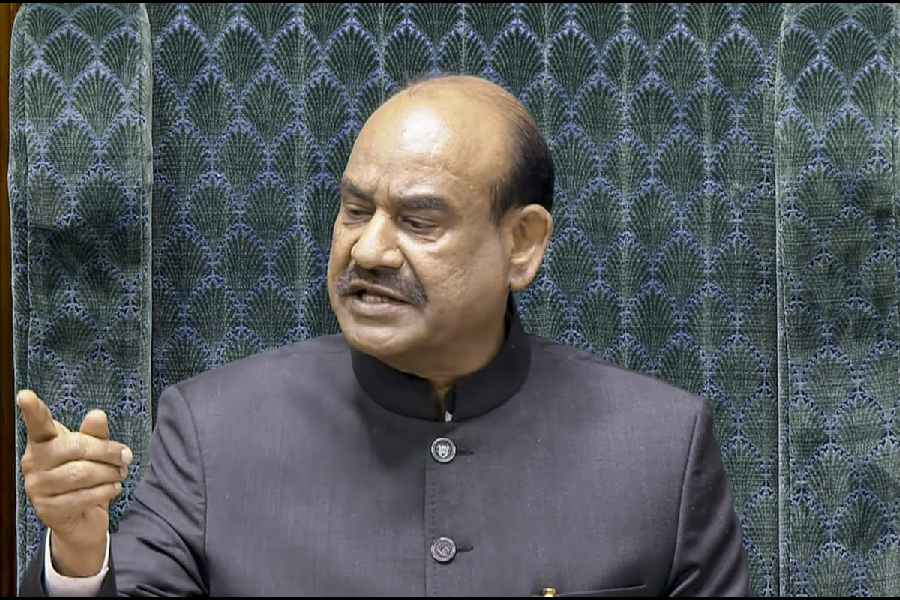
The Opposition on Tuesday submitted a notice seeking the removal of Lok Sabha Speaker Om Birla, accusing him of conducting proceedings in a “blatantly partisan manner” and repeatedly denying Opposition leaders the opportunity to speak.
The no-confidence notice, signed by 118 Opposition MPs excluding members of the Trinamool Congress, was submitted to the Lok Sabha secretary-general after the ruling side refused to allow the leader of the Opposition in the House, Rahul Gandhi, to raise in Parliament his objections to how proceedings were being conducted.
The Congress leader had accused Speaker Birla of silencing the Opposition, giving preferential treatment to ruling party members and falsely claiming that protesting Opposition MPs had posed a threat to the Prime Minister.
Moved under Article 94(c) of the Constitution, the Opposition resolution can be taken up for discussion and voting only after 14 days from the date of submission. Given the NDA’s overwhelming majority in the House, the move is widely seen as a symbolic step by the Opposition to sharpen its political attack.
Sources in the Lok Sabha secretariat said that “upholding the highest standards of morality”, Birla had decided not to preside over the House until the no-confidence motion was resolved. On Tuesday, too, Birla refrained from presiding over the proceedings.
The stalemate in the Lok Sabha eased after the notice was submitted, with the House taking up the budget discussion initiated by Congress MP Shashi Tharoor. Congress leaders said Rahul would participate in the debate, likely on Wednesday. It remains to be seen if he again refers to the unpublished book of former army chief Manoj Naravane, over which he was not allowed to speak on the motion of thanks to the President’s address.
“At 1.14pm today, we submitted a motion of no confidence against the Speaker,” the Congress deputy leader in the Lok Sabha, Gaurav Gogoi, told reporters. Leaders of the DMK and the Samajwadi Party were present at the time of submission.
Trinamool, which did not sign the notice, said a no-confidence motion should be the last resort. The party’s Lok Sabha leader, Abhishek Banerjee, said Trinamool had proposed writing a joint protest letter to the Speaker and giving him two to three days to respond before moving such a resolution. “Even yesterday we made it clear that all TMC MPs will sign the no-confidence motion, but only after these steps are exhausted,” Abhishek said.
The notice stated that the Speaker’s conduct had violated basic democratic norms. “On several occasions, leaders of Opposition parties have not been allowed to speak, which is their basic democratic right in Parliament,” it said.
The notice cited four instances against Birla. The first related to Rahul not being allowed to complete his speech during the motion of thanks to the President’s address, which the notice said was not an isolated incident. “The Leader of the Opposition in the Lok Sabha is invariably not allowed to speak,” it alleged.
The second charge concerned the suspension of eight Opposition MPs, which the notice described as “arbitrary”. The third instance the notice cited was that of Birla allowing a BJP MP to make “wholly objectionable and personalised attacks” on two former Prime Ministers without reprimand, in violation of parliamentary conventions.
The fourth pertained to the Speaker’s remarks that some protesting Congress MPs posed a threat to the Prime Minister. Quoting Birla, the notice said such remarks amounted to “blatantly false allegations” and were derogatory in nature. “The Speaker, who is required to be the custodian of the House, chose the floor of the House to make such statements, indicative of an abuse of this constitutional office,” it said.
Last week, Birla had told the House he had advised Narendra Modi against attending the Lok Sabha after receiving “credible information” that some Congress MPs might reach the Prime Minister’s seat and indulge in “unforeseen” actions.
If admitted, the resolution will be only the fourth instance of a Speaker facing a removal motion. Earlier resolutions against G.V. Mavalankar in 1954 and Balram Jakhar in 1987 were defeated, while a motion against Hukum Singh in 1966 was not taken up as it failed to secure the support of at least 50 MPs.
For the motion against Birla to be valid when it comes up — likely in the latter half of the budget session — at least 50 MPs must support it.