|
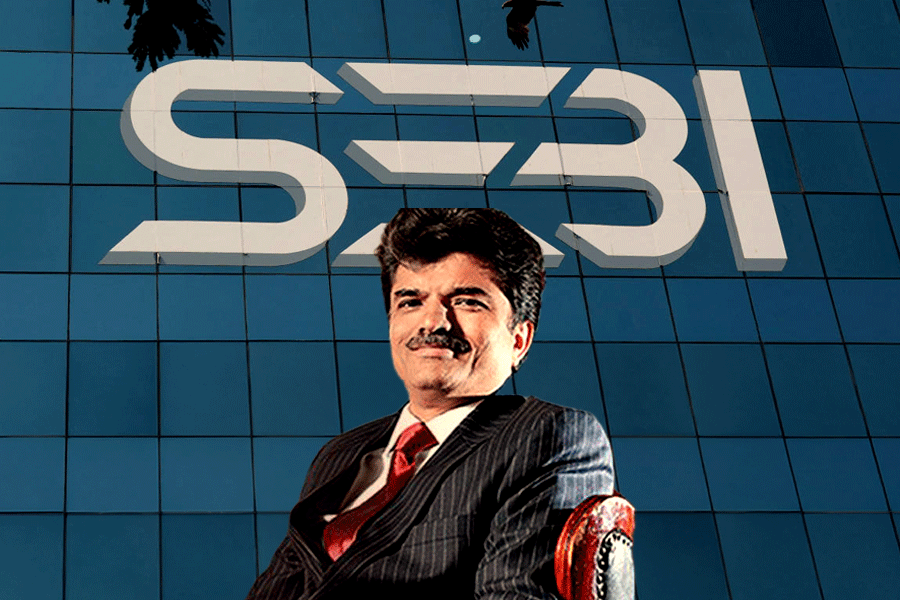
| Pulok Chatterji |
Washington, Oct. 2: During Prime Minister Manmohan Singh’s four-day visit to New York last month, when a long day’s work was done and the time came to unwind, several of the 100 people who accompanied Singh on his special Air India flight met nightly over a drink to talk about ongoing power shifts in New Delhi.
Not mundane power shifts that are the staple of columnists and TV pundits such as an uninspiring cabinet reshuffle or the amazing staying power of ineffective cabinet ministers. What they were discussing in strict confidence were the real changes in power structure: changes that mattered on the ground.
Everyone agreed, for instance, that after many decades on the margins of the nation’s destiny, Mamata Banerjee had brought Bengal to the centre stage, citing the way she put her indelible mark on the Prime Minister’s visit to Bangladesh last month and pulled the Teesta river water pact out of Singh’s bilateral agenda in Dhaka.
Another power shift that will occur on Monday on Raisina Hill, the seat of power in New Delhi, was the subject of equally animated discussions night after night: Pulok Chatterji’s assumption of office as principal secretary to the Prime Minister and what it will mean for the exercise of actual power in the capital.
Those who are elated by Mamata’s rise as a factor in national politics and equate it with Bengal receiving its due are now confident that Chatterji’s arrival in South Block to take up what is arguably one of the most powerful jobs in India will make a decisive dent in the influence that Malayali had exercised in the most sensitive areas of government during the UPA’s two successive incarnations.
Because Chatterji was born in Calcutta 60 years ago, Bengalis in New Delhi’s establishment are tempted to view his appointment as a logical assertion of their state’s way back into the sphere of influence.
But those who harbour such hopes are likely to be disappointed. Although Chatterji was born in Calcutta, his heart is in Uttar Pradesh where he spent the first formative decade as a civil servant. Chatterji joined the Indian Administrative Service in 1974 and was assigned to its Uttar Pradesh cadre.
He spent another two years in the state later at senior levels, holding the post of excise commissioner and as secretary of the welfare department for weaker sections, both sensitive jobs given the political and industrial profile of Uttar Pradesh.
Indeed, if Chatterji had been assigned as an IAS officer to Bengal, instead of Uttar Pradesh, he may never have made it to the Prime Minister’s Office (PMO), where he will be serving a rare third career posting.
Speculation in India about his eventual return to the PMO, which began as soon as he arrived in Washington in February 2009 to take charge as the World Bank’s executive director for India, Bangladesh, Bhutan and Sri Lanka, has surrounded his proximity to Congress president Sonia Gandhi during the five years from 1993 when he was secretary of the Rajiv Gandhi Foundation and later private secretary to Sonia for four years from February 2000 when she was leader of the Opposition in Parliament.
But few people seem to remember that Chatterji was actually then Uttar Pradesh chief minister V.P. Singh’s choice for deputy commissioner of Sultanpur when the then Lok Sabha member from Amethi, Sanjay Gandhi, was looking for a dynamic IAS officer to initiate development work in the area which included his constituency.
Fate willed, however, that the new deputy commissioner would not have any dealings with his MP because Sanjay died days before Chatterji moved from a much sought after urban development job in Lucknow to Sultanpur. As it happened, Rajiv Gandhi was elected to Parliament from Amethi only seven months after Chatterji, then 29, became deputy commissioner of Sultanpur.
He came to the attention of the country’s top leadership when he was posted in September 1983 as district magistrate in Rae Bareli, India’s best known Lok Sabha constituency. From Rae Bareli, he was brought to New Delhi in 1985 as deputy secretary in the ministry of information and broadcasting. Within five months, he was moved to Rajiv’s PMO as a director.
Ill-informed speculation in the capital has centred on the assumption that Chatterji will be some sort of a Trojan Horse for Sonia in the PMO and focused on the nature of his relationship with Prime Minister Singh.
It is often forgotten that from February 2000 to May 2004, Chatterji dealt with Singh on a daily basis. The Prime Minister was then leader of the Opposition in the Rajya Sabha, occupying a room in Parliament House next to his Lok Sabha counterpart. As the civil servant who ran the office of the Lok Sabha’s Opposition leader, co-ordination with Singh and his staff was one of Chatterji’s key daily responsibilities.
Among those who came to New York with Singh, there was intense debate on what will change in the PMO when the new principal secretary to the Prime Minister takes office. In the White House, a powerful chief of staff — roughly the equivalent of Chatterji’s new job — can control even an assertive President.
During the year and a half that Rahm Emanuel was Barack Obama’s chief of staff, he controlled much, from dealings between the White House and the US Congress to interaction between Obama and the rest of his executive, including the cabinet, by sheer force of his personality, his abrasiveness and his impatience. In part, Obama finds himself in his present sorry predicament because of Emanuel, who did not, of course, last a full term.
The most recent clues to Chatterji’s style come from the World Bank where he was very highly regarded as a member of the board of directors of the International Bank for Reconstruction and Development, the International Development Association, the International Finance Corporation and the Multilateral Investment Guarantee Agency.
In the boardrooms of the World Bank Group, Chatterji was known as “Mr Headache” because he always kept the bank’s management on its toes. In a farewell speech to a closed-door meeting of the bank’s board, which was made available to this reporter by two executive directors, Chatterji jokingly acknowledged such a caricature of himself by colleagues on Washington’s H Street, where the multilateral lending institutions are headquartered.
“Although I may have argued hard at times and many of you may remember me every time you get a headache, I am at least proud that I never had to abstain or vote ‘No’ on any proposal in the board or in committee during my short stay here,” he said.
“Diversity must be accompanied by consensus building…. Expressing our own views, seriously hearing the views of others and then trying to find a middle path acceptable to all, is the best way to resolve any conflict.” Unintentionally perhaps, Chatterji appears to have laid the benchmarks for his new role even as he was summing up his style in Washington in the last 31 months.
Widely regarded as the prospective link between the Prime Minister and the UPA chairperson, Chatterji would appear to have relished a similar role that was thrust on him at the World Bank as India’s chief representative on the one hand and a key member of the World Bank Group’s management structure on the other.
Speaking of his style of resolving conflicts, Chatterji said in his farewell address that “this is also the best way for us to combine the two hats we wear, to reconcile the two roles we play as representatives of our countries and members of the board”.
Like his postings to Amethi and Rae Bareli, which fortuitously put him at the right place at the right time, so was his tenure at the World Bank. He arrived in Washington at the most challenging time in the bank’s history, months after the global financial meltdown posed question marks over the very structure of the world’s economic system.
It is a good augury that World Bank president Robert Zoellick, an American, prophetically, it would seem, praised the very qualities that Chatterji may need most in his new job where he will inevitably be seen as wearing two hats in the PMO. “There is always a challenge that you have a constituency and sometimes a country to represent…. Pulok has been able to handle that combination of responsibilities with extraordinary skill,” Zoellick said at the farewell.
Chatterji’s views on development were crystallised in Cambridge where he studied development economics, taking a mid-career break. Because development studies have a liberal curriculum in Cambridge, there is hope that the Rs 32 per capita per day poverty line of the Planning Commission will not go unchallenged in a PMO headed by Chatterji.