.jpg)
.jpg)
New Delhi, Sept. 27: There is no need to condemn the ongoing dialogue between the Centre and the NSCN (Isak-Muivah) but there is a crying need for Nagas to unite for an inclusive settlement, the chairman of the Khole-Kitovi faction of the National Socialist Council of Nagaland today said.
After 60 years as an underground leader, "General" Khole Chetkoh Konyak spoke to The Telegraph in his first-ever interview in the backdrop of the framework agreement signed between the Centre and NSCN (I-M) on August 3.
Although the Centre wants an inclusive settlement, various outfits have demanded their say in the process. At least six outfits in Nagland are jostling for recognition as the main player for the "cause".
Khole's outfit split from the NSCN (Khaplang).
"Why are we not coming together?" Khole asked. "That is why we are in so much trouble while we could have been happy together," the octogenarian rebel leader said over phone, speaking in Nagamese.
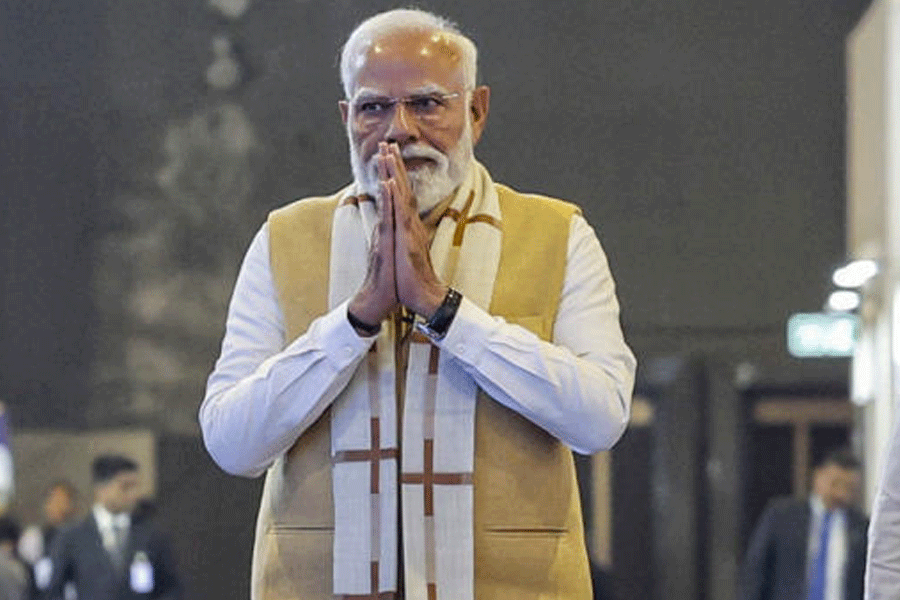
The senior leader dismissed rumours of his resignation recently but admitted that he told his "council of kilonsers" (ministers) he is ready to make way for the younger lot. "I am old, doosra khan ke uthibole dibi (let other leaders rise)," he said. Significantly, he refused to condemn the framework agreement signed by the NSCN (I-M) general secretary Thuingaleng Muivah and the Centre's interlocutor R.N. Ravi in the presence of Prime Minister Narendra Modi.
"We will know the results in due course but I would say the Centre should talk to leaders of all groups and civil society organisations on a single panel," he said. "Do not condemn or say anything against the peace accord, let people decide."
People in Nagaland should also wait and watch instead of making unwarranted comments, he added.
The comments would come as some relief for the Prime Minister's Office, which has been attempting to take everyone on board. While the NSCN (I-M) and the NSCN (KK) are rival groups, Khole is an old compatriot of Muivah and Isak Chishi Swu. Among those who worked together as part of A.Z. Phizo's Naga National Council (NNC), Muivah is believed to be most respectful towards the unlettered but "wise" Khole.
Going underground in 1955, Khole rose through the NNC ranks during the heady days when Naga freedom and sovereignty were the only aims. When a college-educated and English-speaking Muivah joined the council, Khole was already a "captain".
"We were all together in China," said Khole. In the 1960s, as a group of NNC leaders were in talks with the then Indira Gandhi government, another group was being imparted training in Yunnan and Beijing.
Khole is, however, disappointed that Muivah and Swu did not share the details or progress of the dialogue nor reveal to stakeholders the contents of the framework agreement.
Asked if Muivah had indeed approached him, Khole said he would have consulted the "House" or his "council of kilonsers". Clearly though, Khole's sounded that he was willing to confer without bitterness or malice.
Khole felt that with Muivah and Swu's education, they could have pursued more rewarding professions but they chose to work for Naga freedom. "That is what binds us although we may differ ideologically," he said in a written statement issued after the interview.
Other rebel leaders may not share Khole's conciliatory view towards former compatriots, especially towards Muivah.
On the NSCN (K) that abrogated the ceasefire agreement in March, Khole felt the outfit was better left alone to negotiate with Myanmar with which it has signed an agreement.
On Nagas living in different states, Khole said they had gained a sense of belonging to the states in which they live. "Manipur Nagas feel they belong to Manipur as do Nagas living in Assam ...only, we should not fight with these states," he said, hinting at reservations that many rebel leaders in Nagaland have towards the NSCN (I-M) concept of Naga integration.
Nagas have fought for integration since the 1940s and there is a mention of it even in the 1947 Naga-Akbar Hydari Accord. However, with time and formation of new states, perceptions have changed.
The framework agreement apparently relies on the NSCN (I-M)'s concession that territorial integrity of Manipur or other states with Naga population will not be disturbed.