ISRO’s PSLV-C62 mission failed on Monday after the launch vehicle encountered an anomaly during the third stage of flight, resulting in the loss of all 16 satellites onboard, including a foreign Earth Observation satellite.
This marks the second consecutive failure for the Polar Satellite Launch Vehicle, following the unsuccessful PSLV-C61-EOS-09 mission in May 2025.
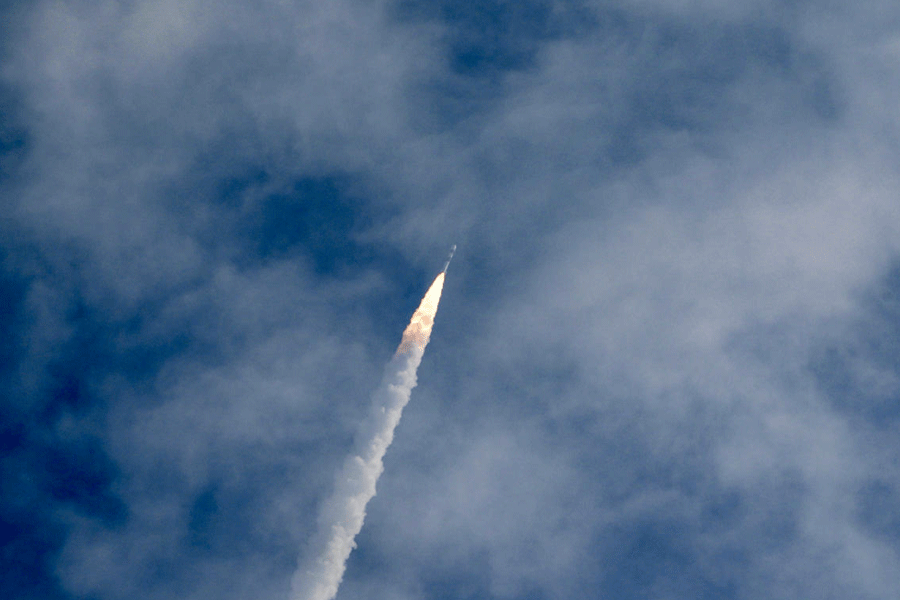
The 44.4-metre tall, four-stage rocket lifted off as scheduled at 10.18 am from the spaceport, following the conclusion of a 22.5-hour countdown.
The mission, the first of the year and undertaken under a contract secured by NewSpace India Ltd, ISRO’s commercial arm, aimed to place a primary Earth Observation satellite and multiple co-passenger satellites into a 512-km Sun-Synchronous Orbit after a flight of about 17 minutes.
According to ISRO, the automatic launch sequence commenced after approval from the mission director, and the initial phases of the flight proceeded as planned. The first two stages performed within expected parameters.
However, disturbances were observed close to the end of the third stage when strap-on motors were providing thrust, leading to a deviation in the flight path.
Addressing the Mission Control Centre, ISRO Chairman and Secretary, Department of Space, V. Narayanan said, “The PSLV is a four-stage vehicle with two solid stages and two liquid stages. The performance of the vehicle up to the end of the third stage was expected. Close to the end of the third stage we are seeing more disturbance in the vehicle and subsequently, there was a deviation observed in the flight path.”
ISRO later confirmed the anomaly on its X handle, stating, “The PSLV-C62 mission encountered an anomaly during the end of PS3 (third stage) of the vehicle. A detailed analysis has been initiated.”
In a brief press conference later, Narayanan said, “As all of you are aware, today we attempted PSLV-C62/EOS-N1 mission... the mission could not proceed in the expected (flight) path. That is the information right now available.”
He added, “We are going through the data and with the data collected from all the ground stations and once the data analysis is completed, we shall come back to you.”
The failure meant that the mission objective of placing the satellites in their intended orbit could not be achieved. As a result, subsequent planned operations — including the restart of the fourth stage (PS4) to de-boost and facilitate the separation of the final payload, the Kestrel Initial Technology Demonstrator (KID) capsule — did not take place.
The PSLV, regarded as ISRO’s workhorse for satellite launches, has a long record of successful missions. Officials said the anomaly is under detailed review to determine its cause and assess its impact on future launches.