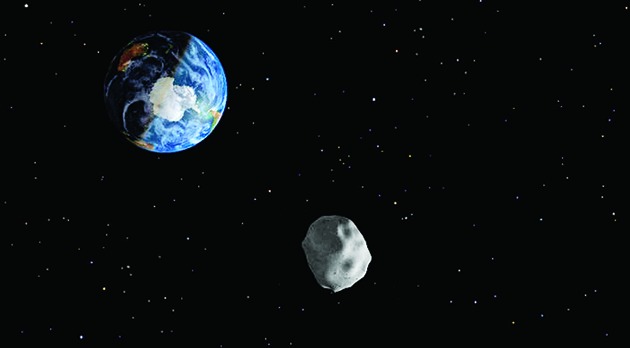

New Delhi, Dec. 2: An Indian astronomer in the US has led observations to study the tiniest of known asteroids, a chunk of rock that he describes as "completely bald", smaller than a car, and rare in the solar system.
Vishnu Reddy and his colleagues at the University of Arizona (UA) have found that the asteroid, only about six feet in diameter, has a rare makeup that causes it to reflect about 60 per cent of the sunlight that falls on its surface.
"We're able to see it through optical, infrared, and radar telescopes only because it reflects so much light," Reddy told The Telegraph in a telephone interview.
A team of UA astronomers scanning the solar system for undiscovered asteroids had spotted the object in October 2015 when it was about 128,000km from the Earth, about a third of the distance to the moon.
Asteroids are residual fragments from the formation of the solar system that orbit the sun, mostly between the orbits and Mars and Jupiter, although some so-called near-Earth asteroids approach the Earth's orbit.
Reddy and his colleagues, who used four telescopes to study the tiny asteroid, have found that it rotates fast, every 133 seconds, but it takes 380 days to go around the sun, just 15 days longer than Earth.
The scientists say this is the first asteroid that lacks the blanket of fine, powder-like dust called regolith found on all other asteroids. "This is essentially bare and bright highly-reflective rock, a completely bald rock," Reddy said.
Most other asteroids reflect between 15 and 20 per cent of the sunlight falling on them, he said, but this asteroid has over three-fold higher reflectivity.
The astronomers, who described their findings in The Astrophysical Journal, have attributed its reflectivity to a surface composition devoid of iron compounds. The presence of iron gives most other asteroids their dark colour and their relatively lower reflectivity.
Reddy said the tiny asteroid appears to be a piece of a larger asteroid that was chipped off from its likely parent, 44 Nyasa, an asteroid as large as the city of Los Angeles.
The scientists said the asteroid belongs to a class of objects made of materials called aubrites, bright minerals, mainly silicates. Astronomers suspect that only one in 1,000 meteorites that fall to the Earth belong to this class of objects.
Orbital trajectory calculations show that this asteroid is unlikely to fall to the Earth.