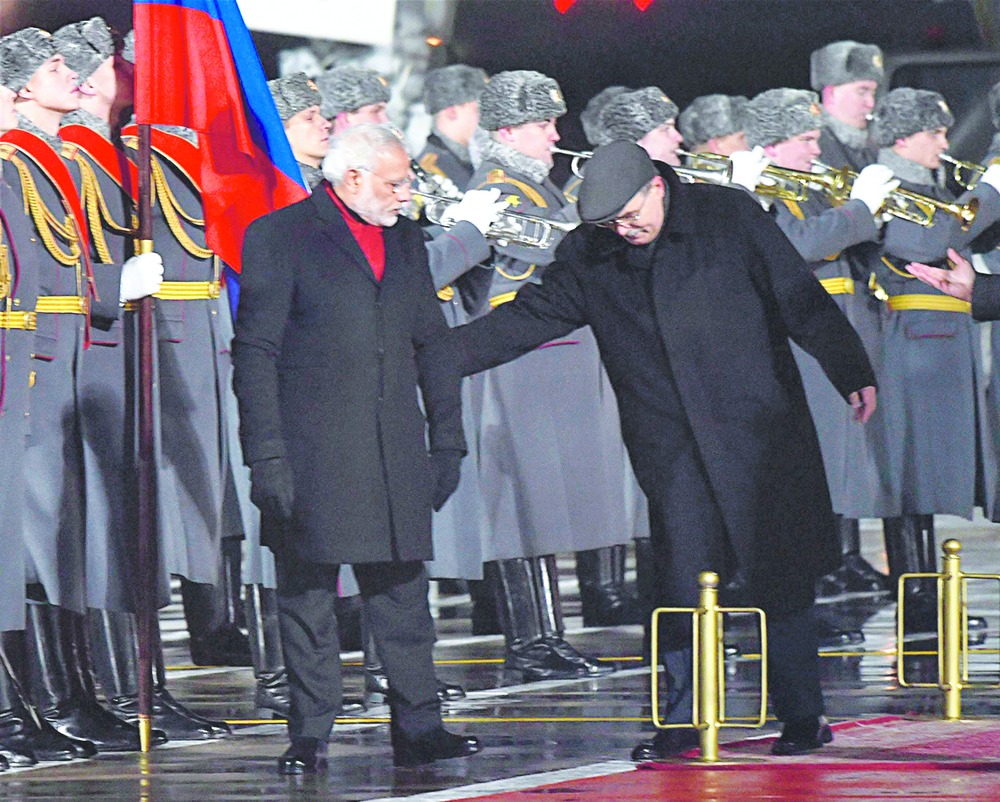

Moscow, Dec. 23: India will offer Russia a site in coastal Andhra Pradesh to build nuclear reactors, signing the death warrant for a protest-hit project originally allotted to Bengal.
In 2009, then Prime Minister Manmohan Singh had announced Haripur, in East Midnapore, as a venue for a proposed nuclear complex where Moscow was to build six reactors, but protests over land acquisition led by the Trinamul Congress, then in the Opposition, stalled the project.
The latest decision on a fresh offer, during Prime Minister Narendra Modi's Moscow visit beginning today, follows a hectic, yearlong search for an alternative site. This was after Russia told India, during President Vladimir Putin's visit to New Delhi last December, that it could no longer wait for the tensions over the Haripur project to ease.
Putin has promised India 12 new nuclear reactors over the next decade - an offer that also gives New Delhi leverage to bargain for nuclear trade with Russia's competitors such as the US and France.
Modi, senior officials hinted, is expected to tomorrow announce readiness for at least two and perhaps four or six new reactors at the Andhra site, in addition to the ongoing Kudankulam project in Tamil Nadu.
"This decision is very, very important," Russia expert and retired diplomat Ashok Sajjanhar told The Telegraph from New Delhi. "We need nuclear power, for our own clean energy goals, but it's also critical for our relationship with Russia."
India had, in 2007, set an ambitious target of producing 63,000MW of nuclear power by 2032, but currently generates less than 6,000MW.
Even getting to a revised interim target of 14,000MW by 2024 appears challenging with key commitments by American firms like GE and Westinghouse and France's state-run Areva still to take off.
In contrast, the first of six Russian-built reactors at Kudankulam in Tamil Nadu is up and running and a second is almost ready to start operating. Two others are under construction and another two are under discussion - apart from the Andhra project Modi is expected to discuss with Putin tomorrow.
The tie-up with Russia has been far from seamless - the Kudankulam reactor that began working last year developed snags earlier this year, forcing the countries into hectic parleys on ensuring the quality of components.
But it remains, officials from both nations said, India's best bet to ensure early generation of additional nuclear power - in part because the deal with Russia will be between the two governments, and details of concessions they make can remain cloaked in secrecy.
In 2009, former Prime Minister Singh, on a visit to Russia, had announced Haripur as a venue for the proposed nuclear complex where Moscow would build six reactors, each of 1,200MW capacity. That announcement came after New Delhi had obtained support for the project from the then Buddhadeb Bhattacharjee government in Bengal.
But Trinamul leaders, including then junior Union road transport minister Sisir Adhikari and his son Subhendu, protested against the project. When the Mamata Banerjee government came to power in 2011, it declared it would not allow the project to proceed.
A senior Bengal minister, who asked not to be named, defended the decision today. "According to the norms, there can be no human habitation within a 10km radius of such a facility. The Haripur area is a multi-crop region and over one lakh people live there. They would have had to be displaced if a nuclear plant had to be set up. This was never a practical proposal," he said tonight.
Sources in the power department, however, said the scrapping of the project did get in the way of development of the region.
"The Haripur plant was supposed to generate 6,000MW of nuclear power. That would have automatically brought in a lot of investment into the whole belt, directly and indirectly generating jobs and a lot of economic opportunities, even if one were to set aside the power concerns," said a senior official.
"It was a tragic miss for Bengal. Eventually, within a decade, we will have to begin striving for nuclear power anyway. The decision in 2011 was myopic," he added.
For Russia, nuclear exports are also a symbol of the country's strategic heft - and the Haripur debacle had hurt. "Nuclear energy and trade is very important for Russia from an image-building point of view," Sergei Strokan, a prominent political commentator here, told this newspaper.
Sajjanhar feels Russia would understand India's constraints in fixing a site for nuclear reactors in the face of protests. "After all, India has a federal structure and the Russians know that," the diplomat said.
But Strokan said demonstrating success in the nuclear sector with India was critical for Russia at a time its competitors have stolen a lead with New Delhi in other areas, including trade.
"Russia's leading competitors strategically have been nowhere near as successful as Russia, in nuclear trade with India, and that's something Moscow feels good about," Strokan said. "For Russia, India is more than important from a nuclear perspective. It's critical."