
It was with a great sense of relief that we found the peach-and-ivory glazed courtyard of the newly opened entrance to the Victoria and Albert Museum in London, on a windy September afternoon. Somehow, we missed the Museum’s more familiar main entrance, after alighting at South Kensington Station. We did not want to be late after months of planning, and walked past a futuristic cafe, into the main building, and were pleasantly surprised to find people standing in a queue, even though it was still an hour before our designated entry time of 1.30pm.
Like everyone else, my wife and I had come to see ‘Pink Floyd — Their Mortal Remains’, an exhibition marking 50 years of the iconic band whose music was light years ahead of their time. The band, which called it a day in 2014, has drawn generations of followers with startling lyrics, psychedelic light shows and unique sounds. When I heard of the exhibition in May, I thought attending it would be the next best thing to being in a live PF concert. Their music and how they made it, has intrigued me ever since I heard The Dark Side of the Moon, when I was all of 12 in 1975.
We were handed Sennheiser headsets with intuitive guidePORT system. And thus started my journey into the world of Pink Floyd through an exhibition.

Shine on, Syd!
Once inside, the first room was awash in a pink-orange glow with psychedelic effects heightened by concentric zebra stripes. For the ardent follower, the Pink Floyd family tree was traced out from the very nucleus — from Sigma 6 and its various avatars to The Tea Set, and finally Pink Floyd in 1965. Posters from their early shows, where Floyd wrote a very English answer to the underground music revolution taking place in America, with their lyrics, light shows and sonic experiments, formed a colourful collage.
Pride of place was given to the Nite Tripper, the very first UFO Club poster advertising “freak out under Berkeley Cinema” with Pink Floyd in December 1966. UFO Club at Tottenham Court Road was the hotbed of underground music movement and it was led by Pink Floyd.
As we moved forward among other eager beavers, we could see this exhibition had been put together with loving detail. The albums, right from The Piper at the Gates of Dawn (1967) to The Endless River (2014), were showcased individually. Listed out with live video recordings of the band members, there were nuggets of information, known mainly to close associates.
I stood in front of the album cover of Atom Heart Mother with its iconic brown-and-white cow and was intrigued to know that the track Alan’s Psychedelic Breakfast had instrumental jazz spiced up with everyday sounds of Floyd’s road manager, Alan Styles, cooking his morning meal!
Pink Floyd is perhaps the only band in history where the music has been more intriguing, and sometimes more mystifying, than the members who made up the band, with the exception of Syd Barett, founder-member, who left them within a year of a heady start. This is more so because Syd’s vision and contribution has always been eulogised by the band. It has specifically come back in a memorable refrain in two of their biggest hits — Shine On You Crazy Diamond and Wish You Were Here (both songs from the 1975 album Wish You Were Here). At the exhibition, a whole room is devoted to the musician, singer-songwriter and painter.
A blow-up of a photo of the band’s van, a black Bedford sporting a single white stripe, with the drummer Nick Mason loading his kit after what was evidently a dusk-to-dawn performance in 1965, was kept next to Syd’s letter (featuring a tiny drawing of the van) to his then-girlfriend: “When I got back to London tonight the others had painted the van with a white stripe which looks good with our name on it. You can’t see the name because it is too small. You can’t see me because I’m in the back.”
On the ceiling hung a gigantic mirrored globe which we have seen open out into a shimmering lotus with millions of dots of light in Floyd concerts while the sound of the opening synthesiser notes of Shine On played. Indeed, this was like being at a concert, with the senses being pampered in every way.
Syd’s lyrics from Flaming — Screaming through the starlit sky/ Travelling by telephone/ Hey ho, here we go — covered one wall. I could sense the longing the band members felt for the poet.

Nostalgia triggered
Syd was also instrumental in involving Storm Thorgerson and Aubrey Powell, who were in Cambridge with him. They formed Hipgnosis, the company which designed album sleeves and publicity material. Floyd’s music was made more distinctive by the surreal designs on the covers of A Saucerful of Secrets (1968) to the more famous The Dark Side of the Moon, which deserve a special mention.
I was intrigued to know that the sleeve of Meddle (1971) represents an ear under water, collecting waves of sound. Powerful imagery.
Here the inflatable puppets and teasers were all assembled, much to my delight. Ever since I had seen the photograph of an inflatable hospital bed float above the Thames, past the House of Parliament, to promote the Momentary Lapse of Reason tour (1988), I wanted to see these props for real. They were there to trigger nostalgia. Suspended from the ceiling was a large-scale model plane, which flew over the audience to crash onto the stage in many PF concerts (since the 1973 tour to promote The Dark Side of the Moon and repeated later).

The Dark Side of the Moon is unequivocally one of Floyd’s most iconic albums, dealing with issues that remain relevant, like greed, insanity and the fear of dying. Released in March 1973, it was a culmination of all the restless experiments done by the band over the previous six years. It was interesting to know that the album, which has sold more than 40 million copies, was played live many times in the year leading up to its release, to gauge audience reaction. It was pruned and polished till each song shone bright.
One of my high points at the exhibition was catching a glimpse of David Gilmour’s 1980 Gibson J-200 Celebrity acoustic guitar, which he uses in live concerts to play the beautiful opening rift of Wish You Were, and, of course, The Black Strat — the electric Fender Stratocaster that is his favourite since 1970. Featured in many Pink Floyd concerts, he played it as recently as in July 2016 during his ‘Live at Pompeii’ gig. This guitar has given us timeless classics, most notably my personal favourite, the brooding yet beautiful, Shine On You Crazy Diamond and the rock anthem Comfortably Numb from The Wall.
Another memorable display was of Hipgnosis’ original artwork for the album cover of The Dark Side of the Moon, with the light ray piercing a prism and breaking into rainbow colours. A classic created by Storm Thorgerson as per the band’s mandate of “a simple yet bold design”, it captured public imagination and became as iconic as the album.
Hipgnosis is famous for their unique concepts and a penchant for filming actual photographs. Hence, the album cover of Wish You Were Here — showing two businessmen shaking hands, with one engulfed in real flames. In order to get the perfect shot, Storm had the stuntman ignited 15 times, with firemen on standby! Perhaps it is this sincerity to capture the mood of the music through album covers that gave us such powerful imageries.

The Deeply Respected Gentlemen
Among the exhibits was the Binson Echorec — which gave Pink Floyd the distinctive amplified echoes from Interstellar Overdrive (The Piper at the Gates of Dawn) to the signature tracks on The Dark Side and the tring of actual coins in 1973 for the punchy jingling of cash registers in Money. Interestingly, the exhibition also provided interactive consoles for mixing your own version of “money”, which I promptly did!
Perhaps the cult status of The Dark Side is best acknowledged by a letter on display. Written by spaceman Piers Sellers of NASA addressed to the “Deeply Respected Gentlemen of Pink Floyd”, it confirms that this is one of the few albums to have been played “in space”. He sums up by saying: “All of us — on and off the planet, will continue to enjoy your music forever.”
But we were nearing the end of the exhibition and paused for a moment to appreciate the hospital bed on the ceiling — from A Momentary Lapse of Reason. The accompanying video clip describing the magnum opus of organising 700 Victorian hospital beds on the beach and subsequent photo shoots, shows again that nothing done by Pink Floyd was done by halves. Along with this, a glimpse of Gilmour’s famous red Jedson lap steel guitar, creating the lingering glides during live performances of the album, completed the experience.

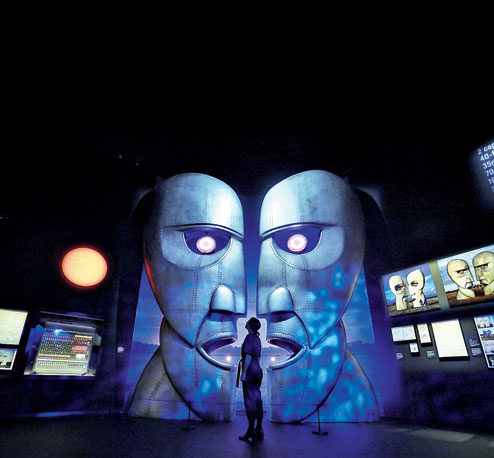
Nothing could be a better example of doing things sincerely than the concept of “the talking heads” of Division Bell. For an album released in 1994, computer jugglery would have been easy, but for the album cover two large metal heads, each the height of a double-decker bus, were constructed in a field in Ely, Cambridgeshire. But now they are in V&A. It was irresistible not to stand between them and get photographed.

Before I sign off, I have to mention the performance zone. This was a huge auditorium-like setting with immersive display. The first video took me by surprise. Harking back to the original foursome with Syd Barett, their hit single Arnold Layne from 1967. The show finale: Pink Floyd’s reunion performance at 2005’s Live 8 in London… the throbbing guitar rhythms with Another Brick in the Wall saw almost all of the audience flopping to the floor and watching the video stream across the walls and the vaulted ceiling in a spectacular display.
Reluctant to leave but “time was gone, the song was over”. I was grateful to have made it. Wish you were there too.
Text and pictures: Biswajit Dasgupta