 |
Where is the truth that Haider chooses the inevitable revenge and death? Why is Gertrude instrumental in killing Claudius? What went wrong with the scriptwriters? Why is it such a Gandhian ending? This is Shakespeare for God’s sake! Why can’t Haider kill and prove the fact that violence is inevitable but not the last word? And where the hell is Horatio?
Report my cause aright to the unsatisfied.
When Naseeruddin Shah says that “Bernard Shaw had a world view which Shakespeare does not seem to have”, I am appalled, despite my huge admiration for him as an actor and theatre director. But when a filmmaker like Vishal Bhardwaj proves him somewhat right with his recent adaptation of Hamlet, I am seriously disturbed. I take this opportunity to look into the adaptation and thereby try to find out what went wrong with the worldview inherent in the Bard.
Bertolt Brecht after his attempt to reinterpret Macbeth, ended up stating; “Change Shakespeare by all means, if you can.”
Which tells me that a classic is always relevant and contemporary if you are able to see through the text. The same man who became very important in Indian cinema to me with Maqbool/Macbeth and his “not that bad adaptation” of Othello/Omkara, killed my huge expectations with his Haider/Hamlet. Everyone is all out to praise the stunning visuals of Kashmir, the darkness of its politics, deprivation, the greyness of the bridge over Jhelum, etc… No one seems to be bothered about Mr Shakespeare in all this.
The sheer irony is that Vishal Bhardwaj had it all. He chose Kashmir of the ’95 with its armed insurrection and human rights violation as a backdrop, which is a fabulous parallel to the “rotten Denmark”.
He had a Hamlet who was studying English literature in Aligarh University and writes poems. He had a scheming Uncle Claudius who is trying to come to power by helping in killing Hamlet’s humanist father and marrying his brother’s wife. He had a fantastic actress like Tabu playing the sexually deprived Gertrude. He had violence and servitude in Kashmir as two options to make “To be or not to be” so relevant. He had the most relevant issue of terrorism as his logic for Hamlet’s delayed decision for violence…. He had it all in his backpocket.
And that speaks for his brilliance which made Maqbool one of the most exciting adaptations of Shakespeare in the world. But Mr Bhardwaj threw it all away by refusing to recognise what to change from the original and what not to tamper with.
WAITING FOR THE GHOST
Haider works for me as a Shakespeare piece from the time the so-called rooh /aatma/spirit appears in a convoluted garb of Irrfan Khan, near the interval. The first part was a tedious prelude about Kashmir and its politically confused state which could have been a part of any other interesting tale, not Hamlet.
Hamlet is a revenge tragedy. The delayed arrival of the Ghost (Act 1 Scene 4 in the original) makes no sense to Haidar’s dilemma. All the flashback scenes of Dr Meer, his humanist stance, Haider having violent leanings during his school days with a gun he borrowed from his school friend, the absolutely pointless character of Kulbhushan and his ‘peace logic’ all rob the film of Haider’s dilemma. If Mr Bhardwaj’s intent is to show that his Hamlet always had a violent streak in him then it is in the original.
His very first entry in Scene 2 Act 1, in black/mourning shows him as an outsider to the scenario. It shows his doubt. Why could not the filmmaker trust the writer and get to the meat with Roohdar or whoever and start Hamlet’s dilemma rolling instead of so much extraneous? What Roohdar does is repeat what we already know. By delaying the Ghost, Haider’s melancholia is stretched and very little time is left for his moral dilemma.
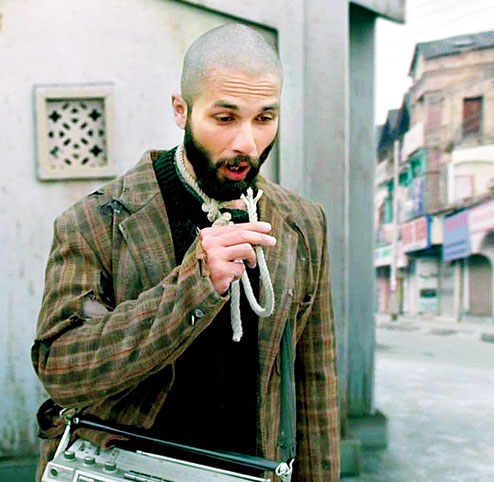
(Innokenty) Smoktunovsky’s entry shows that his fingers are that of an artist, his ears are sharp as a jackal. Ethan Hawke’s had a certain cold fire. Mel Gibson’s was fiery and even brutal. To me Shahid Kapoor is there halfway. I have never seen him perform with such unabashed gusto before, but Haider does not rise above confusion. Why does he seek training in terror camp?
His brutality is pretty evident in the killing of Rosenkrantz and Guildenstern. That his madness seems like psychological crises and not pure play-acting denies him the cunningness which is integral to the character. That Hamlet is capable of violence but refrains from the act till the end is the basic dialectics of the plot. Shahid scratches the surface of this dark, anguished, tormented soul but denied his pulling the trigger on chacha Khurram’s head in the end makes him a saint and not Hamlet. In the personal interaction scenes he works brilliantly and pulls off “frailty, thy name is woman” with ease.
Tabu’s Gertrude, perhaps the ideal choice, becomes too sentimental and not lusty at all.
Irrfan Khan’s Ghost has all the cliches of a Bollywood cameo but no substantial philosophy of personal vendetta. He has a team of armed militants, a fancy phone, lots of guns. Why does he need Haider to kill Khurram? Why does he have to be a cellmate, ex-IFI spy turned terrorist or whatever? What is wrong in having an apparition? Is it just a clever way to avoid the supernatural? Does it help the plot?
If the writers are too superstitious of using ghosts in a modern world then Roohdar could have been anyone not involved in insurrection. By making the Ghost an extremist, Vishal makes the huge blunder of robbing Hamlet’s revenge of its complexity. Because the Ghost is incapable of doing the job himself Hamlet is required to do it. Here Roohdar has all the means. Yet, Irrfan Khan is too powerful an actor to not rise above the plot defects and he comes out with a cold fire which is remarkable.
TRULY SHAKESPEAREAN
Only Kay Kay Menon’s very human and vulnerable Khurram/Claudius, despite his shoddy plotline and delayed attainment of power, is absolutely superb. He plays Claudius with such greyness, such stunning complexity, such humanness that you actually cannot hate him and actually cannot sympathise with Haider’s choice of violence/terrorism. It is only in this context of Claudius that Vishal Bhardwaj and Kay Kay Menon manage to become truly Shakespearean.
The scene where Haider goes to kill his uncle who is praying is the most brilliant of all scenes and worth a repeat watch. Each time there are tears in Kay Kay Menon’s eyes it makes the drama complex. You cannot decide whether he is the main enemy. Then his sudden and utter shrewdness makes him dark. Herein lies the tragedy of Hamlet. Is Menon’s Khurram worth all the killing? Here is where the audience is thrown into the basic conflict of “To be or not to be”.
Watching Menon, I come to a conflict with Irrfan’s version of ‘right’ or ‘not right’. Here is where Mr William comes alive. It is only in the scenes of Kay Kay’s Claudius that I am thrown into the dilemma of opting for violence. Even in the mousetrap scene/Bismil song a cold Menon wins hands down to a melodramatic Shahid, who shows no inner knowledge but sheer dance energy. I am very sorry to add that Tabu’s sexual need for Khurram is not at all evident. Rather Menon, in totally unwanted scenes, plays out that ‘wanton’ love and compensates. I say this with a lot of respect to the great actress who pulled off a bitchy Lady Macbeth in Maqbool with such brilliance.
Once again, before the final disaster, in the ‘closet scene’ between Ghazala and Haidar in the bombed house with a cracked mirror Bhardwaj comes very close to Shakespeare. The only scene where Tabu storms.
The less said the better of the other actors. Ophelia is there. Polonius is a waste of a super character. So is Bashir’s Laertes who has no regrets of his act before death. The climax is an utter disaster. I do not care whether the graveyard is the backdrop for the finale, but where is Hamlet’s violence? Where is the truth that Haider chooses the inevitable revenge and death? First and foremost why is Gertrude instrumental in killing Claudius? What went wrong with the scriptwriters? Why is it such a Gandhian ending? This is Shakespeare for God’s sake! Why can’t Haider kill and prove the fact that violence is inevitable but not the last word? And where the hell is Horatio?
OH, HORATIO!
Why does Vishal do away with the main pillar of a construction called Horatio in Hamlet? Here is where the whole film finally cheats us, the discerning as well as those unaware of the text. William knew what he was doing. By robbing the primal, most important confidant called Horatio, Haider ends up having no worldview, as claimed about Shakespeare by Mr Naseeruddin Shah.
Horatio sees the Ghost first. Horatio shows Hamlet the Ghost. Horatio is the one who bears witness to the disaster and will tell the story of Hamlet.
Hamlet to Horatio before dying; “If thou didst ever hold me in thy heart, absent thee from felicity awhile, and in this harsh world draw they breath in pain to tell my story”.
Why did Ghazala speak so much before dying and Haider not given his best lines? Where is that Kashmiri who will tell us the real tale of 1995? Where is that Kashmiri who bears witness to that violent era? Where is Fortinbras/The Indian Army/ Ashish Vidyarthi or whatever who brings order, saves lives during natural calamity…?
This filmmaker had the guts to make three witches into two corrupt cops in Macbeth/Maqbool. The man had the brilliance to translate the witches’ prophecy “not until Birnam Wood shall move to high Dunsinane Hill…” to the sea coming to land/the Naval intelligence surrounding Maqbool’s house. This is the man who gave us a brilliant Iago/Langda Tyagi. How could he fail in creating that Kashmiri/Horatio who will tell the truth? The truth behind the violence. The truth behind all the chaos that happened in the mid ’90s in Kashmir.
This is not a technical review of a film. There is no such thing as a technical review. Mr Bhardwaj, I am a huge admirer of your work. That is why I took this trouble, which is no trouble at all, to look so deeply into your work. But as Gulzarsaab told you after reading your first attempt based on an intelligence thriller: “Where is the tragedy of Hamlet?” You reworked your entire plotline and shifted to Kashmir, which was terrific. But can I question you with deep respect; “Where is the tragedy of Hamlet, still?”
I must admit you are the only one in our nation attempting international classics repeatedly and I doff my cap to you and will do so for that very fact. You have set me wondering about my own Hamlet in Bengal. You have, despite all the blemishes of Haider, reaffirmed Kosintzev’s belief that “Hamlet is political and personal” purely by your choice of a Kashmiri backdrop in mid ’90s.
Nowadays it is rare of practitioners reacting to each other’s works intellectually. I am indulging in it out of extreme respect to you as a practitioner of the art. I still look forward to your work. I remain your sincere viewer simply because of my belief that you are capable of doing far better than great visuals.