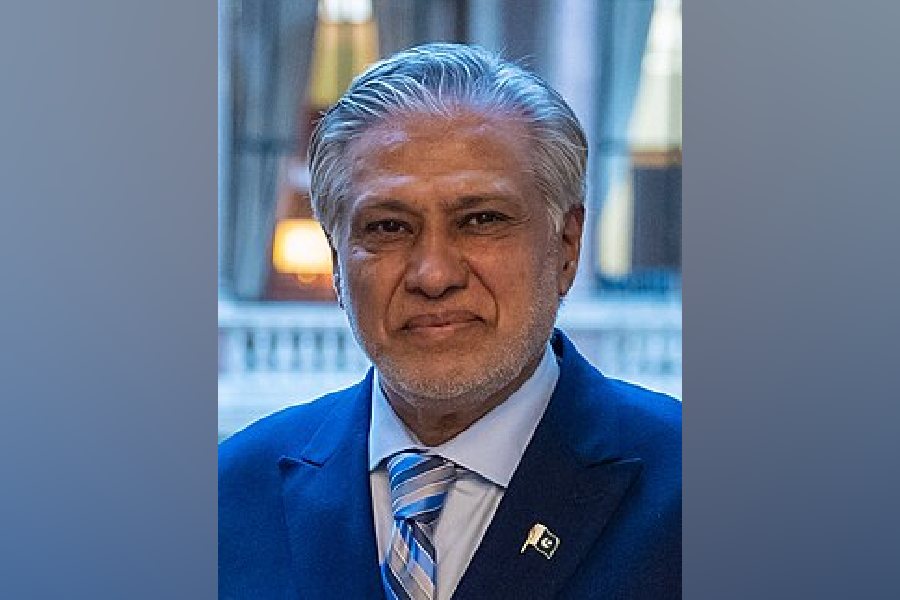
Pakistan’s foreign minister on Sunday indicated the prospect of potential talks between the US and Iran to de-escalate the ongoing war, noting that both countries have expressed their "confidence" in Islamabad to facilitate their discussions.
Ishaq Dar made these remarks while addressing the media after holding quadrilateral consultations with his counterparts from Saudi Arabia, Egypt, and Turkiye.
The leaders also discussed ways to bring an “early and permanent end to the war" in the region as they reviewed the West Asia conflict.
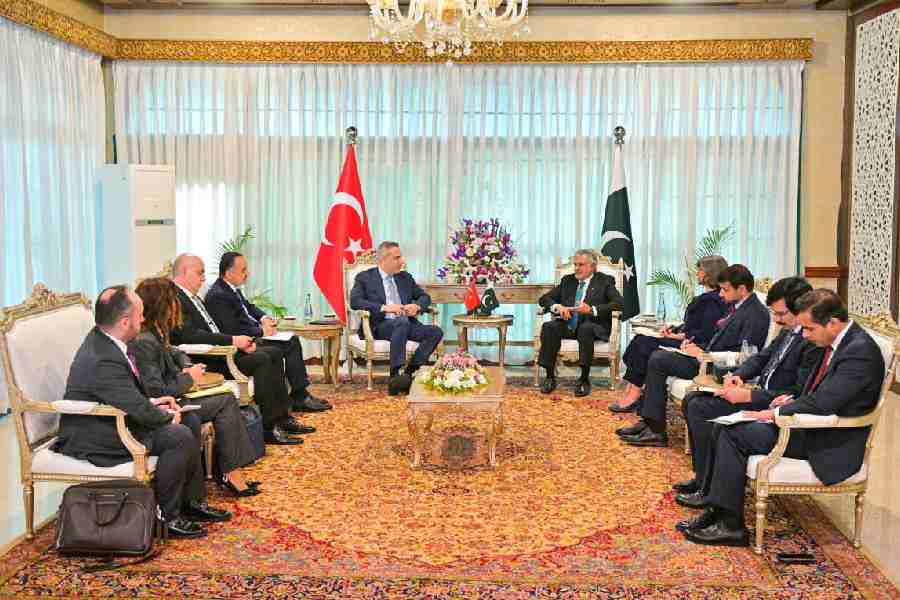
After the quadrilateral consultations, Dar briefed the visiting dignitaries on the prospects of potential US-Iran talks in Islamabad.
"The visiting foreign ministers expressed their fullest support to this initiative,” he said.
"In this context, Pakistan is very happy that both Iran and the US have expressed their confidence in Pakistan to facilitate their talks. Pakistan will be honoured to host and facilitate meaningful talks between the two sides in the coming days for a comprehensive and lasting settlement of the ongoing conflict," he added.
He said the foreign ministers “reaffirmed unity to contain the situation, reduce the risks of military escalation and create conditions for structured negotiations between relevant parties”.
It was the second meeting of consultations among the foreign ministers of Pakistan, Saudi Arabia, Turkiye, and Egypt, following the first meeting held in Riyadh on March 19.
Dar said that the four foreign ministers had a very detailed discussion on the current regional situation. "We also discussed possible ways to bring an early and permanent end to the war in the region,” he said.
He added that all participants expressed concerns that the ongoing conflict was “extremely unfortunate for its devastating impact on lives and livelihood across the wider region”.
“We agreed that this war is not in favour of anyone and would only lead to death and destruction; the unity of the Muslim ummah in these challenging times is of utmost importance,” he said.
Pakistan, along with Turkiye and Egypt, is making efforts to bring the US and Iran to the negotiating table, but so far without success. Officials, however, are keeping fingers crossed for such a meeting in the coming week.
Dar said that under the leadership of Prime Minister Shehbaz, Pakistan has maintained regular engagement with regional and international partners.
"We have remained actively involved in all efforts and initiatives aimed at bringing this conflict to an end," he said.
Calling Pakistan–US relations "very important," he said that they had remained actively engaged with the US leadership as part of efforts to de-escalate the situation and find a peaceful resolution to the conflict, The Express Tribune reported.
Dar further added that he had also had a detailed telephonic conversation with Chinese Foreign Minister Wang Yi, saying that China fully supports Pakistan's initiative to host Iran–US talks, the report said.
The foreign minister also said he had held “very productive” bilateral meetings with the three foreign ministers, who also called on Prime Minister Shehbaz Sharif.
Separately, Dar, after the meeting, said on X that he was pleased to welcome the foreign ministers of Saudi Arabia, Turkiye, and Egypt for consultations.
“Grateful for their presence at this critical moment, reflecting our strong fraternal ties. Our candid and constructive discussions focus on the evolving regional situation and advancing peace and stability, while strengthening our partnership and deepening cooperation across diverse domains,” he said.
The talks were held amidst a delay in direct talks between the US and Iran.
Egyptian foreign minister Badr Abdelatty and Turkish foreign minister Hakan Fidan arrived in Islamabad on Saturday, while their Saudi counterpart, Prince Faisal bin Farhan Al Saud, reached on Sunday at the invitation of Dar.
The two-day quadrilateral summit is Pakistan’s attempt to broker peace in West Asia.
After the meeting, the Saudi foreign minister Prince Faisal bin Farhan called on Prime Minister Shehbaz Sharif and discussed various matters of bilateral and regional interest.
Earlier, Dar held a meeting with the Saudi foreign minister on the sidelines of the quadrilateral huddle, the Foreign Office (FO) said.
“During the meeting, the two leaders held detailed discussions on the evolving regional and international developments. They underscored the importance of dialogue, diplomacy, and collective efforts to promote peace, security and stability in the region,” it said.
“Reaffirming their commitment to closer engagement, the two sides agreed to continue working together at bilateral and multilateral levels to further strengthen cooperation and contribute to regional peace and prosperity,” it added.
Dar also held bilateral talks with his counterparts from Egypt and Turkiye on Sunday.
The FO said Pakistan and Egypt expressed satisfaction with the positive momentum generated through recent high-level exchanges, including the visit of Abdelatty to Pakistan in November last year.
During the meeting with Turkiye foreign minister Fidan, Dar underscored the “historic and fraternal ties between Pakistan and Turkiye, rooted in shared history, culture, and mutual respect”.
In a press statement on Saturday, the FO said the visiting foreign ministers will hold “in-depth discussions on a range of issues, including efforts to de-escalate tensions in the region”.
Separately, the FO in a midnight post on X said that Dar held a telephonic conversation with Iranian foreign minister Abbas Araghchi and “discussed the evolving regional situation and ongoing developments”.
Dar said that he emphasised the need for de-escalation, stressing that dialogue and diplomacy remain the only viable path for lasting peace.
In a related development, Dar announced Iran agreed to allow 20 more ships under the Pakistani flag to pass through the Strait of Hormuz.
“I am pleased to share the great news that the Government of Iran has agreed to allow 20 more ships under the Pakistani flag to pass through the Strait of Hormuz; two ships will cross the Strait daily,” he said.
“This is a welcome and constructive gesture by Iran and deserves appreciation. It is a harbinger of peace and will help usher stability in the region,” he added.
In the post, the Pakistan foreign minister tagged US Vice President J. D. Vance, US Secretary of State Marco Rubio, US Special Envoy to the Middle East Steve Witkoff, and Araghchi and concluded it by saying that “dialogue, diplomacy, and such confidence-building measures are the only way forward”.
Pakistan on Thursday said that it was “actively and constructively engaged” with all stakeholders in the region and beyond to peacefully end the Iran war.