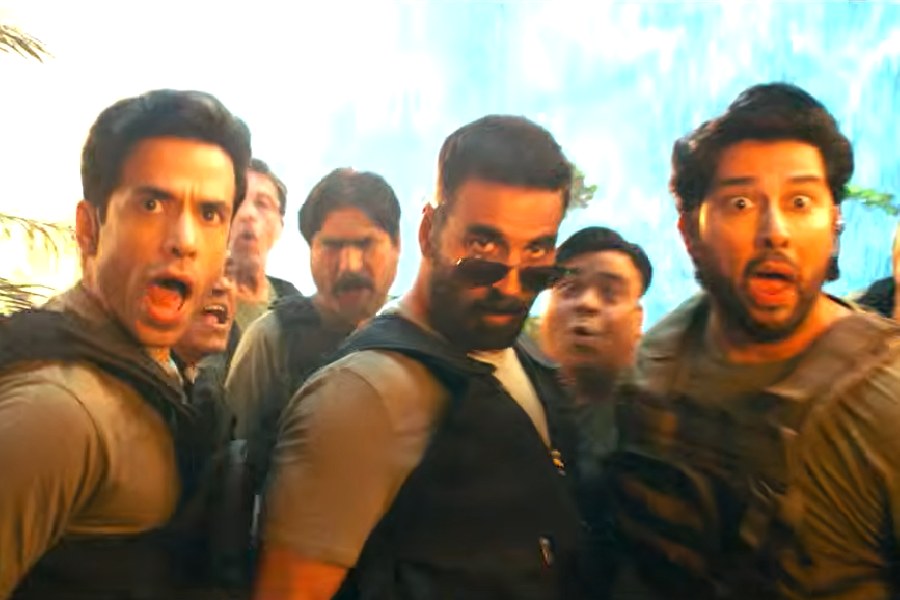
There is no point walking into Welcome To The Jungle expecting logic. Director Ahmed Khan's latest comedy knows exactly how ridiculous it is. It openly mocks Bollywood's larger-than-life heroes, outdated filmmaking tropes and even its own paper-thin plot. In many ways, it plays out like a spoof of Hindi commercial cinema, constantly winking at the audience and inviting them to laugh at the madness unfolding on screen.
The problem is that while the film is fully aware of its absurdity, it doesn't always know how to turn that absurdity into consistently funny comedy.
The premise is as outlandish as they come. A corrupt politician decides to bankroll a Rs 2,000-crore film to deliberately lose it as part of a tax-saving scheme. Two directors are hired to make a guaranteed disaster, and they assemble an army of struggling actors, washed-up performers and complete amateurs. Their fake film shoot soon lands them in a jungle where villagers mistake them for real soldiers capable of taking on a gang of terrorists. Suddenly, what began as a fraudulent movie production turns into an unlikely survival mission.
It is a setup tailor-made for chaos, and Welcome To The Jungle embraces that chaos wholeheartedly. The screenplay throws one bizarre situation after another at the audience, rarely pausing for breath. Characters pop in and out of scenes, misunderstandings pile up and almost everyone behaves with complete irrationality. If the film has one undeniable strength, it is its willingness to go all in on its own insanity.
Farhad Samji's dialogues frequently break the fourth wall and poke fun at Bollywood itself. Jacqueline Fernandez's character questioning why she is even part of the film, only to be told she is there simply for glamour, is among the better meta jokes. Akshay Kumar's struggling actor knowingly accepting a terrible script because he desperately needs the money is another clever dig at the industry. These moments reveal the film's strongest instinct: it works best when it laughs at itself.
Unfortunately, those moments are surprisingly infrequent.
For every genuinely amusing gag, there are several that feel recycled from an earlier era of Hindi comedies. Much of the humour relies on slapstick, exaggerated reactions and repetitive misunderstandings that have long overstayed their welcome. Several jokes feel lifted from the comedy playbook of the early 2000s without being meaningfully updated for today's audience. While the film keeps throwing punchlines at a rapid pace, only a handful actually land.
The result is a comedy where the laughs are few and far between. Instead of building momentum, many sequences, specially in the last one hour, simply become noisy, with the enormous cast shouting over one another in the hope that chaos alone will generate humour. At nearly three hours, the film also overstays its welcome.
The biggest casualty of the film's massive ensemble is character development. There are so many familiar faces that few receive enough screen time to make a lasting impression. Several actors appear only to deliver a line or two before disappearing into the crowd. Rather than feeling like an ensemble comedy where every character contributes something memorable, the film often resembles a celebrity roll call.
Akshay Kumar once again proves why he remains one of Bollywood's most dependable comic performers. He throws himself into the absurdity with complete commitment and carries much of the film's energy on his shoulders. His timing remains effortless, and he understands exactly how seriously—or rather, how unseriously—to play the material.
Paresh Rawal remains reliably entertaining and extracts laughs even from average dialogue thanks to his impeccable comic timing. Johnny Lever also reminds viewers why he continues to be one of Hindi cinema's finest comedians, managing to elevate scenes through sheer screen presence. Suniel Shetty and Arshad Warsi bring nostalgic value, particularly through references to beloved characters from earlier franchise entries, although the film never quite capitalises on their chemistry.
Jackie Shroff lends the antagonist enough swagger to remain memorable, while Raveena Tandon's appearance adds another layer of nostalgia.
Yet throughout the film, one cannot help but miss the manic brilliance that Nana Patekar and Anil Kapoor brought to the earlier Welcome films. Their absence leaves a noticeable void that no amount of star power quite manages to fill.