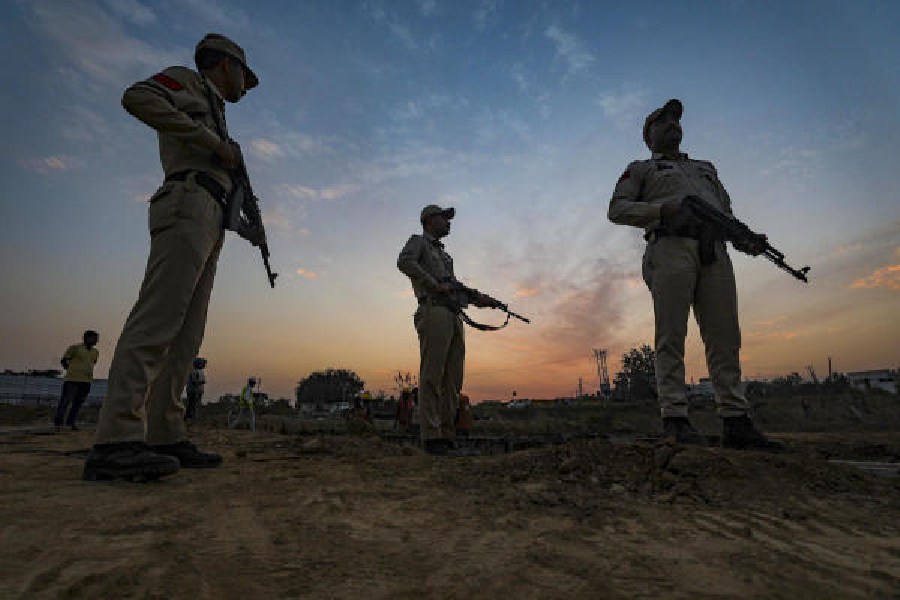
A group of 30 to 40 soldiers led by army officers scaled the gate and boundary walls of a fortified building and launched a midday assault on Wednesday, a Jammu and Kashmir police report says.
Except that this was no high-risk operation to neutralise militants — no insurgents were holed up inside the complex in militancy-hit Kishtwar district.
The targeted building, according to a startling police FIR, was the Atholi police station in the Padder area, and those inside included a group of middle-rung cops.
Apparently, it all stemmed from road rage, with soldiers in civvies blocking a senior administrative official’s convoy and, as a consequence, being brought to Atholi police station before their identities were revealed and they were let go, local sources said. The alleged assault followed sometime later.
The soldiers — who allegedly carried iron rods, sticks and “arms and ammunition” — vandalised the police station, beat up the cops and tore their uniforms, the FIR says.
It suggests the attackers’ intention was to kill.
The Kishtwar district police have booked an army colonel, a major and 30-odd soldiers of the 17 Rashtriya Rifles on the charges of attempt to murder, rioting, assault on public servants while discharging official duties, wrongful restraint and similar offences.
Among those attacked were a sub-divisional police officer (SDPO), a station house officer (SHO), and an assistant regional transport officer (ARTO).
“A group of 30 to 40 Army personnel from 17 RR Camp Kijayee, led by Major Vikas Sharma and Naib Subedar Shanker Gurkhe of 17 RR, launched a pre-planned attack under the direct instructions
and commands of Commanding officer 17 RR, namely N. Arun Gandhi,” the FIR says.
“Having made full preparations and armed with lathis, iron rods, and arms and ammunition, the said group trespassed into the premises of Police Station Atholi by forcefully climbing over the main gate and the boundary walls. Their common intention was to cause fatal injuries and kill the police personnel on duty.”
The FIR does not say how many police personnel were inside the premises.
A defence spokesperson in Jammu said the matter was “under examination through the appropriate institutional mechanism” and that the army would cooperate fully with the legal process.
“Appropriate actions will be taken based on the outcome of the joint investigation. At this stage it would be premature to comment further...,” the army said.
A local official who requested not to be identified described how the dispute began. He said Kishtwar deputy commissioner Pankaj Kumar Sharma’s convoy had tried to prevent what appeared a civilian car from overtaking it on a road, as is the norm.
“Those in the car appeared enraged. They (eventually overtook and) blocked the escort car after which the (civilian) car was seized. The occupants looked like civilians as none of them was in uniform,” the official told The Telegraph.
“It later turned out that they were army men in civvies. None of them was an officer. They were allowed to leave and their car was returned to them. The dispute seemed over,” the official said.
The FIR quotes the Atholi SHO as saying he was attending a Block Divas programme chaired by the Kishtwar deputy commissioner when he learnt about the attack on the police station.
He rushed back but as soon he entered the premises, the FIR quotes him as saying, soldiers physically assaulted him and tore his uniform.
In the FIR, the SHO further claims that the Atholi SDPO, other police personnel and the Kishtwar ARTO — who too had arrived by then — were also assaulted.
A special police officer (SPO) was allegedly hit in the neck with a rifle butt, causing severe injuries, the FIR says. It accuses the attackers of damaging vehicles of police officers and the ARTO.
The official who spoke to this newspaper said the police had shut the gate when they sensed the impending attack.
“The police station has a large iron gate and tall boundary walls. But they (the soldiers) scaled them to enter the premises before they started beating those inside,” he said.
Kishtwar generally makes news for anti-militancy operations. The army achieved a breakthrough last February by killing a senior militant commander, Saifullah, and two associates in an operation in the region that lasted 326 days.
“Forces tracked terrorists in challenging conditions of cold, wet and freezing weather across daunting terrain, leading to multiple contacts (over these months),” the Jammu-based White Knight Corps had said about the operation.