 |
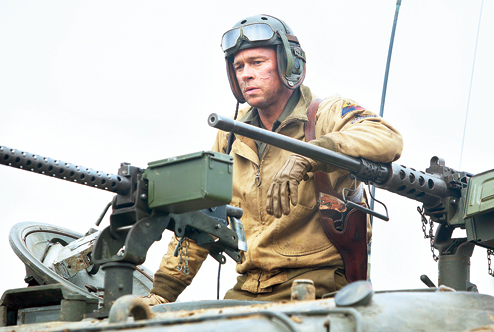
| Brad Pitt as Don ‘Wardaddy’ Collie in Fury |
After a former United Nations investigator fighting a zombie pandemic in World War Z and a charismatic, womanising drug trade middleman in The Counselor, Brad Pitt slips into the role of a US Army staff sergeant during World War II in Fury. A chat with the 50-year-old superstar on the film set for an October 31 release.
Why did you want to do a film like Fury?
I am first a fan of (director) David Ayer... from Harsh Times to End of Watch. In his films, I recognise a knowing that is beyond mine. I knew I could learn something from this man, and that for me is everything. Dave has lived an extraordinary life, including time spent on a nuclear submarine. His extensive knowledge and his respect for the military drew me in... it drew us all in. I knew upon the first read that there was something very special and truthful here... I didn’t know or recognise how deep it ran until we all started working together and came out on the other side. It was truly a unique experience for us all.
 |
 |
What insights can you give into your character ‘Wardaddy’?
The ‘Wardaddy’ character (Don ‘Wardaddy’ Collier) is the tank commander, so his responsibilities are first to his crew... to make sure that their morale is up and that they are operating as a machine. A tank crew has to operate as a machine. If one cog fails, they are not going home. The tank commander also has to simultaneously have his eyes on the playing field, monitoring any and all potential threats — because war comes at you fast and ferociously. One late call means no one’s going home.
He seems a very tough man…
He is strict and he is stern. He has to be because you need clarity in battle. But in his quiet moments, he is also a man carrying a profound loss... the proverbial hole in the heart, a loss which we never quite explain but it certainly has taken its toll. And it’s the accumulative trauma which has formed this dent in his psyche.
Our crew is one of the few crews who have managed to stay together for the bulk of the war and survived. Our tanks were inferior to the German tanks and so we threw numbers at them. The odds of survival were grim. At the start of the film, we’ve lost our fifth crew member and a new kid (Boyd Swan, played by Shia LaBeouf) is thrown into the mix and into our family. If you can imagine, a tank is a very tight and intimate place... we eat, sleep, piss, fight — all within this confined metal box. It’s our home. We’re crammed together, but we each have our comfort spots and our own way of working and our own language.
And then suddenly, this new kid is thrown in. It’s not just that he’s new, but he has had no tank experience, which was often the case towards the end of the war. Because he’s had no tank experience, he is actually a threat, a threat to our survival. If he can’t perform, the whole crew is in danger, the mission is in danger and people will die. So this kid comes in with all the values we cherish at home — innocence, idealism, humanity... but these values have little place on the battlefield. This paradox becomes Wardaddy’s responsibility... to beat this out of him and prepare him for the horror that is war. He needs to get him to act, not think. But, how do you raise a child in a day?
Is that the journey Wardaddy goes through in the film?
Yeah, part of his journey is raising a son in one day and that relationship is sometimes very painful. It is difficult for a father to have to punish his child. Sometimes, it is even harder on the parent. It is a negotiation, an exchange. In the film, we see this trade-off. We see a very hard and capable character versus the innocence of this kid.
Did you feel responsible on set to act as a leader?
Sure... the whole experience was a profound education on leadership. If we were ordered to do push-ups, I was first on the ground. When in class, I studied hard. I never whined, bitched or complained unless it was an exercise to bind us. They had to know I was working at least as hard if not harder than they were. It was my responsibility to set the tone. This was true whether the camera was rolling or not. And as you can imagine, we got really, really tight on this thing.
I am not the most talkative by nature, but here we were, five guys stuck in a tin can and I am the senior of the bunch, and I felt this responsibility to be direct and open with my guys, some of whom are just getting a handle on this thing and what they want to do with it. And I root for them because our industry is a very discombobulating place, especially for young actors today. I worry for them because they get used up so quickly and spat out before they have had time to develop their craft. They especially need a good head on their shoulders and strong guidance, and learn when to say ‘no’. ‘No’ is the most powerful word we have in our business but it’s one that takes some time to learn actually. You’ve got to protect yourself at times.
You compared the tank crew to a family…
Yes, there is bickering, irritation, laughter, smells, proximity, closeness… being tuned to each other’s moods and knowing each other’s next move. Being the patriarch of the family, Wardaddy needs to rule with authority, but never abuse their trust..... There’s a give and take, emboldening them or crushing them depending on the need of the moment. He is in charge of maintaining the morale of the family... this big fat dysfunctional family.
 |
David Ayer apparently put you through some tough training before principal photography began?
We wanted that. We wanted to be pushed to the places we hadn’t been. You want to keep things loose and you want to get some punches thrown at you so that you can throw some punches back. You want to be on your toes and you want that feeling that anything can happen, so we lived that way daily, and as a result, amazing moments happened that you never plan for.
How did the time you spent with World War II veterans influence your performance?
I have seen the hellish photos from the time and I have read the books. So sitting in the presence of these extraordinary men who have lived and survived war and were willing to share their experiences with the five of us, was quite moving. They set a tone for us and I can’t quite describe the immense respect and reverence we walked away with from our meeting. My hope is that they will recognise some of that in this film.
Was this a film set that your family could visit?
My eldest son (Maddox) knows about every tank — so much so that when we first started, I was asking him for information. He has an extensive knowledge developed on his own since he was younger. I brought my five-year-old (Knox) on set and he was awed by the tank, and even though he had no concept of war or a tank’s purpose, he was immediately drawn to it. I think it’s that inexplicable fascination man has for machine.
Did you ever consider joining the military when you were younger?
No, I was too reckless… rudderless. I never considered it in my younger days. I was too much on the drift and it was more about exploring for me. Now, with what we have learned and what we have been through on this film, I have so much respect for what we ask these young men and women to do on our behalf. I have so much admiration for them.
Finally, are there many other filmmakers you would still like to work with?
There are many strong directors working today I would love to collaborate with. I appreciate directors who have an authentic voice, challenge the medium and have a very, very precise point of view. At the end of the day, we are in their hands.