
It all started innocuously enough, in Mumbai some time in the 1990s, when a friend gifted me a small plastic tub containing something called, simply, Green Curry Paste. My heart did a quick little flutter: About the only Thai dish I could ask for by name then was Green Curry Chicken. I knew this dish. I had long been in love with its lemony, spicy, piquant, coconutty gravy.
I read the instructions on the tub carefully. Simplicity itself. Take 200g of chicken or beef or prawns. In a wok, using no oil, stir-fry 50g of green
curry paste, until its inherent oil begins to separate from it. Add a litre of coconut milk, throw in the meat, and allow it to simmer until the meat is done. Presto.
Within days, I had grown obsessed with the idea of making my own green curry paste. I bought a quick and dirty book on Thai cuisine, and raced to the recipe for green curry. My heart sank. It needed at least three ingredients that I knew for a fact I would never easily find in India: galangal, Kaffir lime leaves, and lemongrass stems.

Galangal, the noble ginger, is less pungent, more ceremonial, more dignified. Kaffir lime leaves, which grow in thick, glossy, dark green pairs along thorny stalks, are dramatically aromatic. As for lemongrass, the leaves, used for flavouring tea, are available without ado from roadside vendors in Bombay. But green curry paste requires the stalks, close to the roots, and those could not be bought. Not in India anyway.
IN QUEST OF THE PASTE
There was only thing I could do — go to Bangkok and get the damn ingredients myself.
Bangkok in 1998 was not the gentle, unimposing capital I remembered from my last trip there a dozen years earlier. Everywhere, there were signs of a berserk economy hurtling into globalism. Monstrous billboards featuring the products of Sony, Samsung, Daewoo, Mitsubishi and their ilk stood watch like alien sentinels over highways.
Construction cranes postured with their heads in the clouds, lowering girders in slow motion.
“Somewhere here is a vegetable market where we will get all the galangal we want,” I said to my friend Gopi, looking dreamily out upon the lapidary glitter of downtown Bangkok from the nineteenth heaven of the Monarch Lee Garden Hotel. The question, of course, was how would we find it.
Roadside food hawkers, I thought, would be a good starting point. I simplistically assumed that one selling Green Curry Chicken would direct me to the market where he obtained his ingredients.
After a day-long search, I found my man in a soi, or lane, five minutes away from our hotel. A creased old Thai gent sat expressionless by a stall full of steaming hot food in pots. I surveyed the lot, recognised nothing at first pass — and then spotted, with a quickening of the pulse, the tell-tale lime green of the Green Curry.
GIMME, GIMME, GIMME...

“Is that Thailand’s famous Green Curry Chicken?” I asked.
He stared at me.
“Sorry,” I laughed. “I forgot you don’t speak English.” I pointed close to the surface of the dish and repeated, slowly and explicitly, “Green Curry Chicken?”
No response.
“Gleen Cully Chicken?” I tried again, the smile by now beginning to congeal on my face.
Then inspiration struck. I raised my head to the skies and, fanning a palm behind my head like a coxcomb, called out, “Cockeracoco-o-o-o-!” in imitation of a cock crowing at dawn.
The old man’s face suddenly cracked open and a giggle escaped; his eyes danced momentarily.
“I am looking for galangal,” I said slowly. “Gal. An. Gal.”
He nodded, as though understanding at long last, and then flashed both open palms twice before me. “Yeesip baht,” he said. This was easy, even for me. He was willing to sell me galangal at 20 baht. Suddenly exhilarated, I leapt ahead. “Also makrut,” I said. “Mak. Root.”
Again he flashed a 20. Beaming broadly, I looked around, perhaps to see if Gopi might have somehow turned up to witness my triumph. Galangal and makrut for 20 baht each.
Unstoppable now, I shouted, “Lemongrass!” Again, 20 baht.
“Basil!!” 20 baht.
“Gimme!!” I cried.
The old man made an imperceptible signal towards the rear. Two girls hurried forward with plate and fork, and while one ladled steaming rice onto it, the other smothered it with Green Curry Chicken. The dish was courteously placed before me.
“Twenee baht onee,” said the old man. “You sit. Eat here. Be my gas.”
PAK KHLONG AT LAST!
That evening, I called my friend Pat, a long-time Bangkok resident. “Where do you suppose we could find some fresh ingredients for green curry paste?” I asked.
“You could do worse than make a trip to Pak Khlong,” replied Pat. “They say you can get every vegetable under the sun there.”
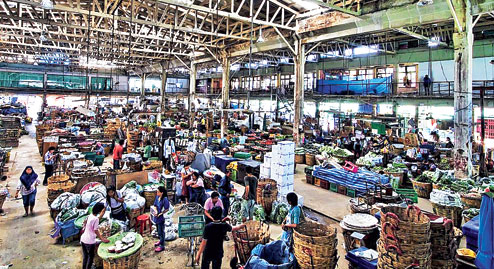
I had no idea I would be searching in an area roughly the size of five football fields for a few leaves and vegetables whose Thai names we did not know.
The entire market began smiling as we entered. I stormed ahead calling out in English to Buddhist vegetable vendors whose lives till that moment had known only peace.
Everything was fresh, having arrived from the Thai countryside early in the morning; everything was heaped in small mountains, and every vegetable was large, healthy and firm, without blemish or bruise.
There was the bell-like Chinese cabbage, pak choi, with dark-green leaves and broad, juicy stalks with their mustardy flavour; yellow soccer balls of vegetable spaghetti, so-called because the flesh separates into long, spaghetti-like strands upon cooking; mango-coloured courgette; straw baskets of coffee-brown, finely textured cloud ear mushrooms; the delightful kiwi fruit, like sandpaper outside, succulent bright green inside, with a sprinkling of grainy, crunchy seeds; orange longan fruit; the so-called pea aubergine, really neither pea nor aubergine, which you will encounter time and again in curries; fat, light-green pods of silky squash; lotus root; palm hearts; carambola, the star-fruit; mangosteen, whose hard, nut-like outer conceals a yielding, sweet pulp; long green stalks of Chinese chives, topped with a kiss of little white flowers; bitter melon; mountains of snow peas, which are more beans than peas, and so sweetly crunchy that they need hardly any cooking.

Finally, a vendor of fat normal ginger seemed to get it. He pointed back somewhat in the direction we had come. “Kha,” he said.
And that was how I finally heard the Thai word for galangal. Kha. In a dark alley that led to a cobbled lane at the back of Pak Khlong market, I discovered galangal heaven: a stretch devoted to the very vegetables I had traversed a sub-continent and an ocean to find. Everywhere there was galangal, heaped in baskets, like some pink deep-sea fish, each with its three or four stilt-like legs sticking out. I bought 30kg right away.
THE MORE THE MERRIER

Nearby, I spotted Kaffir lime, known there as makrut. In adjacent baskets, there was the unprepossessing, gnarled, deep green lime itself which, if pressed, would grudgingly yield a few drops of victoriously aromatic juice. “Twenty kilograms,” I said, pointing to the limes. Then, pointing to the leaves, I added, “Thirty.”
Gopi watched helplessly as I bought up sacks of krachai ginger, basketloads of fat-stemmed lemongrass, and enough fiery red and green bird’s-eye chillies to reduce an army to tears. I had enough already to be swimming in green curry paste for the rest of the millennium.
Then I saw a shop selling dried versions of every ingredient I’d bought thus far, and re-ordered 10 kilos of everything.
Just when I thought my shopping energy was finally sputtering out, I saw a small shop selling ready-made curry pastes, and my wallet emerged strong and gutsy again. Here was everything I’d hoped to concoct in India using original Thai ingredients: Green Curry Paste, Red Curry Paste, Yellow Curry Paste, Mussaman Curry Paste, Tom Yam Paste, Roasted Chilli Paste; Panang Curry Paste; and at least a dozen others, arranged in bowls within a covered glass case.
I bought five kilos each of every paste. When we finally reached the hotel, smuggling in our little forest-worth of shopping through a back door and up the staircase to our room, we had bought up nearly 300kg of Pak Khlong. That was the beginning of my forays into Far Eastern cuisine, which led to the Mainland China chain and more.
I’m sure you’re wondering how I managed to carry 300kg of vegetables back to India in a plane. But that’s another, quite a long story by itself.
Anjan Chatterjee is the chief of Speciality Restaurants, which owns Mainland China, Oh! Calcutta, Cafe Mezzuna, Sigree Global Grill, Hoppipola, Asia Kitchen and more. And yes, he is a foodie