
The Hooghly has always had a flair for drama. On this particular morning, it seemed determined to prove it. By the time we reached Polo Floatel, Calcutta’s floating hotel anchored gently on the Hooghly river, the sky had already pulled a thick grey blanket over itself. The river looked restless beneath it, rippling with the occasional gust of wind. Every few minutes, someone glanced upwards. Every few minutes, someone refreshed the weather app. There was only one question on everyone’s mind — would the rain hold off long enough for the day’s outdoor shoot?
The answer mattered more than usual. This wasn’t just another photoshoot. The hotel had arranged a beautifully decorated boat complete with traditional Jamai Sasthi touches, and the day’s shoot with t2 would quietly mark the beginning of the Bohurupi: The Golden Daku chapter.

A wooden boat, the Hooghly and two actors completely in sync(B Halder)
Shiboprosad Mukherjee and Koushani Mukherjee walked in smiling as they greeted the bustling crew. Within moments, both disappeared into their respective corners as the controlled chaos of hair, make-up and wardrobe transformed them once again into Bikram and Jhimli — the much-loved couple audiences first embraced in Bohurupi, one of Bengali cinema’s biggest blockbusters in recent years.
Soon enough, the waiting game was over. The clouds relented just enough to allow the first set-up, and everyone sprang into action. While the actors and make-up artistes stepped aboard the decorated boat, the rest of us climbed into another vessel that would shadow them through the river, serving as our floating vantage point for the photographs. It was a production in motion, quite literally.
As both boats drifted away from the Floatel, the city unfolded from an entirely different perspective. Ferries criss-crossed the river, their horns echoing across the water. Above it all stood the unmistakable silhouette of Howrah Bridge, stretching across the Hooghly like an ever-watchful spectator to Calcutta’s stories.
For the first look, Koushani was elegance personified in a lustrous golden sari, while Shiboprosad wore a vibrant ivory kurta paired with a traditional dhoti. The festive palette stood out beautifully against the grey skies. The camera was interested in something else entirely — chemistry. And Bikram and Jhimli slipped back into it effortlessly. Between instructions from the photographer came spontaneous laughter, stolen glances and playful conversations. One moment, they leaned against each other, watching the river flow by; the next, they burst into laughter over an off-camera joke. The line between actor and character blurred naturally, making every frame feel less posed and more lived-in.
The boat circled gently on the Hooghly, giving our photographer every possible angle — the river stretching endlessly behind them, the bridge framing them from above and the city fading into soft monochrome beneath the overcast sky. Then came the moment everyone had been dreading. A light drizzle. For a few seconds, everyone froze. Fortunately, the rain seemed content merely to announce its presence. Tiny droplets floated through the air without ever becoming a proper shower, lending the photographs a cinematic softness. Nobody rushed for umbrellas. Nobody called for a break. The camera simply kept clicking.
Sometimes, the weather knows exactly when to cooperate. Once the river sequence was wrapped, the production shifted indoors. Gone was the windswept romance of the Hooghly. In its place came the warmth of a traditional Jamai Sasthi celebration. Polo Floatel had transformed its restaurant into a festive Bengali setting, complete with colourful décor and an elaborate feast that celebrated the spirit of the occasion. Copper serving bowls, fruits, sweets and traditional delicacies filled the table, recreating the generosity synonymous with the festival.
The wardrobe changed with the mood. Koushani emerged in an elegant white sari accented with emerald-green jewellery, while Shiboprosad swapped the white kurta for a regal burgundy bandhgala. The romance gave way to playful domesticity. They teased each other over the extravagant spread, laughed while pretending to negotiate who would get the choicest dishes and exchanged knowing smiles between photographs. Every frame celebrated the warmth, humour and affection that Jamai Sasthi has long symbolised in Bengali households. The overcast skies, the gentle breeze, the harmless drizzle, the slow circles around the Hooghly beneath the watchful Howrah Bridge and the warmth of a Jamai Sasthi celebration aboard Calcutta’s iconic floating hotel came together to create a shoot that felt unmistakably cinematic.
A bigger canvas, the same heart
For Shiboprosad Mukherjee, the success of Bohurupi has only strengthened the responsibility of making its sequel. While audiences are eager to know what lies ahead in Bohurupi: The Golden Daku, he’s careful not to give too much away. “There are certain things from Bohurupi that people loved, and they’ll definitely find those again. The promise of Bohurupi was that it celebrated Bengal — its people, its villages and its culture — and that continues. But there are plenty of surprises that I’d rather audiences discover in the theatres.” What he does reveal is the scale. “Honestly, this is the biggest film Windows has ever mounted. We’ve shot in 96 real locations. Hardly anything has been shot in Calcutta; almost everything happened outdoors. We wanted authenticity, and that’s exactly what we’ve tried to achieve.”
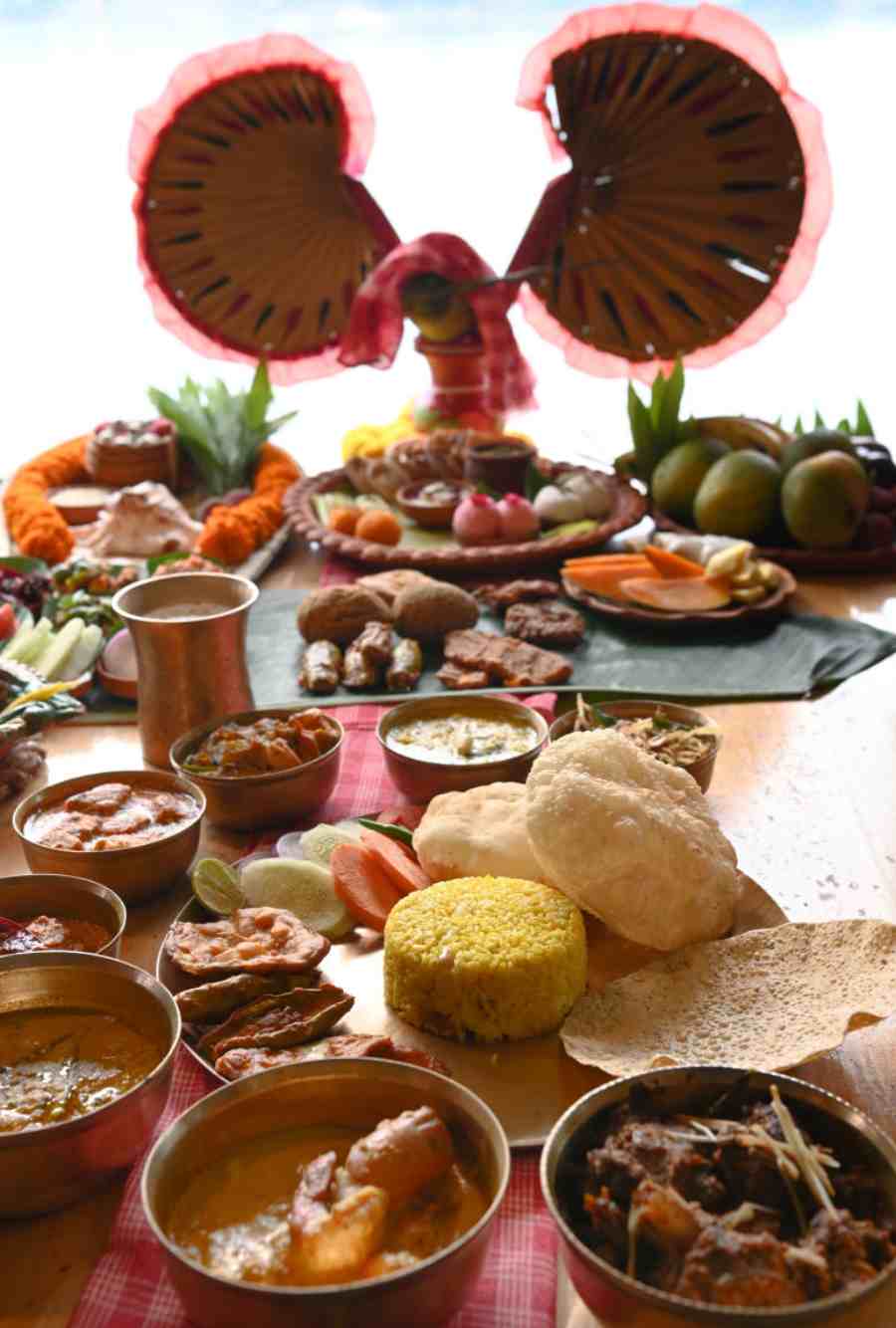
No Jamai Sasthi celebration is complete without a grand feast, and Polo Floatel delivered one to remember.
Koushani agrees that expectations are inevitable after the phenomenal success of Bohurupi, but she sees them as a compliment rather than pressure. “People expect more because they loved the first film so much. That’s a beautiful thing. I genuinely believe Bohurupi: The Golden Daku will surpass all expectations. Every track in the film is so beautiful that audiences are going to fall in love with them.”
Family, food and festive fashion
For Shiboprosad, Jamai Sasthi has always been synonymous with family. “This year’s Jamai Sasthi is truly special — it marks the 10th year of my married life. What makes it even more memorable is that despite suffering a fracture in her hand, my mother-in-law has lovingly taken charge of the entire celebration. My father-in-law is handling the market shopping himself, Zinia is in the kitchen following my mother-in-law’s instructions, and my brother-in-law has taken care of all the fruit arrangements. As always, Jamai Sasthi at their home is nothing short of a grand feast. It is a beautiful expression of love, care, and family traditions that make Jamai Sasthi so special,” said Shiboprosad.
Koushani’s answer came instantly. “Food!” she laughed. “My relationship with Jamai Sasthi is all about food.” The festive styling also carried a nostalgic connection.”
Talking about their looks for the shoot, Shiboprosad said, “Roy Abhisek styled us when we announced Bohurupi during Jamai Sasthi, and his touch is here this year too. It feels like a full-circle moment.”
Koushani approached the looks as though she were celebrating the festival herself. “I imagined what I’d genuinely wear if I were married and celebrating Jamai Sasthi. I didn’t want to be excessively traditional. I wanted both looks to have a festive feel while still reflecting my own personality. The first one was grander, while the white sari felt softer, calmer and very elegant.”
PS: Life jackets are mandatory for anyone heading out on the water at Polo Floatel, and despite the glamour of the photoshoot, safety protocols were followed throughout.
(Pictures: B Halder
Koushani Mukherjee: Make-up: Babusona Saha; hair: Gini Halder; styling: Soumya Nandy; golden sari: Ethnic Boutique; white sari & blouse: Rangoli; jewellery: Jhalak
Shiboprosad Mukherjee: Make-up: Papiya Chanda; costume & styling: Roy Abhisek, Roy Calcutta; assistant stylist: Ram; location courtesy: Polo Floatel)