 |
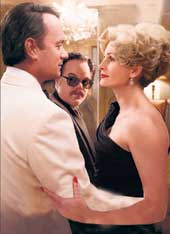
| Tom Hanks, Julia Roberts and Philip Seymour Hoffman in Charlie Wilson’s War |
Can this really be Tom Hanks, allround cinematic good guy? Forrest Gump, for goodness sake? In an LA hotel suite Hollywood’s King of Clean laughs wryly: “Yes, I went into this career specifically so I’d end up naked in a jacuzzi with a bunch of naked strippers.”
The nice-guy reputation irks him at times, yet he recognises that it is most likely deserved. He is too straightlaced to indulge in coke-fuelled badinage with real-life strippers. For what he has just said playfully refers to the hedonistic tableau of the opening sequence of his new movie, Charlie Wilson’s War, the spa baths and strippers filling a scene that introduces Wilson, a US Congressman with a penchant for the high life — emphasis on “high”.
The film, directed by the legendary Mike Nichols, who made The Graduate and Catch 22, and written by Aaron Sorkin, the creator of The West Wing, tells the remarkable true-life tale of how Wilson played a key role in the outcome of the Afghan war of 1979-89, pushing US funding for the Afghan resistance from $5 million to $1 billion a year and facilitating a morale-crushing defeat for the Soviet Union. It has grossed $40 million in the US since its release on December 21.
“Wilson may have lived his life in a certain way, but to give him his due, he severed the Achilles’ heel of the Soviet Union,” Hanks says. “It was just nine months after they pulled out of Afghanistan that the Berlin Wall came down. And one of the reasons it fell was that the Soviet government knew that the cream of its armed forces had been decimated by a bunch of people in a place called Afghanistan. That meant that they couldn’t defend their borders in East Germany and Poland. That has Charlie Wilson all over it.”
The film, which also stars Philip Seymour Hoffman and Julia Roberts (who has Charlie Wilson all over her), may sift through the political scheming that supplied the Mujahideen with the funds and technology required to neuter the Soviet assault, but it is neither war movie nor political allegory. “You can be sure there will be editorials written blaming Charlie Wilson for the war in Iraq,” Hanks says. “People will be saying, ‘Well, if Charlie didn’t arm the Mujahideen we wouldn’t have al-Qaeda — that’s horseshit!”
While recent politically-minded movies such as Lions for Lambs or A Mighty Heart struggled at the box office, Charlie Wilson’s War is simply snappy and sophisticated entertainment. It has a serious backdrop but a glamourous visage. The film has been nominated for five Golden Globes, and its Best Picture nod comes in the comedy or musical category. “Mostly, political films are designed to tell a lesson and to communicate the opinion of the film-maker,” Hanks says. “But I don’t need somebody’s movie to tell me the truth about what is happening. A lot of movies educate and enlighten us, but only if they reach us on a personal level. It cannot be like school or a history lesson; to succeed it’ll have to be enjoyable enough for people to go and see it.”
Whether the allure of the talent on show in Charlie Wilson’s War — both in front of the camera and behind it — is enough to command significant returns at the British box office remains to be seen, but Hanks clearly revels in the role. The 51-year-old Californian is widely perceived as the nicest guy in Hollywood — although Will Smith must be hot on his heels — and, like a latter-day James Stewart or Gary Cooper, he carries his easy, everyman charm into many of his roles.
“I’m in an interesting position there with the nice guy thing,” he says, “and the problem is that I cooperate. I could sit here with you and be some miserable surly guy, but why do that? This is how I am; it’s what I’m like when I get up in the morning. But that means that if I play a guy who shoots someone in the head and then machine-guns everyone else in the movie, everybody still says: ‘Yeah, but he’s still such a nice guy.’ Same if I play an executioner, and it’ll be the same now that I’m playing a guy who f**** everyone he can, goes to bed drunk every night and snorts coke. People are still going to say that I’m a nice guy.”
In films such as Road to Perdition, Green Mile or Charlie Wilson’s War, Hanks has proved himself willing to gamble with his affable image — indeed he confirmed his place on the Hollywood A list by playing a lawyer dying of AIDS in Philadelphia (1993), and then starring as the speedy and simple-minded Forrest Gump a year later, a potentially perilous double that paid off with back-to-back Oscars for Best Actor, a feat not achieved since Spencer Tracy’s wins for Captains Courageous (1937) and Boys Town (1938).
He even went so far as to make Cast Away in 2000, a film that gave us more than an hour of nothing but Hanks. It took nearly $500 million (£250 million) at the box office. His last major outing, the critically reviled Da Vinci Code (2006), nonetheless took more than $750 million, while he and Ron Howard, who directed him in Apollo 13 (1995) are reuniting for another Dan Brown adaptation, Angels & Demons.
Whatever he does, or whoever he plays, everyone still believes that Hanks is a terribly nice guy. But, he claims, “I’m not the guarantee that a movie’s going to be successful or that a movie will touch the zeitgeist. The only thing I can guarantee is that it will be news if it does and news if it doesn’t.”