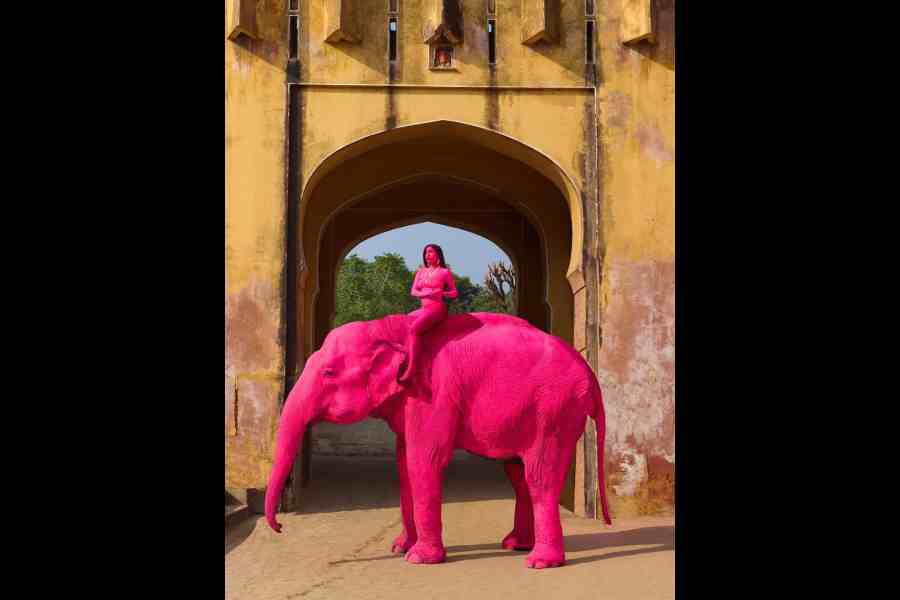
The death of Chanchal, the elephant painted pink in Jaipur, has renewed scrutiny on using captive elephants for commercial tourism activities, with prominent NGOs Wildlife SOS and Peta calling for an end to humans riding jumbos.
Wildlife SOS termed Chanchal’s death a “reminder of the continuous neglect” captive elephants face and flagged the role of a “well-organised cartel” in Jaipur that fools both domestic and international tourists into participating in a “cycle of abuse”.
The organisation has launched a campaign, “Refuse to ride”, calling on the global community to advocate for India’s elephants and urging tourists to be more informed. “It is time to look past the paint and decorations and refuse to ride,” it said, urging “responsible tourists to consider compassion and kindness.”
“Amer Fort is one of India’s top destinations, but a dark reality exists for the elephants forced to labour there,” said Kartick Satyanarayan, co-founder and CEO of Wildlife SOS. “A well-organised cartel in Jaipur effectively fools innocent foreign & Indian tourists into participating in a cycle of abuse.”
Chanchal, who was 70 years old, died due to natural cardiovascular issues, per the post-mortem that was reported on by a number of publications.
Ballu Khan, president of the Hathi Gaon committee, said the elephant died three months after travelling with art photographer Julia Buruleva’s “pink” photoshoot. He denied the use of paint as a cause of death and cited using organic colours, or ‘gulaal’, which is used during Holi, for the pink photoshoot featuring the model Yashasvi.
Wildlife SOS painted a far grim picture.
“Many of these captive elephants are blind, crippled, bearing scores of abscesses, pus-filled wounds, all masterfully concealed beneath colourful decorations, velvet fabrics, and paint,” Satyanarayan said.
“Tourists are often clueless that their 'cultural experience' is built on animal suffering, abuse and irreversible spinal damage. Many elephants are blinded on purpose.”
The statement mentioned that the exploitation of one of India’s most revered animals doesn’t stop there.
There are several “tourist traps” in Jaipur, which pose as safe sanctuaries for elephants, for the sole reason to attract visitors with options to bathe, ride, feed and paint these animals, which carries a risk of severe lead poisoning, the organisation said.
“Chanchal spent decades in service to greed, dying without ever knowing a day of kindness or freedom. She was a helpless victim & lost her life as greedy people profiteered from her exploitation. We are calling on the global community to become informed advocates for wildlife,” the organisation claimed.
According to wildlife experts, making an elephant rideable starts with a long and brutal process called ‘phajan’, which involves separating an elephant calf from its mother.
They are then restrained with a contraption, where their legs and arms are tied up so that they are forced to stand, stewing in their own dung and urine. The calves are abused with whips, electric prods, or bullhooks for months, along with sleep deprivation and starvation to build “obedience”.
Hathi Gaon claims it is not merely a tourist destination but a living community where elephants, mahouts, and their families coexist.
A recent letter by the animal rights organisation Peta to Russian artist Julia Buruleva underscored the poor conditions faced by elephants like Chanchal used for rides at Amer Fort.
Dr Mini Arivandan, Peta India’s senior director of veterinary affairs, urged the artist to either take down the commercial print from her website or donate the entire proceeds towards elephant conservation and protection efforts in India.
The print is being sold for over Rs 3 lakh apiece, according to her website.
According to the letter, the animals are chained, they have to stand on concrete, like cars in a garage, and are controlled with weapons often concealed under costumes and decorations.
Research has also indicated that an elephant's foot can suffer significant damage from walking on concrete, pavement, and other hard, unnatural surfaces.
While elephant feet are designed for soft, natural terrains like mud and grass, prolonged contact with hard surfaces, particularly in captivity, leads to a variety of chronic, painful, and sometimes fatal health conditions.
Buruleva had slammed domestic media outlets for the public backlash, claiming she was being unfairly targeted for false news.
She claimed that the non-toxic paint lasted 10 minutes and was washed off 30 minutes after the shoot, with all activities being supervised by the handlers.
“The tradition of painting elephants has existed in Rajasthan for more than 2000 years”, she had said in an Instagram post.
The Rajasthan forest department has announced a probe into the incident to check if any wildlife laws were violated.