 |
 |
 |
 |
 |
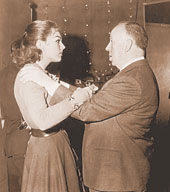
| (From top) Kim Novak with Alfred Hitchcock on the set of Vertigo; Julie Andrews and Paul Newman in Torn Curtain; Poster of Psycho; Cary Grant and Eva Marie Saint in North By Northwest; Poster of Strangers on a Train |
This November it is a Hitchcock festival on the small screen with PIX showing an Alfred Hitchcock classic every Thursday at 10pm — Psycho on November 8, Frenzy on November 15, Marnie on November 22 and Torn Curtain on November 29. Here’s a dummies guide to Alfred Hitchcock...
All about the suspense: Hitchcock preferred suspense over surprise. In surprise, the viewer is assaulted with frightening things. In suspense, the audience is told or shown things the characters do not know, thereby artfully building the tension around what happens when the characters finally learn the truth.
The audience as voyeur: Further blurring the moral distinction between the innocent and the guilty, occasionally making this indictment inescapably clear to viewers, Hitchcock also made voyeurs of his “respectable” audience. Psycho begins with the camera moving towards a hotel-room window, through which the audience is introduced to Marion Crane (Janet Leigh) and her divorced boyfriend Sam Loomis (John Gavin). They are partially undressed, having apparently had sex though they are not married and Marion is on her lunch “hour”. Later, along with Norman Bates (Anthony Perkins), we watch Marion undress through a peephole.
The MacGuffin: One of Hitchcock’s favourite devices for driving the plots of his stories and creating suspense was the ‘MacGuffin’. Hitchcock defined this term as something that sets the film’s plot revolving around it. It’s really just an excuse and a diversion. Many of his suspense films revolve around this device: a detail which, by inciting curiosity and desire, drives the plot and motivates the actions of characters within the story, but whose specific identity and nature is unimportant to the spectator. In a whimsical anecdote told by Hitchcock, he compared the MacGuffin to a mythical ‘apparatus for trapping lions in the Scottish Highlands’. In other words, it could be anything — or nothing — at all.
Catch me if you can: Many of Hitchcock’s films contain cameo appearances by Hitchcock himself: the director would be seen for a brief moment boarding a bus, crossing in front of a building, standing in an apartment across the courtyard, or appearing in a photograph. This playful gesture became one of Hitchcock’s signatures seen in 41 of his movies. As a recurring theme he would carry a musical instrument — especially memorable was the large double bass case that he wrestles onto the train at the beginning of Strangers on a Train. In his earliest appearances he would fill in as an obscure extra, but he became more prominent in his later appearances.
Motifs: Numerous motifs (recurring objects or stylistic choices) can be found throughout Hitchcock’s work.
Ordinary person: Placing an ordinary person into extraordinary circumstances is a common element of Hitchcock’s films In Psycho, Janet Leigh is an unremarkable secretary whose personal story is violently interrupted by a furious schizophrenic. Other clear examples are Strangers on a Train, I Confess, Vertigo and North By Northwest.
Wrong man: Mistaken identity is a common plot device. In North By Northwest, Roger Thornhill (Cary Grant) is mistaken for George Kaplan, a non-existent CIA agent. In The Wrong Man, Henry Fonda is mistaken for a criminal. The plot of Vertigo revolves around James Stewart’s investigation of Kim Novak’s actual identity. In both versions of Man Who Knew Too Much the lead character is mistaken for a spy.
Stairways: Images of stairs often play a central role in Hitchcock’s films. In Psycho, several staircases are featured prominently. In Rear Window, an entirely non-functional staircase adorns James Stewart’s apartment, in addition to the numerous fire escape staircases seen each time we follow Stewart’s gaze out of his window.
Mothers: Frequently depicted as intrusive and domineering, in Rope, Notorious, Strangers on a Train, North by Northwest, Psycho, and The Birds.
Brandy: Hitchcock includes the consumption of brandy in nearly every film. “I’ll get you some brandy. Drink this down. Just like medicine...” says James Stewart to Kim Novak in Vertigo. In a real-life incident, Hitchcock dared Montgomery Clift at a dinner party around the filming of I Confess (1953) to swallow a carafe of brandy, which caused the actor to pass out.
Sexuality: For their time, Hitchcock’s films were regarded as rather sexualised, often dealing with perverse and taboo behaviours. Sometimes, the prudish conventions of his era caused him to convey sexuality in an emblematic fashion, such as in North by Northwest, when the film cuts abruptly from two aroused but visually chaste lovers to a train entering a tunnel. Hitchcock found a number of ways to convey sexuality without depicting graphic behaviours. In a particularly amusing scene in Psycho, Anthony Perkins is carrying on a conversation with Janet Leigh while one of his hands strokes a dead animal and the other hand lingers on his crotch. Biographers have noted how Hitchcock continued to challenge censorship until he was allowed to show nudity in Frenzy.
Crime: With only a few exceptions, crime is the foundation for all Hitchcock stories. Occasionally, we encounter a crimeless film, such as The Birds, but Hitchcock should be classified as a storyteller who primarily told stories about crime and criminals.
Blonde women: Hitchcock had a dramatic preference for blondes, stating that the audience would be more suspicious of a brunette. Many of these blondes were of the Kim Novak/Grace Kelly variety: perfect and aloof. In Vertigo James Stewart forces a woman to dye her hair blonde. The Lodger features a serial killer who stalks blonde women. Hitchcock said he used blonde actresses in his films, not because of an attraction to them, but because of a tradition that began with Mary Pickford. The director said that blondes were “a symbol of the heroine”.
Silent scenes: Hitchcock strongly preferred to convey narrative with images rather than dialogue. Examples of imagery over dialogue are in the lengthy sequence in Vertigo in which James Stewart is silently following Kim Novak, or the extended sequence in Psycho in which Janet Leigh is frantically, wordlessly fleeing Phoenix.
Numbers: Hitchcock often placed numbers that add up to 13 in his movies. Two specific examples are found in Psycho (1960). The license plate of the car that Norman is driving that ends up in the swamp equals 13. And in the motel he reaches first for the key to cabin 3, then reaches for the key to cabin number 1. The sign outside the dealership where Marion purchases a car also adds up to 13.