 |
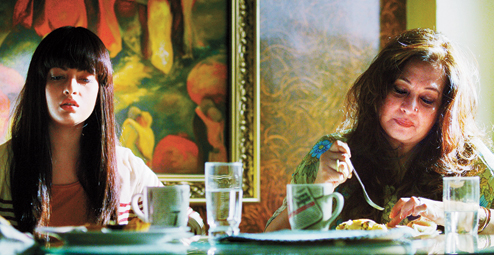
| Riya Sen with mom Moon Moon Sen in Kolkata Calling |
Some people go to shrinks, some talk to friends or a loved one, others write in a diary. I write movie scripts. Everyone has their own demons, and I exorcised my fair share during the making of Kolkata Calling.
The painful truth about me is that I’m a psychotically secretive person who fiercely guards his private life and secrets like it would be a life risk if anyone knew about them. I’ve got a self-made brick wall around me, just like Linda Goodman describes Capricorn men in her book on Sun signs (Yes. I’m the dork who not only read it but also had it memorised back in school). But a pattern started forming in my early years when my aunt watched one of my first short films, and asked me, looking a little amused: “Are you trying to tell your mother something?”
 |
I had no idea what she meant until I noticed that I had got my characters to literally speak in dialogue some of my deepest secrets that I never had the courage to share with my mother. How much she actually understood I still don’t know, as I’m still the same lily-livered bumbling idiot when it comes to confrontations and owning up to my secrets and lies in person. But give me a notepad and a pen, and leave me in a room for a few days, and I will end up revealing more than a shameless exhibitionist who bares all on the most public platform imaginable.
 |
| Raima Sen |
But when actually writing a script, I genuinely think I’m being a creative genius, dreaming up crazy original characters and plot lines from scratch. Until pop! My bubble bursts the second I read it to a loved one who invariably points out that all my characters are some versions of me and all the events have something to do with my life. And I think “oh…”, a little dumbfounded, because I had no clue.
 |
| Samrat Chakrabarti |
The fact that Maach Mishti & More was personal, I kind of figured out during the script-reading sessions. But with Kolkata Calling, I had no idea, until I actually started shooting the film and found myself picking shooting locations that exactly co-related to my childhood; and had characters saying and doing stuff that I either did, or subconsciously wish I had the courage to say and do in real life, but still can’t.
Ritwick Chakraborty’s character Shuddhyo, who dreams of being an actor and waits around endlessly in studios hoping someone will give him a chance, is a thinly veiled version of me waiting around for months on movie sets, trying desperately to get my foot through the door as a filmmaker. I had Ritwick literally catch a bus from the exact same spot in Howrah from where I used to catch my bus when living with my grandfather in Howrah.
 |
| Ritwick Chakraborty |
Riya Sen’s Krittika is a female dork version of me, who is an awkward social misfit, wanting to break away and be independent from her family to figure things out for herself.
Samrat Chakrabarti’s Deep and Koushik Sen’s Ranjan are not so thinly veiled versions of me. Deep, who had aspirations of being a painter and was forced to be an engineer, leaves his steady job in the US to return home as a “loser” in his family’s eyes (just like I did); and Ranjan, too, quits his job to make a documentary film called “Kolkata Calling”. All of them at some point or the other are mocked and told that their dreams are foolish and not based in reality. They are not the typical “successful” kids that parents could be proud of. They are misfits. But still, despite it all, they remain dreamers, just like me.
 |
| Koushik Sen and June |
Eerily enough, “reel” overlapped “real” during the shoot of Kolkata Calling, not just in my life but in the life of my cast as well. In the middle of this film’s shoot, that turned out to be the first film to have two generations of the Sen family in it with Moon Moon, Riya and Raima, the legendary matriarch of their family, Suchitra Sen, passed away during the shooting, leaving millions of Bengalis all around the world devastated. While the public mourned and crowds thronged outside the hospital to witness the last few moments of what was the end of an era for Bengal and for Bengali cinema, all I saw were two grieving granddaughters and their mother trying to maintain a strong front, in the face of what was possibly their biggest personal loss.
These experiences that left us all emotionally drained, nostalgic and vulnerable are what make Kolkata Calling so much more than just a film for me.