As a filmmaker, Imtiaz Ali has always been fascinated by love as a force that refuses to stay confined within time, geography, or social convention. His lovers are often separated by circumstance, haunted by memory, and driven by longing. With Main Vaapas Aaunga, Ali returns to familiar terrain, but this time the backdrop is perhaps the most traumatic rupture in the history of the subcontinent: the 1947 Partition of India.
The story revolves around Ishar Singh Grewal, affectionately known as Keenu, played in old age by the magnificent Naseeruddin Shah. At 95, suffering from dementia and recovering from a debilitating stroke, Ishar appears to be approaching the end of his life. Yet one desire continues to burn within him: he wants to return to Sargodha, the town he left behind during Partition.
His family struggles to understand his fragmented memories and incoherent pleas. Only his grandson Nirvair (Diljit Dosanjh), who has returned from the UK carrying emotional baggage of his own, seems capable of deciphering what his grandfather is trying to say. As Nirvair begins piecing together the mystery, the film journeys back to the 1940s, revealing a love story interrupted by history.
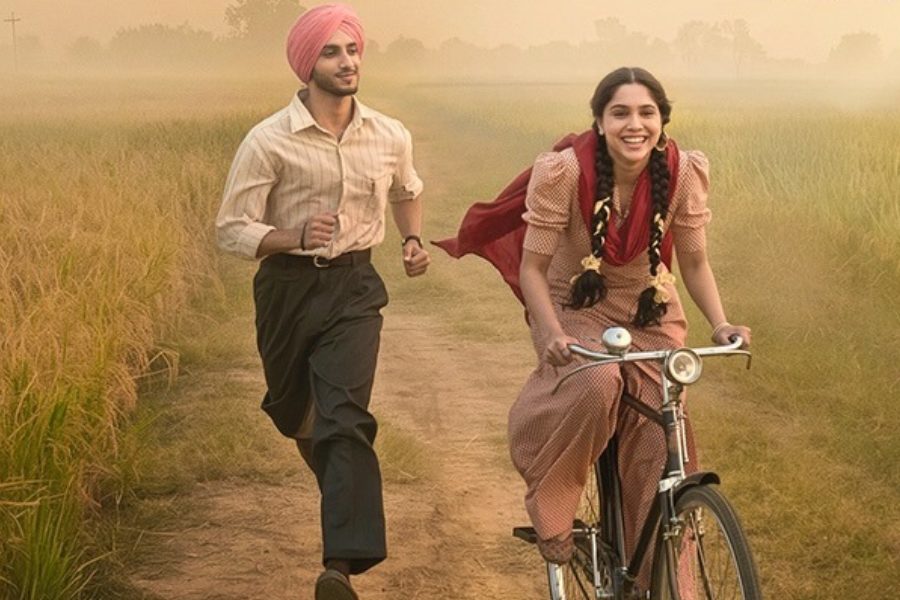
Young Keenu (Vedang Raina) is deeply in love with Jiya (Sharvari), a Muslim girl. Their romance unfolds in a world where religious identities have not yet hardened into barriers. They exchange stolen glances, secret meetings, and youthful promises that seem destined to last forever. Then comes Partition, and with it, violence and heartbreak.
The structure is classic Imtiaz Ali. Two timelines mirror each other. One explores youthful passion; the other examines the emotional residue left behind decades later. The film seeks to find an answer to the question: what happens to a love story that never gets a proper ending?
What distinguishes Main Vaapas Aaunga from many recent Partition dramas is its refusal to reduce history into a simplistic narrative of heroes and villains. Imtiaz acknowledges the horrors committed by all sides and portrays Partition not merely as a political event but as a collective human tragedy. Communities that once coexisted are torn apart, neighbours become enemies, and ordinary people find themselves consumed by fear and vengeance.
This balanced perspective gives the film much of its emotional weight. Rather than exploiting historical trauma, Imtiaz is interested in exploring how that trauma survives across generations. The wounds may belong to the past, but their echoes continue to shape the present.
The film is at its strongest when it focuses on this inherited grief. Scenes involving the elderly Ishar are the film’s strength. Shah delivers one of the finest performances of his recent career, communicating entire lifetimes of regret through a glance or a pause. Even in moments of confusion, he retains a sharp sense of humour.
Diljit Dosanjh brings warmth to Nirvair, a character who serves as the emotional bridge between generations. The actor's natural empathy makes the role work. Nirvair's growing understanding of his grandfather's pain provides some of the film's most affectionate moments.
Visually, Main Vaapas Aaunga is stunning. The recreation of pre-Partition Punjab — from the architecture and costumes to the agricultural landscapes — every frame feels carefully considered.
Adding further emotional texture is the reunion of Imtiaz with composer A.R. Rahman and lyricist Irshad Kamil. Their collaboration once again produces music that feels inseparable from the story itself. The songs do not merely accompany the narrative; they deepen its emotional undercurrents, reinforcing the film's themes of longing and remembrance.
Yet for all its strengths, Main Vaapas Aaunga suffers from the issue is pacing. The first half takes an unusually long time to establish its characters and conflicts. Imtiaz has always been a filmmaker willing to meander in search of emotional truth, but here the storytelling occasionally loses momentum.
The younger love story also lacks the spark required to fully justify its mythic importance. Vedang Raina and Sharvari are both appealing performers, and Sharvari in particular brings considerable grace to Jiya. Yet the chemistry between them never quite reaches the intensity that the narrative demands.
Fortunately, the film recovers strongly in its latter stages. As the mystery surrounding Ishar's past unfolds and Nirvair moves closer to delivering the closure his grandfather desperately seeks, Main Vaapas Aaunga finds its emotional climax.
The ending is not simply about a romantic reunion. It is about forgiveness. The film argues that memory can be both a burden and a blessing. Some wounds never fully heal, but acknowledging them may be the first step toward peace.