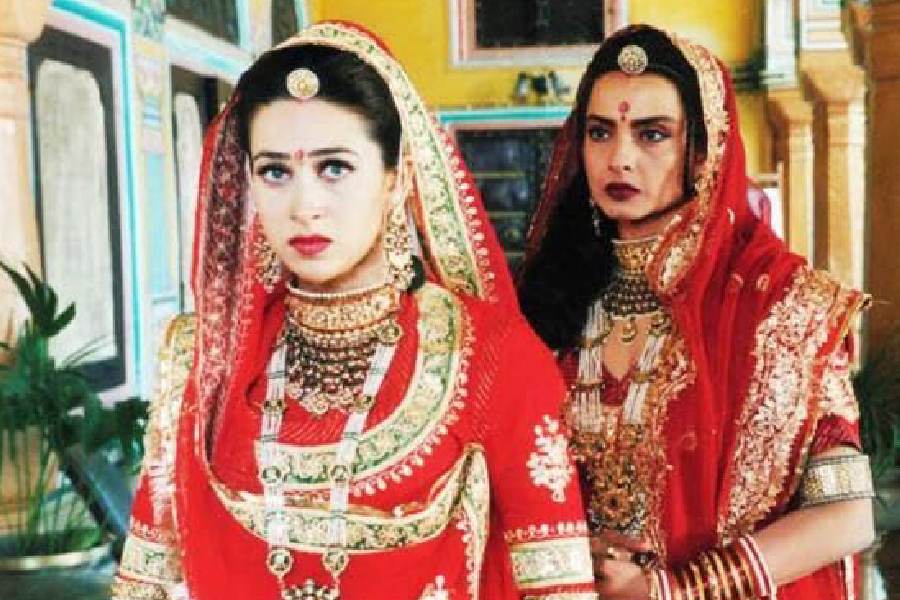
As Zubeidaa completed 25 years of its release on Sunday, writer Khalid Mohamed said A.R. Rahman’s music helped the makers recover part of their investment at a time when woman-centric films struggled for theatrical acceptance.
Released in 2001 and directed by the late Shyam Benegal, Zubeidaa starred Karisma Kapoor in the titular role, alongside Manoj Bajpayee, Rekha, Rajit Kapur, Amrish Puri, Lillette Dubey and Surekha Sikri. The film was the third part of Benegal’s trilogy on Muslim women, following Mammo (1994) and Sardari Begum (1996).
All three films were written by Mohamed and were inspired by women from his own family.
While Benegal’s earlier films in the trilogy featured music by his long-time collaborator Vanraj Bhatia, Zubeidaa marked a shift with Rahman coming on board. Mohamed said the decision was deliberate. “Both Benegal sir and Farouq felt that Rahman would give us a score that could mix the various Rajasthani folk and modern elements,” he told Bollywood Hungama.
The move, he admitted, was not without friction. “Vanraj Bhatia wasn’t at all happy about this,” Mohamed said, but added that the results justified the choice. “I don’t think anyone but Rahman could have composed a more emotionally shattering theme song, used in the background score – So gaye hain – or the ‘mehndi’ song, which is still played at weddings.”
Mohamed said Rahman’s music also helped makers recover a part of their investment. “It was because of Rahman’s music that Farouq recouped a fair share of his investment, since it was bought by Sony Music at a premium price,” he said.
Mohamed said distributors and exhibitors were wary of backing the film. “It’s to the credit and the courage of its producer Farouq Rattonsey that he did not pay any heed to the discouraging distributors,” he said, adding that there were suggestions it be released “only at a limited number of cinemas for morning shows.”
According to Mohamed, theatre owners were equally hesitant. “Not many theatre owners were willing to take the risk of showing ‘a woman-centric’ film,” he said.
“Even after Zubeidaa became a favourite, especially women audiences, all OTT channels were refusing to acquire it for streaming,” Mohamed said. He described what he called a “vicious system” of bulk acquisitions and alleged that pirated, poor-quality versions circulating online may have hurt the film’s prospects.
The film eventually found a streaming outlet on YouTube. “At long last, it was sold for a piffling amount of money to YouTube, which is streaming Zubeidaa in a spanking new print,” Mohamed said.
He added that he had written a sequel titled Rutba, revolving around the murder of his half-brother, Rao Raja Hukam Singh, son of Zubeida Begum and the Maharaja of Jodhpur, but it “didn’t find any financial backing”.