
Ever since the announcement in October 2016 that Arundhati Roy would return to fiction the following summer, 20 years after creating a God of Small Things-shaped place in our hearts, I began dreaming. That once this new book — curiously titled The Ministry of Utmost Happiness — was out, I would go meet Ms Roy and chat with her (er, interview her I mean, as a journalist, not gushing fangirl, of course). Book came out, interview was set up and I landed in Delhi, ready with a set of carefully curated questions. But while I was on my way to Guppy by ai, a Japanese restaurant in Lodhi Colony that she had picked for our interview, I chanced upon a YouTube interview of hers from a few weeks back. And the fangirl threatened to take over!
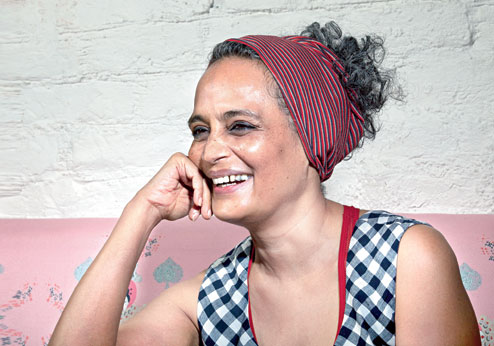
Arundhati Roy, in sleeveless checked cotton kurti, breezed in with a smile and a firm handshake, her mass of grey curls held back in a colourful bandana. Black-coffee-milk-on-the-side ordered, she was all mine.
I was all prepared with my questions when I saw one of your interviews given in America and one thing you said made me so happy that I want to first talk to you about that. You said that if their story had ended differently, Tilo (S. Tilottama of The Ministry of Utmost Happiness) could be the child of Ammu and Velutha (from The God of Small Things)!
(Smiles wide) Obviously it was a notional thing... it was a notional thing in my head....
You know as well as I that even though people look at India as kind of this anarchic, crazy place, it is, in fact, not at all anarchic. The anarchy is on the streets and in the traffic... but otherwise, this is actually a society that doesn’t even live in a grid, it lives in a mesh. Of caste and ethnicity and all that... and any kind of trespass is so ruthlessly put down. And you know that The God of Small Things is a long passage about the jam-jelly question and how they all crossed into forbidden territory. And in this book, it’s only something I realised afterwards, that all the characters actually have the borders of that mesh running through them... they are not inside (the mesh).
Whether it’s Anjum, who has the border of gender running through her, or Saddam, who has the border of religious conversion and caste, or Tilottama, who has the border of caste, or Musa, who has the national border... in a way he’s the straightest because his borders are obvious and geographical. Or even Garson Hobart (aka Biplab Dasgupta). He has a kind of... the Hindi word for it is thhehraav... the ability to wait and watch and analyse and give a historical perspective of the state. That’s half of him... and the other half is a sort of shambling, thwarted lover. But always self-deprecating, aware of his own shallowness. Politically he has a kind of depth. A person who picks his battles, isn’t a man of instinct....
So ya, Tilo is one of a cast of characters who all perhaps have their own The God of Small Things stories behind them (smiles wide).

Okay, now on to my list of questions. Congratulations on writing your second novel! And for the Booker nomination...
Well, it’s not technically a nomination yet. It’s the longlist... a pretty long list... (laughs).
It’s a short longlist of just 13! Does being on it bring a sense of déjà vu?
They are so different, you know. For the first book, I wasn’t even really aware of this machinery (of prizes)... it just happened. This book (being on the longlist) in a way, surprised me because it’s such an experimental, risky book. But so was that (The God of Small Things).
So, what was the germ of the idea 10 years back that became The Ministry of Utmost Happiness?
Well, in a way, you know, in all those 20 years of travelling and writing and arguing... really it was 20 years of putting forward a kind of argument in my non-fiction... but in those years of travelling, there was a sort of layered universe building up in me, very different from an argument, very full of the idiosyncracies and the complications and the things which aren’t necessarily reasons, but these universes through which I travelled, so it had started building up in me... become some kind of a layered sedimentary rock (laughs lightly).
But I think perhaps the germ... the first thing I wrote in The Ministry of Utmost Happiness was.... I used to spend a lot of time just hanging about in Jantar Mantar late at night, there were all those people — students and nutjobs and all of that... [“Communists, seditionists, secessionists, revolutionaries, dreamers, idlers, crackheads, crackpots, all manner of freelancers, and wise men who couldn’t afford gifts for newborns...” is how they are described in Ministry...] and actually a baby appeared one night. Nobody really knew what to do. That made me think about the complexity and beauty of that moment, and the sadness and loveliness, all of that... that was when I started to write.

Oh, what happened to the baby?
Actually the police took it. I was sorry to see that. In my mind someone else took it... may be I took it (laughs). [In the book, before the police arrives, Tilo picks up the baby and runs. She later names her Miss Jebeen the Second.]
How did you pick up the people of your Ministry? Did you meet them during your travels and they never left you, or did you court them and offer them a place in your Ministry?
Umm... well, eventually they came to me and refused to leave. All of them have a germ of, you know, complicated aspects of things that have happened to people that I’ve met, who then grew into somebody else or something else... it’s like a little grain of sand in an oyster, where you are secreting stuff around it. But eventually it was a little insane, because they became more real to me than real people and it became a world that was more real than the real world.
While choosing a publisher, you had said you need to consult the people of the book… tell me, what is it like living with an Anjum, a Tilo or a Saddam Hussein in your head… for 10 years?!
No, they are not in my head, they’re in my house (laughs)! Now they are probably in other people’s heads and houses too. In fact, yesterday a friend of mine was showing me a Facebook post by someone who had got obsessed and gone and visited all the places in the book... and then he said, ‘now I have started adding my own characters to the book’ (laughs). Like Anjum says, everyone is welcome....
But she also turns away people for no reason, no?
Ya, ya ya... she’s an unreasonable woman (laughs)!

But why did your friend (writer-poet) John Berger have to make you show him the fiction you were writing? Didn’t you want to publish this book?
No, no, that was while I was still thinking about it and writing fragments of it, so it was years ago. He sort of surmised from my possibly secretive and elusive manner that there was something going on that I wasn’t telling him about. So, one day he said, ‘Okay now, enough. Come on, open that computer and tell me what you are doing.’ And it was still developing, still fragments, and he said, ‘You know, this is the thing you gotta do... go and do it!’
But then as soon as I came back, with all my intentions of finishing it, I got this note under my door asking me to go to Chhattisgarh, and then you know how it happens... you write something and it leads to things. So, eventually, when I finished the book, it was many years later. I knew that John was fragile and wasn’t for this room much longer. Almost the first thing I did was to go and give him the manuscript.
[Berger passed away this January.]
The cover is stunning in look and feel. What was your brief to Mayank Austen Soofi, who shot the cover, and book cover designer David Eldridge?
My idea and my brief to Mayank was that it has to be a tombstone of some kind. Because apart from the borders that are running through the characters in the book, there’s also somehow the liminal space between life and death and the comings and goings and all of that.
I’ve spent a lot of time wandering through these spaces... and there are lots of spaces in Delhi where actually people do live in graveyards... lots of places, it’s not just one or two places. I’ve been to many of them, sat around chatting to many people....
And then Kashmir too, where there’s this sense of how present the dead are... and so to me ‘utmost happiness’ and a gravestone were not inimical, they belonged together, in some ways.
I also went with Mayank to many places where these pictures were taken.
And my brief to David... I mean (smiles) I didn’t have anything to do with him really for 20 years after designing The God. I didn’t even know if he was still designing. I said, ‘Hey, only you can do this...come.’ And I wrote him a long letter about what I was thinking about, the idea of the militant rose... the rose that’s on a grave, not the beautiful English rose but the broken rose that’s still standing and still means something in those places.
I sent him a lot of pictures... and he was phenomenal, in the sense that he just didn’t get... you know how some designers can get fed up of constant interference? Well, he was like, ‘Keep it going. Anything you like.’ So, right up till the end, the texture of the stone and all of that was a constant conversation between us. And he was completely on the same boat. So he was really happy to be micromanaged (laughs out loud) and that was really lovely.
Why do you say ‘militant rose’? That’s a very interesting phrase...
Because, you know, a lot of the graves in the book are the graves of people dying in struggle or having been killed in this very unseemly communal situation either here in India or there, in the battle in Kashmir. So there’s a militancy to the graves that I write about, not militancy only in the Kashmir sense of the term.
And there’s a militancy to Anjum and the Jannat Guesthouse too, you know, despite all odds. A militancy to carve out a life for yourself there, in the face of everything... and not for it to be the life of a martyr or a life of flared nostrils... just a life of anarchy and beauty and love too... is a militant thing, in the face of all they’ve been through, in their own ways. Kashmir, who’s buried in that graveyard of course I talk about... but who’s buried in this graveyard, in Anjum’s graveyard, is very interesting. From Tilo’s mother to Comrade Revathy to all Anjum’s friends from Khwabgah to old relatives....
The title of the book is very intriguing…
The title is actually not satirical, you know. I think eventually what happens in Jannat Guesthouse, the kind of transcendence and momentariness of happiness, the temporariness of it and the ability to celebrate it when it’s there and mourn it when it’s gone… but not to consecrate it in some way or formalise it, that place between death and life and happiness and deep grief and loneliness… it’s all there, constructed in a place where, I think, metaphorically, the human race lives right now, in a kind of graveyard… because that is what is going on in the planet today. And unless we move it forward from there, we are really being pushed into that space right now.
THE WRITER

Can you take us through the method or madness of your writing?
As time goes by, I probably make it sound saner than it was (laughs)... but it was actually quite strange because I have all these random notes and things that I have been making over the years... handwritten notes, newspaper clippings, strange sentences that I would come back with, instead of the vegetables I had gone to buy... and even I would get worried about myself when I saw them (giggles). Because they were not pieces of research or anything, they were very angular, peculiar observations, may be about the sky, or somebody I met or something I saw, or something I had dreamt. And initially they really scared me, because I was worried for myself. And yet, when I look at them now, what scares me is that they are all in the book! And sometimes they were so random that I didn’t know why I was looking at this particular thing. It was almost like there’s a subconscious track which I wasn’t aware of, where these things were falling in place.
When do you write... early morning, late night, or any time the mood strikes?
I think the dangerous thing is I write all the time. It’s not as if I have to be sitting at a desk with a computer or pencil and paper, you know. I was just telling a friend that the last three weeks I feel as if I am really sleeping, after 10 years. Like your mind is just all the time trying to put things in place in some way... so, in a way there’s that constant process, then there’s the actual discipline, which is very, very solid for me.

So you are a disciplined writer?
Extremely disciplined, insanely disciplined. So it’ll be like every morning, after exercise, just sit there and be there, till about 3 or something. The last two years, of course, it was 24x7.
Do you write on a computer or by hand?
I do both. I suppose it’s because of the architecture part [she studied architecture at the School of Planning and Architecture, Delhi]... I love writing longhand and sketching and drawing and designing my press releases and newspaper clippings before I put them in (laughs)... but I’d say a lot of work on the computer.
Music or total silence while you write?
Total silence.
Do you sip or munch on anything?
I tend to burn the things I try to cook... almost had a couple of bad fires because I put things on the stove and forget! I do some coffee but... for me the food and cigarettes and all of that is replaced with this very militant routine in the gym, you know, it gets me centred.
THE READER
Can we talk a bit about your journey as a reader? Do you remember the first book that struck a chord with you?
Of course I do! I think the first thing that struck a chord in me was the great White imperialist, Mr Kipling (laughs out loud). And very, very early on, for some reason, I was started off on Shakespeare. In fact, I’ve just come back from Kerala, so I met my first English teacher there. She was telling me, ‘I don’t know what we were thinking but you were nine when we taught you The Tempest’ (laughs).
And you’ve always been a big reader?
No, I wouldn’t say so, actually. It’s not like as if I have a big turnover and I read everything... I don’t. And sometimes I read the same things over and over. Now I am reading this book that really kind of churns you up. It’s a memoir, it’s in two parts and I had read the first part a while ago and I was really having trouble finding the second part. The widow of Osip Mandelstam, the Russian poet. She’s written a memoir about the Gulag… so disturbing. It’s about saving poetry in the midst of absolute horror (Hope Against Hope: A Memoir).
So, how do you pick your books?
Smell (laughs)!
You said sometimes you read the same things over and over… which books are those?
(Pauses) Well, Berger’s books…. But you know, whenever people ask me about books I get so worried… my mind just goes blank! I have these towers of books and I am thinking what do I say?!
[I tell her that this happens all the time when I am interviewing authors… they say ‘the books are right on my nightstand but I can’t recall a single title!’ She nods and laughs.]
I dip into things and dip out of them, you know. Poetry and all that… Aitmatova I’ve been reading, Proust I’ve been reading… and Kessler. I seem to be obsessed with the Gulag these days for some reason (laughs). I don’t know… what does it mean?! (Grins mischievously)
I read your non-fiction articles and essays as the obvious successor to The God of Small Things, and now I read Ministry as a natural extension of your essays. Do you see it that way too?
I am sure they all belong to a universe but I feel that the essays were always an urgent intervention in a situation that was closing down. If you actually look at when they were written, when they came out… starting with The End of Imagination, which was written at a time when everybody was exulting in these nuclear tests… and I somehow was seeing the beginning of something terrible. Even just a terrible new public language. And I was being celebrated as this great… whatever… Miss Universe in the literary world and I just wanted to step off that train! I found it very distressing. And then it led to so many others. But they’re all very urgent interventions.... Whereas, The God of Small Things and The Ministry of Utmost Happiness are universes. It’s not an argument, it’s a construction of a universe. But obviously informed by all those journeys I have made.
This book has been received with a lot of enthusiasm as well as criticism. Do you read reviews?
So was The God of Small Things (smiles). It was the same. And that’s good. I mean this is a spiky book... it’s not easy. Some people might find it extremely uncomfortable, and that’s fine. One is not looking for some consensus or standing ovation every time you do something.
And it’s also the kind of book, I feel, that takes many readings… it’s not baby food (smiles). The structure is not some accident, it’s very carefully thought out, it may not work for some people, but it was also a risk. Which is why I never went in to sign a contract with some publisher and take a big advance, because I wanted to experiment. And I knew that it would be something spiky and experimental.
There’s one line in the inside flap that says this book ‘reinvents what a novel can do and can be’. What were you trying to with this novel?
I felt that after you write a book like, say The God of Small Things, and whatever happened to it happened to it, and then you have two choices, you know. One is essentially to write ‘The God of Small Things 2’ or ‘The Son of the God of Small Things’ or, to roll the dice. And I didn’t want to do that again. I felt that somehow even though I had sort of sidestepped it, because after I wrote God and it won the Booker and I was a prime specimen for big advances and book after book after book, I just backed out. Because I felt the danger of domestication. And fame can domesticate you like nothing else. Everyone sort of decides ‘this is who she is, this is what she writes, and this is how it should be.’
And I felt that somehow the moment now has changed. I was uncomfortable with the idea that ‘now this is the theme’, this book is about caste, or about X or Y… some sort of NGO funding subheading.
Also creative writing schools have created that perfectly comfortable universe and that very capable language and that very measured intimacy and all that… and to me something wild is going on, you know, something broken and uneasy and crazy… how does fiction deal with it? How do we break out of that straightjacket of what it’s meant to be and how it’s meant to be, perfectly confected, perfectly based, perfectly structured thing. How does it get elbows and knees and is not a pet that you are taking for a walk….
Finally, as a huge fan of God, I want to ask a slightly strange question: Would Rahel and Estha be welcome in the Ministry?
Oh ya, for sure. They would have a little room with a little grave… (laughs).