
I don’t know why I did not read Roald Dahl’s Charlie and the Chocolate Factory or Matilda or The BFG when I was growing up in the last century. I don’t remember any children’s book by Dahl, who turns 100 on September 13, among the many shelves at my school library that were bursting with Enid Blytons. Blyton was the first British writer I thoroughly read, then went straight to Sidney Sheldon, who introduced me to America. Maybe it’s the publishing industry’s fault. Or the school’s. Or the scanty globalisation of my childhood.
So by the time I came to Dahl, and met his Uncle Oswald, and read Skin, I was in high school. Entering his creepy adult world, at once sinister and seductive, I think I — and all my girlfriends who were in his thrall — felt the fascination of Mina first meeting Count Dracula. Though I later came to know that Dahl was gorgeous and totally non-creepy in his looks.
But I am glad that as a child I didn’t read his stories for children, for I am discovering them now, with my daughter who goes to junior school. Discovering a fabulous author is like the early stages of falling in love, of which one can never have enough. My daughter glows after finishing every Roald Dahl. I suspect so do I, a bright shade of orange.
Dahl’s child heroes, between ages six and 10, a significant number of them girls, are exceptional characters. They are found in the toughest of situations, but they are tough little adventurers themselves, seeking out a universe of their own, or making them — with magic, or dreams, or whatever it takes — and working out their own resolutions. As a grown-up reading these stories I find that Dahl’s children often inhabit the very world that he writes about in his fiction for adults: it is as full of perversities, crime, monsters, and loneliness — only at a different tilt. The children are not the perpetrators.
Dahl in his children’s books often brings up that other writer of childhood, who too writes about perversities, crime, monsters, and loneliness — Charles Dickens. If Dickens had George Cruikshank as his illustrator, Dahl had Quentin Blake. Both their stories abound with orphans. And both write of the deep delights that persist despite everything.
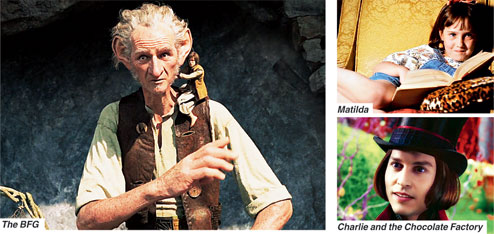
Like the stuff from Willy Wonka’s magical chocolate factory (in Tim Burton’s film Johnny Depp is Willy Wonka, dark and dazzling). The location of the factory is important. It is the most terrible torturing thing for Charlie Bucket of Charlie and the Chocolate Factory, for it is not only in the same town where he lives, but also within the sight of his house.

Here Charlie’s house needs a little description. The seven members of the Bucket family — Charlie, his parents, his father’s parents and his mother’s parents — live in a tiny wooden house on the edge of the great town. They are very, very poor. The house has only two rooms and only one bed. So the four grandparents live in the bed, never getting out of it, and Charlie and his parents sleep on the floor. Charlie’s father is the only person who works — in a toothpaste factory. They have mostly cabbage, for all meals, with a second helping on Sundays. So all of them, especially little Charlie, go about the whole day “with a horrible empty feeling in their tummies”.
On top of it, the thing that Charlie adores most and can afford least is chocolate, and the chocolate factory stands right there. Willy Wonka’s is the world’s largest, most famous and best chocolate factory, looming enormous behind huge iron gates, and mysterious and forbidding — from which come out sweets that are scrumdiddly-umptious (a BFG coinage) and seem to have a life of their own while being reputed to have been made by an invisible people.

The intensity of Charlie’s torture reaches its height twice every day when he has to walk past the factory on his way to school and back. “And every time he went by, he would begin to walk very, very slowly, and he would hold his nose high in the air and take long deep sniffs of the gorgeous chocolatey smell all around him.”
It is the most delicious torture and how Charlie longs to be inside one day! But he will one day — and if you don’t know how, if you can afford to read Charlie and the Chocolate Factory and haven’t yet, then you are very poor indeed!
Matilda, in Matilda, is no less magical. Ill-treated and utterly neglected by her selfish, mindless, TV-addicted family, and left alone every afternoon — she is a virtual orphan — Matilda retaliates by reading. By the time she is four, she has read up all the children’s books in a library and jumps straight to Dickens — Great Expectations, which is, of course, about another famous orphan. She reads Nicholas Nickleby and Oliver Twist too, and is soon done with a whole lot of books for adults. It gives her a peculiar strength to deal with Mr and Mrs Wormwood, her parents, and also Miss Trunchbull, the giant headmistress, who would have been a man-eating bone-crunching monster in another time.
But in the end, the lesson to be taken away is this. Parents, be warned. If you thought that only you could leave each other, or your children, think again. A child can say no too.
Matilda was made into a sharp, moving but underrated film by the actor Danny DeVito, who cast himself as the crook-salesman Mr Wormwood.
Meanwhile In James and the Giant Peach, a rhinoceros escapes from the London zoo and eats James’ parents.
It is tempting to read correspondences between Dahl’s own childhood and that of his young heroes. The similarities are not obvious, but Dahl had his rough patches, too.
He had a remarkable family. His father Harald, a Norwegian who had travelled to England and set up a successful business in Cardiff, South Wales, UK, had lost his left arm as a child because he had been given the wrong treatment by a drunk doctor. Harald died young, leaving his young wife Sofie — Dahl’s actress-granddaughter has the same name, and so does one of his young heroes — to bring up six children, two from his previous marriage, in a foreign land. This she did with tremendous courage and Dahl remained very close to his loving family his entire life, especially to his mother. But he had his share of ups and downs.
His early life could be a source of his characters, too. Mrs Pratchett the sweet-shop owner in the first part of his autobiography Boy, Tales of Childhood, could be a model for Miss Trunchbull. One school Dahl attended was a perfect little laboratory for the authorities to conduct sadistic practices on little boys, with strong sexual overtones. Quite early in life Dahl learned the importance of keeping his own head, not losing courage — not to mention sweets.

Not in a nicey-nice way. He was ruthless in the manner in which he wrote every day (Dickens comes to mind again). He cut himself off absolutely to be in his “Writing Hut” for hours. It was never cleaned because no one else was ever allowed in.
Matilda and Sophie are ruthless too in the way they go about freeing themselves from their oppressive, little lives. This ruthlessness is crucial to writing or to any act of imagination.
So when my daughter and I recently watched The BFG, Steven Spielberg’s film on Dahl’s novel of the same name, we were moved. It is about yet another orphan, a true-blue one, Sophie. In the film she is reading Nicholas Nickleby when the BFG, the Big Friendly Giant, materialises at the window in the dead of night, at witch hour. The BFG, who speaks in an inventive, semi-nonsensical English, which sometimes seems to gently question the assumptions of the Queen’s English, which, in the book, he has learnt from the only book he has and is always reading, Nicholas Nickleby, is the maker of dreams. He is the one who blows dreams into sleeping humans every night. He and Sophie change the world together, with the help of — who else — the Queen.
It could well be that the big friendly creature materialises out of Sophie’s giant loneliness, out of that “horrible empty feeling”. In the film too, Mark Rylance’s BFG, a shy, lonely creature with the gentlest eyes, is indeed a little girl’s dream come true. But my eight-year-old said she liked the book better than the film. Because, she tried to explain, in the film, everything was done for her. She had nothing to think about.
The image, already formed, is less than the imagination. That is why the best of computer graphics fall short sometimes. Especially because it is the best of computer graphics.
Long live Roald Dahl. May he be there for our children’s children, too, giving them dreams that work.
If I had to pick from Roald Dahl, Enid Blyton and J.K. Rowling, I would.... Tell t2@abp.in