A FANGIRL ON WHY SHE’S A ‘GONE’ GIRL WHEN IT COMES TO THE DELICIOUS DARKNESS OF GILLIAN FLYNN
 |
I have been a “gone” girl ever since I picked up Gillian Flynn’s third novel last year. Gone Girl is the story of Amy, who goes missing on her fifth wedding anniversary, and her husband Nick, who is the prime suspect.
As the author became Nick and Amy in alternating chapters, I went along with her, knowing full well that I was being had. Nick wasn’t just a lazy husband stuck in a marriage of one-upmanship, and Amy couldn’t possibly be the honey-and-cream little wifey “with an adopted orphan smile” as her diary would have us believe. A crime novel is one of the few places where we pay to be taken for a ride.
So there I was, merrily riding along, hoping for Amy, not her body, to turn up. But the mesh of lies and deception that Flynn weaves, along with her fascinating cast of characters, meant I was up all night, feverishly trying to get to the end. Was such evil possible for regular people? Just imagine being married to this character! Even worse, just imagine being married to someone who can think up such a character! That’s when I think I was a goner.
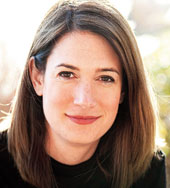
I googled Gillian Flynn. The picture that popped up added to her appeal. Not because she’s pretty — which she definitely is — but because there’s something decidedly sinister about someone with that glowing face, freckled nose and golden-brown hair manufacturing such malevolence.
 |
I was piqued to know that Flynn, now 43, was herself a film and TV journalist in New York when one fine day she got laid off because of the recession, just like Nick in Gone Girl. And she sure looks like Amy. No wonder she has them down pat. Flynn is married to a lawyer, Brett Nolan, who is her first reader and gives her “honest” feedback, she says. Brave, brave man. They have two kids, a four-year-old boy and a two-month-old girl. Wonder if she’ll hide her books once they are old enough to read. Well, I would.
 |
As devilish as the end of Gone Girl is, it could’ve been better, may be a tad more believable. Flynn has written the screenplay for David Fincher’s cinematic adaptation of Gone Girl and a few months back, she let on that the film would have a twist separate from the book. I can’t wait.
But wait I had to for Ben Affleck to become Nick (I didn’t much care for Rosamund Pike as Amy; I really hope I am wrong), and started on Flynn’s second novel, Dark Places (2009). As she recently told The Guardian, “If you are someone who reads books to feel like you have a friend on the page, my book is not going to be the book for you”.
Oh yes, that sure can be said of Libby Day, the central character of Dark Places. She’s a 30-year-old now, having survived a massacre that killed her mother and two sisters when she was seven. Her 15-year-old brother Ben gets a life sentence based on Libby’s testimony. Did that scared little girl speak the truth? But more than the truth, Libby is concerned about her depleting victim fund, which was set up with public donations after the massacre. She thinks she deserves it, she’s angry with another little girl’s misfortunes, which she feels ate into her sympathy booty. She doesn’t want to get a job or be grown up. She has no qualms in selling family memorabilia to members of a kill club obsessed with finding out the truth and freeing Ben.
The mystery behind who killed the Days aside, there is Flynn’s chilling depiction of Libby’s Midwestern childhood on a failed farm in Kansas with a mother who can barely afford one child but has four. The children are not little rays of sunshine as popular myth would have us believe but miniature monsters just as capable of cruelty, selfishness and duplicity. And then there’s the teenaged Diondra, who made me shudder. This book too is headed for the big screen, with Charlize Theron as Libby, Christina Hendricks as her mom Patty and Chloë Grace Moretz as the young Diondra.
Flynn’s America is so far removed from the America we see in Modern Family, Grey’s Anatomy or even Homeland that it could well be another country.
Take for instance Wind Gap, a forgotten dot on the Missouri map where Flynn sets her first novel, Sharp Objects (2006). Camille Preaker, a journalist in Chicago whose own childhood demons haven’t been tamed, must return to Wind Gap, her hometown, to report on two girls gone missing.
Wind Gap seems like a place where hope would go to die. If the dark side of children made up Dark Places, the mother-child bond in Sharp Objects sent a chill down my spine. This was Flynn at her twisted best, I felt, with a raw freshness that would soon mature into a Gone Girl.
With the film’s release, the book sales for Gone Girl have shot up again. In any case, it had been firmly perched on the NYT bestseller list for 97 weeks, now it’s back at No. 1. If you haven’t read the book, buy it but don’t read it yet. As The Times, London, reviewer says: “Those who have read Flynn’s book will know where Gone Girl is going, but I envy viewers who come at the material fresh.”
The film releases in Calcutta on October 24. The buzz is that there’s all of Ben Affleck to feast your eyes on. Sadly, the nudity scene is unlikely to make it past our (Swachh Bharat) censor board. Never mind, the rest of him is delicious enough. And the story deliciously dark enough.
Samhita Chakraborty
Have you read any Gillian Flynn novel? Tell t2@abp.in
T2 TOURS THE REVAMPED CLASSICS SECTION AT STARMARK, SOUTH CITY
 |
The revamped classics section at Starmark, South City Mall, is an English literature lover’s delight. Well, we might often repeat the mantra ‘Don’t judge a book by its cover’, but let’s admit it, an array of beautiful covers in a bookshop makes for a happy sight. Here’s a few classics that are worth checking out.
Pelican Shakespeare: Penguin has dedicated three series to the Bard of Avon and one of them is the Pelican series, the best at least in terms of cover design. For those who find reading Shakespeare a tad tedious, the cover art will ease the pain a bit. The price is reasonable as well, with most titles available for Rs 250.
Wordsworth Classics: We have all grown up reading books from this series but now there’s a new set, mostly children’s classics, and they come with lovely cover art by Claire Ruddock. You can find all your beloved titles, from What Katy Did by Susan Coolidge to Swiss Family Robinson by Johann David Wyss and even a few elusive titles like Charles Perrault’s Fairy Tales and The Enchanted Castle by Edith Nesbit. Again, prices are great, most of them within Rs 150 and Rs 200.
Giants Classic Library: The books in this series remind us of old libraries with a huge fireplace and an overstuffed armchair beside it. Though without any cover design, these hardbound books smell and feel ancient, minus the termite-ridden, yellowed pages. You can find all your old faves like Daddy-Long-Legs by Jean Webster, Three Men in a Boat by Jerome K. Jerome or The War of the Worlds by H.G. Wells here for Rs 200 each.
Wilco Classic Library: The books in this series are simple, with monochrome covers in everything from yellow, blue and purple to a soothing shade of bottle green. Reading Dickens or Austen will be even more pleasurable with these.
The Harper Perennial Forbidden Classics Series: Earlier, one would either have to order them online or visit bookstores in other cities. The books are shocking and explicit and were understandably forbidden at one point of time. Whether it is the scandalous Fanny Hill with vivid descriptions of sexual pleasure by John Cleland or the anonymously written Sadopaideia, a classic tale of sado-masochism at the heart of English society, you can find them all in Calcutta now. There are nine titles in this series.
Abhinanda Datta
Pictures: Pabitra Das