How many fans of Diesel in this room?” asks Sabyasachi Mukherjee, and the hall explodes in shouts. “I too am a Diesel fan and the company is not paying me to do this, I am doing this because I am a fan,” he laughs. Over the next one hour, Sabyasachi took the audience through the career graph of Diesel chief Renzo Rosso, pepping it up with anecdotes from his own life as a designer. t2 sat through the chat at the Lakme Fashion Week Summer/Resort 2016 in Mumbai. Excerpts...
Sabyasachi: I have a house help who comes to water the garden, he wears Diesel too. Only it is spelt d-e-g-e-l (laughs out loud)… well, so it is all over. Now getting to the man. They say, very early in your life you show big signs of becoming an entrepreneur. I started selling jewellery while I was in school, I used to sell jewellery out of tiffin boxes when I was 16. Mr Rosso started earlier on. He was given a rabbit by a friend, and instead of eating the rabbit he turned it into a business. So tell me about it.

Renzo: It was a present from a friend. I got it home and then I started breeding rabbit at home and selling them. I went up to 120 rabbits. So that was my first business.
S: Many entrepreneurs all over the world have the same evolution. When I was reading about Mr Rosso, I found a few similarities in our lives. When I first started designing, my store was on the third floor of my parents’ house… there was no elevator, there were no racks, the clothes used to hang from curtain rails. Mr Rosso also started his business from his bedroom. He started by making jeans for his friends on his mother’s machine. Do you know who was your first customer?
R: Myself. It was very special… it was a super skinny pair of jeans, with big pockets… distressed. And that’s what I wear every single day of my life. So that was the beginning of my business.
S: As they say, big entrepreneurs can’t hold on to their first jobs. So when I finished studying at NIFT, I got a scholarship to study in Nottingham University, which I turned down. I took up a job and was fired in one week. Mr Rosso, too, was fired from his first job, they said he was very lazy. He was taken in again, and then he over-performed and after that he resigned. Can you tell me about it?
R: I was very young… it was a jeans factory and my job was checking and matching…. I was waiting to go into the army, so I got into the job just for enjoyment. I was working but not convinced about it. So one day he fired me. His wife loved me, she said, please, please give him an opportunity… so he gave me one more possibility, but this time he started paying me by quantity of jeans produced. Then I started working and in three months I met my targets and was overachieving my target. So then I said, thank you, but now I want to have my own jeans brand. He offered me a partnership in his brand, which I didn’t take up because I wanted my own brand. After that I started Diesel.

S: October 6, 1978, the brand Diesel was born. A lot of people didn’t like the name. They thought it was a terrible brand, it was industrial, it was almost dirty. But Renzo loved it. Let’s hear from him why.
R: Well, I was looking for an international name. There was Levi’s there, which is like my grandfather. If Levi’s wasn’t there, I wouldn’t have been there. Even after I launched Diesel, I wore Levi’s jeans every day of my life till 1985. Because 1985 was a big change in my life, in terms of production in Diesel. Anyway, coming back to the name, Levi’s was short, elite and easy to pronounce. So I was looking for something simple, short and easy to pronounce and one particular moment I thought of ‘diesel’. I thought of the diesel engine, and how it warms up slowly and then gains power to go more and more.
S: So, after his brand is doing well and he finds a name for it, what a good entrepreneur does is he tries to find a logo. So what Renzo did was, for his logo he found a Mohawk, which was very edgy, very cool… it’s got the whole world’s imagination behind it.
S: I read in a book on Renzo, that he’s a great HR. He hires people with his heart, not his head. So I want to ask Renzo, how do you do it?
R: I am looking for something different, something fresh in people. One night I walked into a bar in New York. I met an absolutely crazy guy who ended up pissing on the bar table. Next morning I hired him… and this was the guy who gave me the most incredible innovation in design. I hire people from everywhere, when I see someone who loves and believes in what they want to do. I think my strength is to convince people. I look for people who don’t work for themselves but who love to work in a team. In the village where I live in Italy, people come from all over the world to work for me — US, London, Japan….
S: Fantastic! I must be doing something wrong, I don’t get anyone to come and work in Calcutta. I only get bored housewives at airports (starts laughing).
S: When you are a young entrepreneur, it is difficult to get retailer and distributors to sell your stuff, they only want to go by past records. So how did you do it?
R: In the beginning it was very, very difficult to sell our products. But we were selling everywhere… in London, Paris, Stockholm, Munich, but the US was the most difficult. When I arrived there, even the journalists attacked me... who is this stupid Italian who wants to sell jeans in our country? And I had to explain why my jeans was expensive… the quality, import duty. But I convinced a big store in one of the poshest parts of New York to stock my jeans; it was a store selling bags and shoes, but I convinced them to keep my stuff.
S: Investors always want to support successful businesses, nobody wants to put their money on stories that might become successful. But at a time when nobody even knew of distressed jeans, you found your investors pretty early… your supply chain was very supportive, everybody wanted to help you. Why?
R: Because I was very serious. I have gone to Germany with trucks full of denims and sold them and came back with money. I was so happy then…
S: One of his guys in Germany made so much money selling Diesel that he gifted Rosso a Porsche…
S: Let’s talk about Calcutta, because there’s a connection. Calcutta was never regarded as a very strong fashion capital… Delhi and Bombay fight on who is the fashion capital, that’s a little debatable, but we are regarded as a village. When I started my business, I had the option to move to Delhi or Bombay and I chose neither, I preferred to stay back in Calcutta. Because I have a very unique notion — that if you stay away from the main fashion industry, you have a voice that is your own, you stay naive and uncorrupted.
He comes from Bassano, a small little village in Italy. He had the option of putting his headquarters in Milan, but he tells us a very unique thing… he says because I live in Bassano, every time I travel the world, I feel like a child and I have so much gumption inside me to see everything in a very new way and I never get jaded. So this was a very conscious choice for you to set up the business in Bassano?
R: It was not where I was born, but I arrived there for my first job. And I was so impressed. How nice the people were. Like you don’t know anybody, but you see them in the park, in the supermarket… very nice people. And very good workers. I had the option of changing my company’s headquarters to Milan… in fact it was difficult to bring in dealers from New York, London, Paris to Bassano… but at the end of it, our incredible success brought them in. When you want to do research in the market, you need different eyes… when you are going out you are so hungry to see everything, to bring back something.

S: Fifty years later, Renzo how would you like to be remembered?
R: I would like them to remember our group, because it is no longer just Renzo today. We work in a very good team and everyone is important. We share all the positive and the negative things.
S: You have done so many groundbreaking things to support talent. You’ve started the International Talent Support, an award for talented people from all over the world. Can you tell us about it?
R: The young people, for me, means innovation… everywhere. The success of my group is thanks to the young people… they give me so much innovation, so much creativity, they do such crazy things. So every year I go to schools for the International Talent Support because I need young talent. I am 60 now, I learn so many things from them. These young people keep you alive.

S: When I was starting out, there was a fashion show in Calcutta, with Madhu Sapre and Milind Soman, inside a store.… I had never been to a fashion show then. The store was called Ogaan, it had just come to Calcutta. I went back home, and came back with my portfolio the next day and of all people, I showed it to the security guard. I said one day I am going to become a big designer and sell my clothes here, he said yeah yeah, go home. So I went home heartbroken and told myself that one day I am going to own that store. The store is a few blocks away from my parents’ house.
So when the store was getting sold, they called my father and said, ‘We hear your son is doing something in fashion now, so would you like to buy the store?’ I had no money and no clothes to fill up the store. It was a 5,000sq ft store, but I was always a bit of a gambler. So I bought the store, much to my father’s annoyance, who was also the CFO of my company, he still is. I said, let’s do a store that is 20 per cent retail and 80 per cent experience. That’s the model for all my stores now. Renzo has a similar story. He wanted to go to America, and opposite who did he want to open his store? Levi’s.
R: I wanted to be in front of Levi’s, in New York. I got a 15,000sq ft space. Firstly, it was difficult to get the store because they had almost given it to GAP. So I went there with the cheque to give the key money and said I want the store and in the end I got it. It was so big, what would I do with so much space? I didn’t have enough clothes to fill it up. So I did coffee, a DJ… after the store would shut, we put the clothing in a corner, spread a red carpet and turned it into a disco. The more the young people came there, it meant more customers for me.
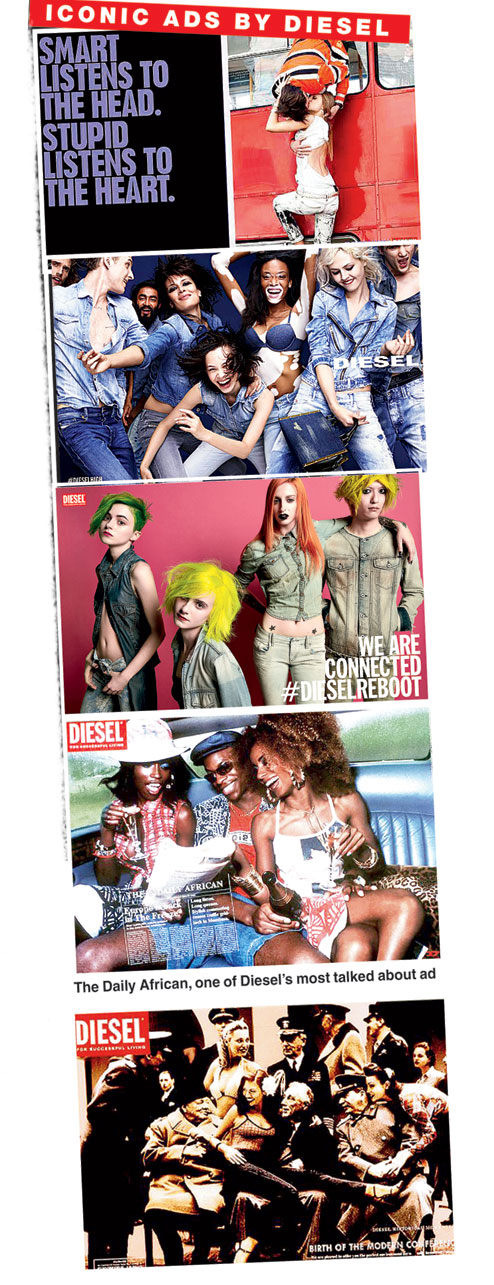
S: Diesel’s advertising has always been very fearless, iconic, groundbreaking and culture-bending, which has got many awards all over the world, including multiple awards at Cannes. Also, they have been the first people to advertise in a gay magazine and their ads have always been very provocative. The Daily African is probably one of your most talked about campaigns.
R: It was 1991, I wanted to pay my respect to Africa. It was important for me to create something that would draw attention and I thought the best way to do that would be to shock.
S: So The Daily African was a satire on how the world looks at Africa. They run a magazine called The Daily African which had headlines like say, ‘Africa gives financial aid to the US’ and so on…
S: He is a man who built his company by giving recognition to the people who work for it. So when Mr Rosso got the advertiser of the year award at Cannes, he had a unique way of receiving it. He got all the creative people responsible for getting the award and everyone was wearing a Renzo Rosso mask, so people were confused as to who the real Renzo Rosso was. So the lesson was, I am who I am because of the people who make me who I am....
Let me tell you a story. His good friend Roberto Baggio (football star) was travelling with Renzo in his private jet, with a few other friends. Suddenly Renzo asked everybody to get off their seats and sit on the floor. He then took out his wine and his home-cooked food and they had a picnic on the floor. So, big men come from small places, but the heart remains as vulnerable, soft and beautiful as ever.
Text: Smita Roy Chowdhury
Chat pictures: Sandip Das