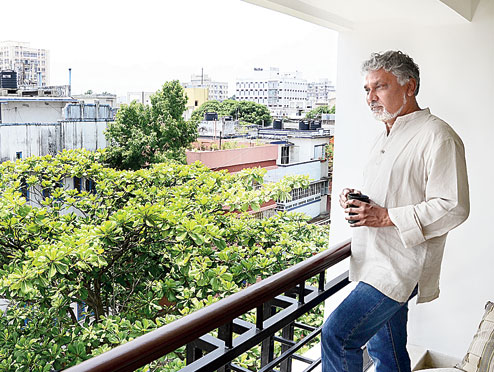

After a two-year search, Kunal Basu is finally home — a fifth-floor apartment on Lake Road.
Exhausted from the rigours of settling in but exhilarated at returning to the heart of the city (from a posh enclave further south), he welcomed t2 into his home.
Congratulations! You have finally found a place that you can call home...
What decided it for us is this big tree just outside our home. It’s a badam tree. Susmita (wife) and I came to this spot, looked at this tree and were immediately hooked.
This tree kept calling us back to this flat. But we didn’t know what tree it was. Right after that we went to Mauritius for the International Literary Festival. And there, we saw a tree exactly like this. A label said it was an endangered plant, Bois Boeuf, the beefwood tree. We thought, an African tree on Lake Road?!
Every time you possess something, there is a fear of losing it. We started fearing that somebody was going to cut down this tree. We heard people say, ‘If this tree is cut down, parking will become so much easier at this spot.’ We went to the builder and said, ‘We will take the most difficult parking spot in this building, but no one should touch this tree.’
I read somewhere that last year 9,000 trees were chopped down in Calcutta. What we don’t realise is that Calcutta has more trees than Bombay, Bangkok, Hong Kong, Kuala Lumpur, Jakarta… all the major cities in Asia. So we still have something, we shouldn’t lose it.
Also, you are back in your para...
Yes, this is my old para (his parents’ house was off Purna Das Road). Most importantly, we don’t like living in enclaves that are cut off from the city. It takes a real effort for anybody to come visit us. It takes a real effort for us to go to the market and buy onions. And once you are inside, you are overcome with a kind of lethargy. So you look at Calcutta with a bird’s-eye view. We were on the 29th floor. And for anybody who is involved in writing, or any of the arts for that matter, one cannot afford to cut oneself out... I cannot afford to cut myself off from going to Lake Market in the morning and buying fish.
When Susmita says we are out of tea, going out and getting it, when the street is waterlogged, negotiating my way through that, watching election michhils and comparing the strength of each party’s following… and hearing everyday chatter.... I was pining to return to a neighbourhood where I could live like a writer, and not be somewhere where I had a closed-off study and the city was away from me. Also, this flat has a lot of natural light. Living in England half the year (he teaches at Oxford University), we are light-deprived. And the light in this flat shifts. In the morning there’s a certain kind of light, and then the sun sets right outside the balcony adjoining my study. So I can sit there with my tea and watch the sun set.
We now go for walks in the Lakes in the morning and at the end of it, we’ll go to Lake Market and buy the day’s provisions. And there are wonderful street eateries all around.
Your books have settled in too...

I’m terribly fortunate. People inherit villas, jewels, crores in the bank, I have inherited my parents’ books, which are more valuable than any of the above. My father (Sunil Kumar Basu) was a publisher, my mother (Chhabi Basu) was a writer and I’ve grown up surrounded by books. And when I see these books around me, I feel as if I haven’t left Calcutta. That part of Kunal, who spent 30 years abroad, seems like a fiction written by somebody else. Because I have grown up with Bankim Rachanabali right in front of me. I’ve grown up looking at Parichay Patrika. When I see these, I feel as if I am where I had grown up... my parents will come out and dust the books every Sunday and they’ll discover a book from their own library and say, ‘Ah, eta je achhe jantam na toh (We didn’t know we had this book)!’
So, how have you arranged your books?
I’ve been very partial. My study has only literature — poetry, plays and cinema. Bangla to my left and English to my right. There are slightly more Bangla literature books than English. And I have hidden away my books… they’re somewhere there, just to remind me, occasionally, that I do write (smiles). We have many French books, which are in the living room. My parents were Francophiles. They had met in Alliance Francaise in Calcutta and fallen in love, in the 1940s. So they have a collection of French books, which Susmita and I can’t read very well but our daughter (Ajlai, who is pursuing a Phd at Berkeley, California) does.
Many things about Calcutta have changed, but one thing that has significantly changed is, when we were growing up, seven homes out of 10 had books. It’s a bit rude but even now, when I go to somebody’s house, I always go to their bookshelf and see what books they have. Now you’ll find few households have books.
And people give all the wrong reasons! They say, why keep so many books when you can read on the Net? Because it’s not about accessibility, it’s about living with books. You don’t say why have your spouse living in your house when you can talk on the mobile phone! It’s about sharing space. Just like you share your space with your loved one, you share space with books.
I have this thing about Rabindra Rachanabali. In my novel that is coming out in November, Kalkatta, a non-Bengali asks, ‘What are the signs of being a real Bengali?’
There are three things. One is, your house must display all the volumes of Rabindranath Tagore, even if you’ve not managed to read a single one. The second, you must have original Bengal School art… Jamini Roy, Gopal Ghosh (if you like bathing beauties, that is)… but they must not be fake.
These you can get with money, the third requires real patience — you must teach your maid to cook
really vegetarian dishes that don’t have a hint of fish or fowl.
In our household we have the second and the third. But I have steadfastedly refused to have all the volumes of Rabindranath Tagore. We have a great many, and we have a great many of his works in single volumes, but it seems too much like a display piece to have the whole thing.

And in your living room?
There are books on history, politics, economics, area studies. Then Raj-era books written on India, like Bengal Under the Lieutenant Governors, The Crisis of Britain and the British Empire, published in 1874.... This is the kind of thing that makes my blood race.
Here’s The Makers of British India by W.H. Adams, with maps and illustrations. I touch this book with the thought that the makers, the grandsons and great-grandsons of the ‘makers’ are dead but the book has survived them all. This is the romance of books. My parents were Marxists, we have books by [Karl] Marx and [Friedrich] Engels, some published in Russia, some in China, but also some that were surreptitiously published in India. They were banned books at the time. Also pamphlets from the time.
Show us some of your most prized books...
Like most Bengalis, I have grown up with Saratchandra Chattopadhyay and read certain of his novels when I shouldn’t have been reading them (smiles). But I had never owned a Saratchandra. I always wanted to own an old, tattered copy of a Saratchandra novel and one day I found that on College Street.
These books are not just artefacts, they have personal stories. A lot of my parents’ books are signed by their authors. Subhas Mukhopadhyay’s poetry, Samaresh Basu’s short stories, Bishnu De’s book of poems.... These are my crown jewels that I guard.
You have very interesting art pieces...
We’ve collected them for 30 years from all over the world — Africa, Latin America, Southeast Asia, India, China. There is coexistence among these pieces. They have become siblings now. Our house in Oxford has a lot more art. This was a consuming passion for about 25 years. Before I wrote my first novel. After that all of this took a backseat.
Who designed the look of this house?
Susmita and I have designed every corner of the house. In every city of the world that we have lived in, we design our home. Because a home is really a joint autobiography. This is who we are, this is how we have travelled, this is what we have found exciting or important. If you hand over your home to an interior designer, be assured they will bring their autobiography into yours. And we’re very fussy people (laughs).
In our home, antique furniture coexist with contemporary pieces. We go hunting in different parts of Calcutta for old furniture. The house is a mishmash of our tastes. The books are the constant factor. My father used to say you need four things for a home to be a happy home — books, art, flowers and love.
What does your bookshelf mean to you? Tell t2@abp.in