
New Delhi, Aug. 27: The Narendra Modi-government wants to transform the metro airports into global aviation hubs, like the ones in Dubai and Singapore, through a series of policies, including stalling bilateral deals that favour rival airports.
The move, officials feel, will also address the aviation sector's financial woes.
Both the finance and the civil aviation ministries feel there is a need to stop feeding rival airports in Dubai, Doha, Abu Dhabi, Singapore and Istanbul while major domestic airports and airlines remain under-utilised on global routes.
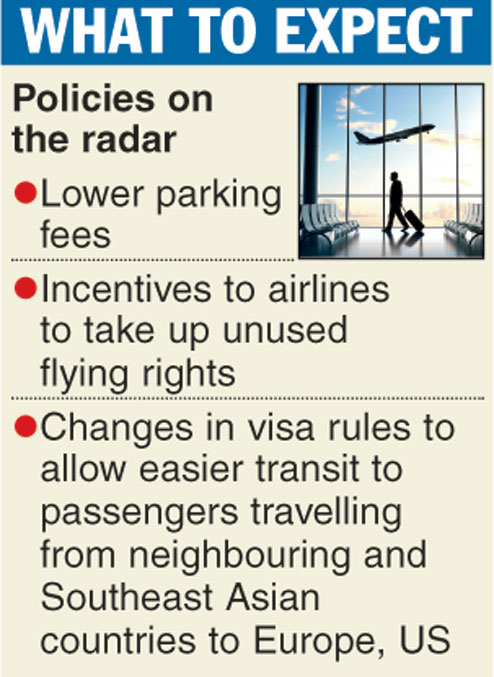
A number of policies are being considered to make the metros more cost effective for airlines to fly internationally. These include lower parking fees, incentives to airlines to take up unused flying rights and changes in visa rules to allow easier transit to passengers travelling from neighbouring and Southeast Asian countries to Europe and the US.
"India can be a hub for neighbouring countries to fly to Europe and the US. We have to be imaginative. Singapore gives a three-day transit to anyone with a valid visa and ticket to Europe, the US or Australia as they know these travellers have been vetted by stringent checks. The result is funneling of passengers as well as spending in dollars in Singapore's hotels and duty-free stores," said aviation ministry officials.
Officials point out that besides Air India, whose huge losses have forced the government to put it on the block, at least two major airlines have negative net worth and huge borrowings.
Survey suggestion
The economic survey tabled in Parliament earlier this month said though the Gulf and the Southeast Asian countries were top destinations for passengers flying to and from India, "these countries are not the end destinations for all. In fact, these countries are invariably being used as stopovers/hubs by their respective home airlines to carry passengers for onward destinations to the US, Canada, Europe".
"Domestic airlines have a very lower share in international traffic to and from India. It is surprising that the bulk of Indian traffic (to and from) are serviced by foreign airlines. Among foreign carriers... Gulf and some of the Southeast Asian nations have proven to be our major competitors," it said. The UAE alone accounts for 33.6 per cent of the total number of passengers flying abroad.
"Factors like foreign airlines utilising the sixth freedom of air, expansion of capacity entitlements under bilateral air service agreements with foreign countries and lower utilisation of India's own capacity entitlements are responsible for the same," it added.
Sixth freedom is the bilateral air traffic right to fly from one foreign destination to another while stopping in one's own country.
For instance, Emirates operates flights between India and the UK while stopping in Dubai, its home country.
Traffic under sixth freedom constituted 61.14 per cent of the total international traffic in 2015-16, up from 59.15 per cent in 2014-15.
Officials said about 38 per cent people fly in and out of India using Indian carriers, while the rest fly foreign carriers.
Unused bilaterals
Officials said they would be coming up with policies to allow new airlines planning to fly abroad to pick up unused bilateral flying rights.
"Several markets have remained absolutely untapped, such as Russia. While Aeroflot does good business on all flights to India, as yet we do not use our rights to fly to that country," they pointed out.
New bilaterals or those coming up for renewal may also stop allowing smaller cities from being "points of call", restricting it to major metros such as Delhi, Mumbai, Calcutta, Chennai, Hyderabad or Bangalore.
Allowing foreign carriers to fly directly to these smaller cities will allow them to siphon off passengers who would have otherwise flown via Indian metros.
The civil aviation ministry is also planning to hold consultations with domestic airlines and airport operators before signing the bilaterals to ensure that they are not at the receiving end of the new policies being drafted.
Officials said while India did not discriminate while giving slots (time for a flight landing or take-off), foreign airports often did, putting Indian airlines at a disadvantage.