
New Delhi, Oct. 2: Airlines in India could soon be allowed to offer mobile telephony and internet services on flights.
If and when this happens, Indian carriers will join a club of more than 30 airlines, including British Airways, Singapore Airlines, Emirates, Qatar Airways and Virgin Atlantic, that allow passengers to use mobile phones and surf the Net during a flight.
Telecom regulator Trai has kicked off discussions on the subject by floating a consultation paper that looks at the possibility of introducing in-flight connectivity for voice, data and video services for domestic and international flights as well as planes flying over the Indian airspace.
"It is possible for the passengers to have telecom services in the aircraft travelling at 800 km per hour and 10,000 metres in the sky because of satellite-enabled connectivity. As technologies to provide such access have developed, so too have consumers' expectations. They desire seamless connectivity regardless of their location - whether on land, in the air or on the sea. New advances in technology mean more flyers have access to telecom services than ever before," says the Trai paper.
The regulator has tossed up a set of 18 questions that cover a gamut of issues - from the kind of technology that should be harnessed and the need to regulate the new breed of service providers to security issues involved and ways to monitor the cabin chatter with relatives and associates on the ground.
Tackling technology
Technology is a big issue: most airlines today provide in-flight connectivity using Wi-Fi. Singapore Airlines, for instance, has a partnership with Sitaonair and Panasonic that use such a system.
But Trai notes that "there has been a shift away from basic Wi-Fi systems to faster systems. The launch of high throughput satellites (HTS) in both Ku-band and Ka-band is expected to be a game changer for the in-flight connectivity band".
Both Ku and Ka bands are high-frequency bands that haven't as yet been farmed out. The Ku band is a frequency range of 14-14.5GHz (earth to space) and 10.7-11.7GHz (space to earth). The Ka band typically covers 19.7-20.7GHz (space to earth) and 29.5-30GHz (earth to space).
"The HTS systems will not only tremendously increase data speeds to the plane compared to the regular satellite systems, but will also significantly lower costs, thereby driving the adoption of IFC (in-flight connectivity) services," the paper says.
The Trai paper is in response to a reference from the department of telecommunications (DoT) on August 10, asking the regulator to furnish its recommendations on the "licensing terms and conditions for provision of in-flight connectivity" and associated issues relating to entry fee, licence fee, spectrum and usage charges.
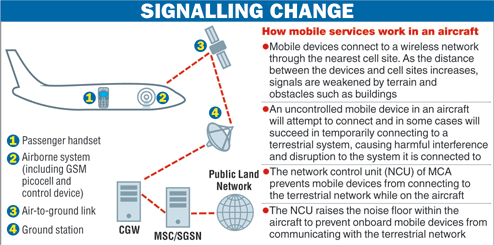
The paper says the most common mobile communication services on board aircraft (MCA) systems consist of an airborne picocell - a very small low power mobile base station; and a network control unit (NCU) that stops onboard phones connecting with land-based networks. The third element of the MCA set-up is a satellite link connecting the aircraft to public phone networks on the ground. The cabin network also contains an aircraft GSM server (AGS) that integrates the main modules onboard.
The picocell is analogous to an in-building distributed antenna system used in large buildings and malls to enhance the reception of signals.
Service provider rules
One big issue is who will provide the service and how will the entity be regulated. Most airlines have partners who help them provide the service. The Trai paper has sought views on whether an IFC service provider should be required to take a unified licence like the telecom operators.
Alternatively, it posits that the IFC may be permitted to enter into an agreement with a unified licensee in India for the provision of in-flight services.
One question raised is: if MCA services are permitted in the Indian airspace, what measures should be adopted to prevent an airborne mobile phone from interfering with terrestrial cellular mobile network? Should it be made technology and frequency neutral or restricted to GSM services in the 1800MHz frequency band, UMTS in the 2100MHz band and LTE in the 1800MHz band in line with EU regulations?
Most airlines provide in-flight communication services at a minimum height of 3,000 metres above the ground level to ensure that flight safety isn't hampered because of interference with ground-based mobile networks.
But the regulator has sought views on whether the altitude restriction for the use of personal electronic devices, including smartphones, can be removed to provide "gate to gate connectivity" - from the boarding gate of the departure airport to the disembarking gate at the arrival airport.
In the spirit of reciprocity, the paper says: "When offering IFC services, Indian airlines will overfly other countries' airspace and will want to have the ability to provide continuity of service. The authorisation for IFC provision on foreign aircraft while overflying is already provided on a global basis, with a very few exceptions. Foreign airlines, while in the Indian airspace, may like to have the same rights to provide IFC services to their passengers."
Security concerns
But security issues cannot be brushed aside.
The paper says: "To ensure lawful interception, one possibility can be to mandate the use of the Indian Satellite System while travelling over the Indian airspace."
But it also ruefully admits: "The issue of the availability of domestic satellite capacity has to be addressed. Moreover, foreign airlines may not like to switch to the Indian Satellite System."
It suggests a third option to address security concerns: "Traffic to and from user terminals in Indian airspace may be sent to a node owned and operated by an Indian entity to address the requirement of lawful interception directly or in mirror mode."
It also asks whether the IFC operations in the domestic flights should be permitted only through the INSAT system of satellites to head off any security risk.
But the paper is realistic. It admits that the IFC service may not generate much revenue - at least in the initial stage. If the IFC service provider enters into a commercial agreement with a telecom entity, there is the added burden of being subject to a licence fee and spectrum use charge.
"One option could be that the IFC service provider may be imposed a flat annual licence fee of some token amount, say Re 1, for its in-cabin operations, to be amended at a later stage, if need be, in public interest and for conduct of telegraph services," the paper suggests.
If Trai's recommendations on in-flight communication services eventually fly, it will mark the end to that irritating announcement that irks the hell out of every passenger: "Switch off all mobile phones when on board the aircraft."