
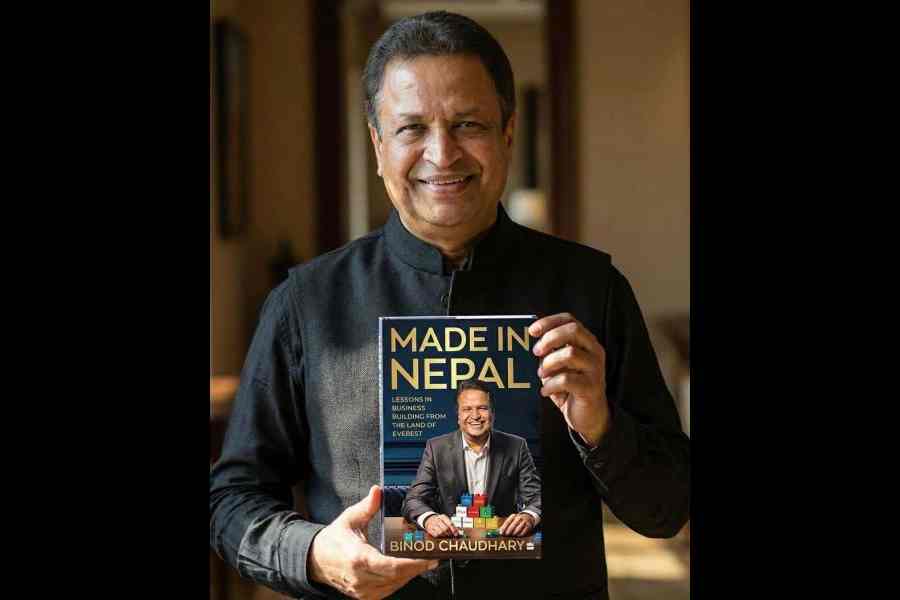
Nepal stands on the brink of a major economic and political reset, and Binod Chaudhary, who has dabbled both in business and politics, believes the moment must be seized with bold policy choices and deeper regional cooperation.
The chairman of the diversified and multinational business conglomerate, Chaudhary Group, and Nepal’s sole representative on the Forbes billionaires list said the country could unlock its vast potential by leveraging tourism, hydropower, connectivity and education, while positioning itself as a strategic bridge between India and China.
Chaudhary was in Calcutta to showcase his latest book, Made in Nepal and participate in a session with Harshavardhan Neotia at the Kolkata Literary Meet.
In an interview with The Telegraph, Chaudhary cited underutilisation of Nepal’s infrastructure as a key point for reform.
Despite having three international airports, most international flights operate through just one. He said that there is a need to convince India to extend its UDAN regional connectivity scheme to link Indian cities with Nepal’s other airports, boosting tourism flows.
“Tourism is a big sector. Five million tourists can help create fifteen million jobs, according to industry estimates,” he said, stressing that better air links could be a game changer for employment and regional development.
Energy exports, he added, represent an even larger opportunity. Nepal has an estimated hydropower generation capacity of around 80,000 MW, but currently sells less than 2,000 MW. With India reportedly willing to buy up to 10,000 MW, Chaudhary said expanded cooperation in the power sector could transform Nepal’s balance of payments position, while catalysing infrastructure investment and job creation.
“This is going to be a game changer,” he said, calling for broader, faster execution of cross-border power projects.
Connectivity infrastructure is another core pillar of reform. Drawing parallels with the transformation of Indian Railways, Chaudhary advocated for joint ventures, BOT models or other partnership structures with India to strengthen Nepal’s railway network, including the long-envisioned east-to-far-west railway line.
Beyond physical infrastructure, Chaudhary underscored the need to scale up human capital. He suggested that Nepal work with neighbouring countries to establish more engineering, management and medical colleges, and attract reputed international institutions through franchising and collaboration.
“Today, Indian, Canadian, Chinese, Australian and European institutions are available for supporting education anywhere in the world,” he said.
With the right push, Nepal could emerge as an education hub and a competitive back office for software and IT-enabled services, mirroring India’s early-2000s IT boom. Such a strategy, he noted, would help retain youth, create high-quality jobs and position Nepal as a complementary, rather than competing, services destination.
Chaudhary also outlined a broader geopolitical and trade vision, in which Nepal plays a facilitative role between its two giant neighbours. He sees scope for India and China to invest in Nepal in a complementary manner, with Kathmandu acting as a bridge based on mutual preferences and coexistence. “There could be several transit corridors between India and China through Nepal,” he said, adding that becoming a transit hub could significantly boost trade facilitation revenues and overall economic momentum.
Highlighting historical trade ties, Chaudhary reaffirmed the importance of Calcutta and eastern India as gateways for Nepal’s commerce. Despite the opening of newer ports, he said, a large share of Nepal’s trade still routes through Haldia and Calcutta.
On the domestic front, Chaudhary said Nepal’s recent political upheaval reflected widespread frustration among the youth over economic mismanagement and missed opportunities. Despite being richly endowed with natural and spiritual resources, Nepal remains one of the poorest countries in the world, featuring in the UN’s list of the 44 least developed countries across the world.
With elections scheduled for March, Chaudhary expressed optimism that new leadership and reformed parties could usher in faster, more pragmatic decision-making. He cautioned, however, that slogans would not substitute for sound policy, particularly as Nepal prepares to graduate from the least developed country (LDC) category. Without careful sequencing, he warned, losing LDC benefits could prove more damaging than beneficial if the economy is not simultaneously lifted to a higher growth trajectory.
“If the new government does not deliver at a very fast pace, people are not going to tolerate it,” he said.
Chaudhary’s new book showcases how businesses can still thrive in Nepal with the right management and policies, and highlights the opportunities that remain untapped.
“As a group active for over 140 years, we have grown both at home and globally. We have brought international brands to Nepal and taken Nepali brands to the world,” he said.