Book name- APPLE: THE FIRST 50 YEARS
Author- David Pogue
Published by - Simon & Schuster, Price- $50
Apple, which turned 50 in April, has fundamentally changed the way we interact with the world. Marking the occasion is Apple: The First 50 Years, a book that arrives alongside Paul McCartney's special performance at the company's headquarters.
David Pogue has, for decades, injected tech journalism with fresh energy and his credentials are very much on display here. Unlike most books on Apple — a company renowned for cultivating mystique and rarely permitting a peek behind the curtain — Pogue goes deep and delivers an edge-of-the-seat read.
The late Steve Jobs, Apple’s co-founder, naturally commands a lion's share of the narrative, but Pogue does not reduce the other co-founder, Steve Wozniak, or the widely misunderstood former CEO, John Sculley, to mere supporting roles. Only a few pages into the book, Pogue makes it clear that "John Sculley did not fire Steve Jobs" — one of Silicon Valley's most persistent myths. He goes on to describe Sculley as "an East Coast establishment type — introverted, shy, self-described as scrawny and pale — who'd never stepped foot in Silicon Valley and had zero experience in technology”. It is a brisk, satisfying corrective.
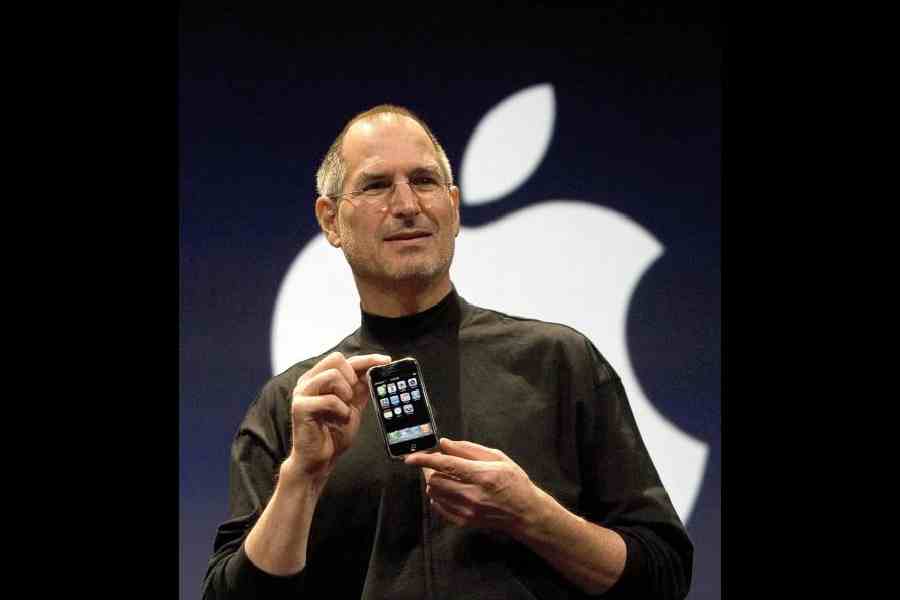
Much of the book traces Apple's evolution through two distinct eras: Steve 1.0, when a young Jobs ran a rapidly growing global business without a degree and with no experience in managing people, and Steve 2.0, the period after he left Apple in 1985 to found NeXT, acquired the computer graphics division of Lucasfilm — which he renamed Pixar — and eventually returned to Apple in 1997.
Pogue captures both the volcanic and the visionary Jobs in full colour. There is the Jobs who told his design team, upon seeing alternative colour swatches for the iMac, "You guys suck. Get the f**k out of the room." And there is the Jobs who inherited a company haemorrhaging talent at a rate of 33%, whose products were shoddy, whose marketing was splintered and ineffectual, and whose sales were being eaten away by clones.
This is where the book truly shines. Rather than offering paeans to Jobs, Pogue reconstructs a remarkable corporate turnaround — the Monday morning executive meetings at 1 Infinite Loop, the ban on PowerPoint, and the relentless focus on ideas over process. Drawing on interviews with a stream of former Apple employees, Pogue traces the arc from the Think Different campaign through the iMac, iPod, and iPhone, to the eventual handover to Tim Cook — a character diametrically opposite to Jobs in almost every respect.
Where the book falls short is in its treatment of India's growing importance to Apple. The Kindle edition's formatting, too, leaves much to be desired.
What lingers, ultimately, are fun anecdotes and convictions. The first public call made on the iPhone was a prank call!
Above all, Pogue makes the case that human beings and ideas have always been Apple's secret ingredient. Pogue proves himself a chronicler of facts rather than another fanboy, and that, in itself, is a rare thing.