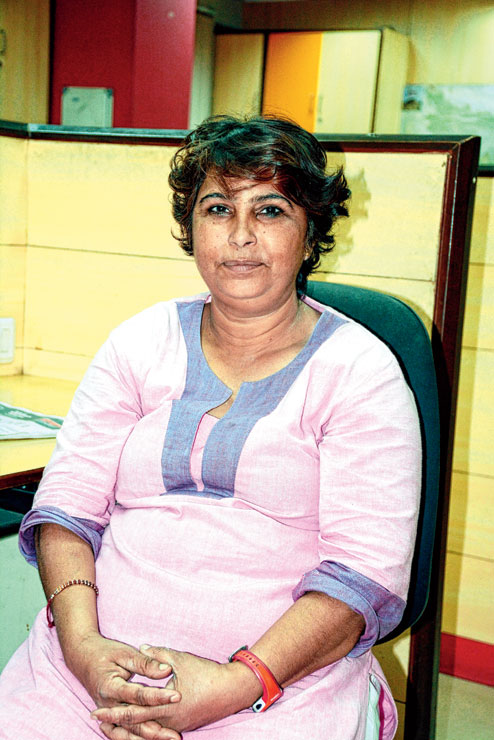

Shakuntala Kazmi (43), who hails from Haryana and completed her schooling and college from Delhi, is now the mukhiya (village head) of Maniyari panchayat in Bahadurpur block of Darbhanga district. In a conversation with Shuchismita Chakraborty of The Telegraph , Shakuntala talked of how 50 per cent reservation has ensured women's participation in the panchayat system but men still rule the roost. She spoke how mukhiya patis (husbands of women mukhiyas) still dominate and discourage the women mukhiyas from taking decisions. Before being elected mukhiya, Kazmi was a social activist for 18 long years. She was associated with the Janvadi Mahila Samiti where she worked with Brinda Karat among others. Excerpts of what she said:
The Nitish Kumar led government's move to give 50 per cent reservation to women in panchayats definitely helped me get a place in the panchayat. I got a chance to work for residents of my village - of which I am also a " bahu (daughter-in-law)" - because the government reserved 50 per cent seats for women in panchayats. But the problem is people here still don't give respect to women donning an administrative position. Mahilaon ko koi tawajjuh hi nahi dete (Women are not given due attention). I assume they wonder how a lady can talk so much or a woman mukhiya talk about her rights.
I got a taste of this during the first district-level meeting called by mukhiyas in August last year. To my surprise, I didn't find any woman mukhiya other than myself at the meeting. I was the only woman mukhiya in attendance. When I asked where the other women mukhiyas were, the male mukhiyas and mukhiya patis (husbands of mukhiyas) were continuously staring at me. I asked why out of around 18 women mukhiyas, I alone had turned up at the meeting. One mukhiya pati replied: "He he mukhiyaji, ye sawal mat puchiyega (Hey mukhiyaji, don't ask this question)."
Then every mukhiya and mukhiya pati started shouting at me in the jam-packed hall. I also shouted back and was adamant that the meeting would go on if only I am told why the other women mukhiyas were absent. My husband works in an organisation, but I cannot interfere in his work. Similarly, husbands of women mukhiyas are not supposed to attend meetings for mukhiyas. I later requested the mukhiya patis to bring their wives, the actual mukhiyas, to the next meeting. I even told the gathering that women mukhiyas should get training and should attend such meetings.
The condition improved slightly at the next meeting. Apart from me, another woman mukhiya, too, attended the meeting. But the problem is mukhiya patis still discharge the duties that are rightfully their wives'.
There should be a government mechanism to check this practice. While husbands of women mukhiyas don't lend their wives much support, the local administration, too, has a don't-care attitude towards us (women mukhiyas). I can cite an example. Recently, during a Dalit wedding in my village, some strongmen (dabangs) played wild songs and began misbehaving with women members of the family. I rushed to the house after I was informed about the incident. But when I called the police, they arrived on the scene but instead of helping, began leaving the scene, saying they had to go for night patrol.
I shouted at them, saying they were required more at the house at that moment than at any night patrolling site, but the police were reluctant. At long last they decided to stay there. But, the next moment, I was shocked to see the policemen laying out a khaat (cot) to sit. Imagine the situation. The women members of the family were shrieking for help and all the police did was sit on a khaat with no care in the world. That night I somehow managed to arrange necessary help for the family.
In another bizarre incident, when I went to meet the previous mukhiya, Komal Yadav, at her office, I found her husband there. He was not ready to let me meet his wife. Later, I found Komal pasting cow dung cakes on her house walls to be sun-dried. When I asked the mukhiya pati why he did not bring Komal to panchayat meetings, he arrogantly replied that Komal was a woman and could not take part in official meetings.
So, women mukhiyas were acting like puppets whose strings their husbands pulled.
Also, ward members in my panchayat create problems in my work. People who helped me win the election are now creating hurdles for me. They had earlier thought I would continue to live in Delhi with my husband, visiting the village sometimes to look after the job of mukhiya but I shattered their dreams by coming here. Seeing the tradition of mukhiya patis, they might have desired for another rule by proxy.