Indian stock markets zoomed and the rupee leapt after Donald Trump tweeted the unexpected news that India and the US have clinched a surprise trade deal after months of bickering. The deal was instantly dubbed the ‘Father of All Deals’ after India struck what it had called the “mother of all deals” with the European Union in New Delhi.
However, there are giant question marks hanging over the deal, not least the fact that the details coming out of Washington and New Delhi appear to conflict substantially. Still, the Indian government was clearly delighted that it may have been able to mend ties with Washington which have been hammered in the last year.
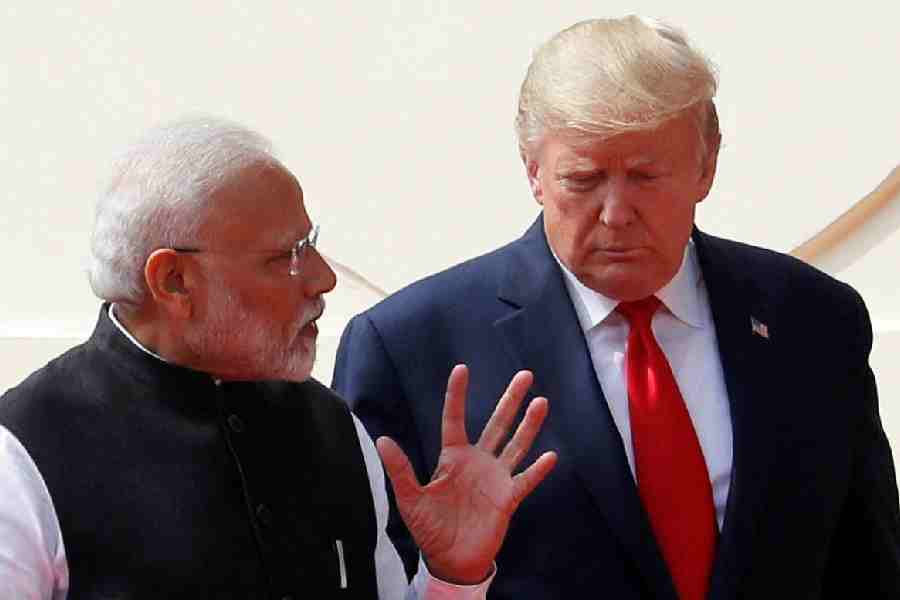
Indian government statements stuck to generalities and broader statements like, “When two large economies and the world’s largest democracies work together, it benefits our people and unlocks immense opportunities for mutually beneficial cooperation.” Prime Minister Narendra Modi and US President Trump also gushingly reiterated how they were great friends.
Crucially, tariffs on Indian exports to the US are being slashed from the punitive 50 per cent to 18 per cent, a figure greeted with whoops of joy by Indian exporters as it will put them ahead of rivals, particularly in textiles, like Pakistan which faces 19 per cent tariffs and Vietnam 20 per cent.
The Tiruppur Exporters Association (TEA) jubilantly hailed the agreement, pointing to the fact that “the tariff is the lowest among our competitors.” Textile exports to the US had taken a massive hit from Trump’s levies, falling 31 per cent year on year till November.
Bear in mind that the US slapped 25 per cent tariffs on India in May and 50 per cent in August over Delhi’s purchase of Russian crude, so the crash in just a few months has been huge. “This development is expected to give a strong boost to apparel exports,” says A. Saktivel, the veteran TEA chairman.
Trump likes to spring surprises and this pleasant one sent the stock markets, which had crashed on Sunday on the back of a disappointing Budget, suddenly exploding upwards. The BSE Sensex climbed a hefty 2 per cent or 2,304 points. At one point it had shot up by some 4,000 points. Similarly, the rupee gained strength and scrambled back up against the dollar to 90.15 from its crash to an all-time 92.29 a few weeks ago.

The markets seemed unflustered by the uncertainties that still have to be cleared up around the deal. Trump insists that most US exports to India will face zero tariffs, though Indian products going to the US would continue to face 18 per cent tariffs.
He also waxed eloquent about how India would stop buying crude oil from Russia and would instead look at buying crude oil from the US and also Venezuela. Additionally, he insisted that India would buy other energy products like coal from the US. From India’s point of view these are tricky propositions because the cost of transportation from the US and Venezuela is considerably higher than from oil-producing nations closer to us. The same applies to coal.
Till now, the ban on Russian crude has only applied to two giants, Rosneft and Lukoil. It isn’t clear whether Trump is now insisting on a total ban. India still buys over one million barrels a day of crude from Russia and many refiners were frantically trying to figure out what was happening on this issue on Tuesday.
Brussels-based data analytics firm Kpler, which tracks the oil industry, insists there’s absolutely no sign that India is completely shutting down its purchases of Russian crude. Kpler’s lead research analyst Sumit Ritolia says, “India’s Russian crude imports are unlikely to see a near-term decline. Volumes remain largely locked in for the next 8-10 weeks.”
Ritolia notes that right now India is getting significant discounts on Urals crude compared to Brent crude prices. On some consignments, India is reportedly getting discounts of $24. He adds: “A more pronounced reduction would likely require a clear policy shift by the government of India, which appears highly unlikely.” Ritolia reckons India may buy marginal amounts of American and Venezuelan oil.
Trump, who is always in quest of eyeball-catching announcements, also proclaimed that India had committed to buy $500 billion of US exports. Let’s look at the numbers that Trump has thrown about.
In 2024, India took $41 billion worth of US imports, so it’s well-nigh impossible to see how we can hike our US imports by such a huge amount. One possibility is that we might import more military equipment from the US, but there are questions about cost even around that, as well as worries about Indian strategic and military autonomy.
Commerce minister Piyush Goyal stressed at a press conference that agriculturalists and dairy producers have been firmly protected. “This is a farmers-first deal, protecting agriculture, dairy and other key sectors.”
However, the US Agriculture Secretary Brooke Rollins specifically mentioned that some agriculture products will be included in the deal. Rollins hailed the agreement as a win for American farmers, saying it would export more US farm products to India’s massive market, lift prices and pump cash into rural America, noting that in 2024 the US agricultural trade deficit with India was $1.3 billion and that the deal would help reduce this gap. “Thank you @POTUS for ONCE AGAIN delivering for our American farmers,” she wrote on X. “New US-India deal will export more American farm products to India’s massive market, lifting prices, and pumping cash into rural America.”
Indian experts point out that New Delhi had already offered to buy walnuts, pine nuts, pecan nuts and cranberries from the US at lower tariffs, similar to terms offered to the EU and Australia, and trade in soya beans was already discussed given lower Chinese demand. Similarly, India had offered zero tariffs on 90 per cent of US products including electronics and medical devices. The budget has also brought down duties on nuclear equipment.

In the short term, markets are cheering. But there seems to be a clear mismatch between the rhetoric and reality. On the Indian side, the emphasis has been on tariff relief for exporters and on protecting sensitive domestic sectors. On the US side, officials are toasting expanded access for American agricultural and industrial products.
Over the medium term the real test will be in implementation and clarity. Without concrete text, the ‘Father of All Deals’ could end up more hype than substance. Investors and industry alike may find that the devil lies in the details.