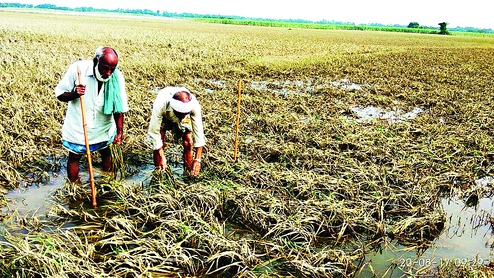

Farmers try to salvage crops damaged by floods in Laukariya panchayat in Raxaul. Picture by Jai Prakash
Preliminary estimates suggest standing crops spread over 8 lakh hectares were damaged in this year's floods in Bihar.
The figure assumes significance as the floods have, so far, hit only about half of the 38 districts in Bihar where kharif crops were sown in over 39 lakh hectares.
Of the total sown area, paddy had been sown in over 34 lakh hectares, of which standing crops were damaged on 6.67 lakh hectares. According to early estimates made by the agriculture department, maize crop standing on 42.2 thousand hectares and sugarcane on 67.8 thousand hectares were damaged.
If one divides the damaged crops in terms of irrigated and unirrigated fields, official figures say, of the total 8,10,453 hectares hit by the floods, 6,95,937 hectares were irrigated land and 46,675 hectares unirrigated. Also, standing crop of sugarcane on 67,840 hectares got damaged.
This segregation of crops in terms of irrigated and unirrigated land assumes significance as the government would provide compensation to farmers on the basis of this categorisation.
According to norms, a compensation of Rs 13,500 per hectare (upper limit 2 hectare for an individual) is provided for irrigated land for seasonal crops like paddy, maize and vegetables and in case of unirrigated land for seasonal crops the compensation rate for damaged crops is Rs 6,800 per hectare (upper limit being 2 hectares for an individual).
In case of annual crops like sugarcane, banana, mango etc, the compensation is paid at the rate of Rs 18,000 per hectare.
'Based on preliminary estimates, we have asked the Centre for a compensation of Rs 1093.36 crore for farmers,' agriculture minister Prem Kumar said.
The minister also said he had asked department officials to keep close tabs on the ground and do extensive survey of areas from where floodwaters had receded so that the estimate of damage could be updated accordingly. 'The department has also set up a disaster management cell for collecting damage reports from the districts,' Kumar said.
Though the department is working fast to assess the damage caused to the agriculture sector, farmers feel the compensation offered by the government was not adequate to compensate the losses they suffered because of the floods.
'On an average, one produces around 40 to 50 quintals of paddy on one hectare, which would fetch around Rs 50,000. The state government would offer just Rs 13,500 in case of irrigated land and Rs 6,800 in case of unirrigated land, which is not sufficient anyhow,' said Bhola Prasad Yadav, a farmer from Parihar in Sitamarhi district.
Chandra Vijay Kumar of Banjariya in East Champaran district echoed the views of the Sitamarhi farmer and demanded the government review its compensation policy.
Officials in the agriculture department, however, maintained that the department was seized of the farmers' concerns and special steps would be taken to ensure farmers don't suffer much at the end of the kharif cropping season.
'The cash compensation is just one of the steps we are taking and it aims to compensate farmers for their input costs. Once the floodwaters recede, the department would launch a special drive for alternative farming in the remaining months of the kharif season and seeds would be provided to farmers for this purpose,' a senior official of the agriculture department said.
The official pointed out that department minister Prem Kumar had already issued a directive in this regard and officials concerned had started working out the details of alternative farming which would be suggested to the farmers.
The agriculture department has also come out with specially designed booklets, which would be circulated in flood-hit areas, which has suggestions for farmers in case of partial damage to their crops and alternative crops which farmers could go for in the remaining period of the cropping season.
The department has also come up with a helpline, 0612-2217103, and a toll free number, 18001801551, on which farmers could share their problems and seek the advice of agriculture experts.