|
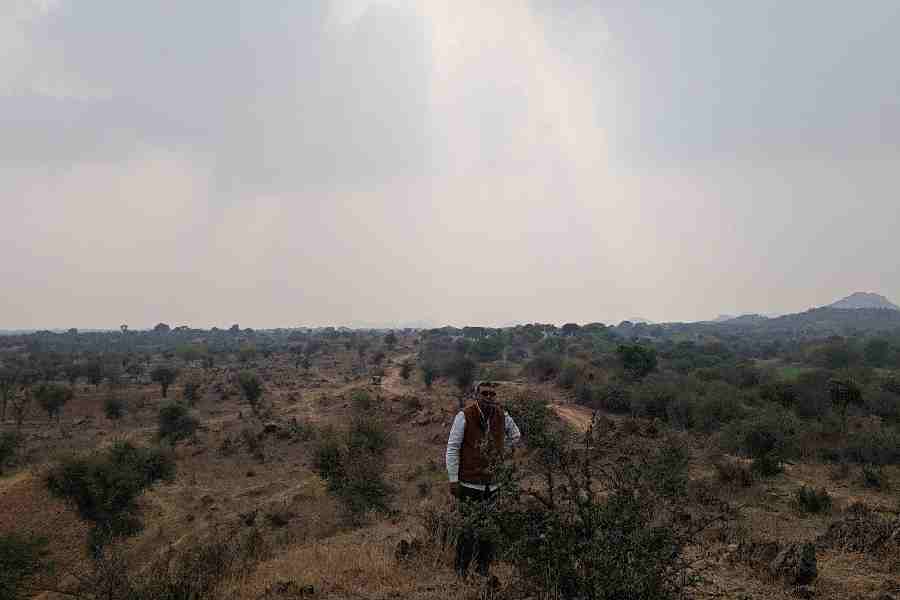
| Valmikinagar Tiger Reserve. Telegraph picture |
Raxaul, Jan. 2: The tiger population has gradually dwindled in the forest reserve at Valmikinagar in West Champaran, while the trend is just the reverse in the Chitwan and Parsa district forest reserves, on the other side of the India-Nepal border.
According to recent statistics, a sizeable increase in the number of tigers was registered in Chitwan Rashtriya Nikunj and Parsa Vanya Jantu Araksh of Nepal adjoining the border in the East Champaran and West Champaran districts.
Parsa, Bara and Chitwan forest ranges in Nepal are adjoining each other and they touch the borders of Valmiki Tiger Reserve.
It is also possible that due to often reported hunting in Valmiki Tiger Reserve, incidents of fire and inadequate food, the big cats have been on an exodus to the forests in Nepal in recent years.
Tirthraj Kushwaha, a resident of Bagaha, said: “Two panchayat areas under Ramnagar block of West Champaran district fall in the middle of Valmiki Tiger Reserve and rampant deforestation destroys forest cover. These factors have spoilt the tranquility needed for tigers, leading to their migration to forests in Nepal.”
Porous borders, coupled with human interference, have been disturbing the tigers, Kushwaha said, before adding that tigers keep on shuttling among the adjacent reserve forests, but more tigers leave Valmiki Tiger Reserve than coming to it.
In 2009, the total number of tigers in Nepal was 121, while a release issued there on Tiger Preservation Day on June 29 gave the total number of tigers to be 155. Only in the Chitwan Rashtriya Nikunj, the number of tigers increased by 34 from 91 in 2009.
Apart from this, four tigers in Parsa Vanya Jantu Araksh, 18 in Bardiya Rashtriya Nikunj and eight in Shatlafant forest under Kanchanpur are still present.
The in-charge of Chitwan Rashtriya Nikunj, Narendra Maan Pradhan, told that a scientific survey conducted in March-April this year found only 125 adult tigers in 261sqkm area under the Churiya and Bardabhand forest range.
In a recent survey, jointly conducted there by the national forest department, Nature Preservation Fund and World Wildlife Fund, it was found that 6.53 tigers lived in every 100sqkm area in Nepal.
Encouraged by this development, the Nepal government has announced an extension of the Parsa forest range in order to provide more dwelling space and faster growth of edible cattle/animals for survival of tigers present there. Moreover, the Nepal government has also expedited the Bagh Bachao Movement and in that context, a global tiger workshop was organised at Kathmandu in November last year.
Delegates of nearly 13 countries had taken part in a workshop and it was resolved that the then worldwide population of 3,200 tigers be doubled by the end of 2015.