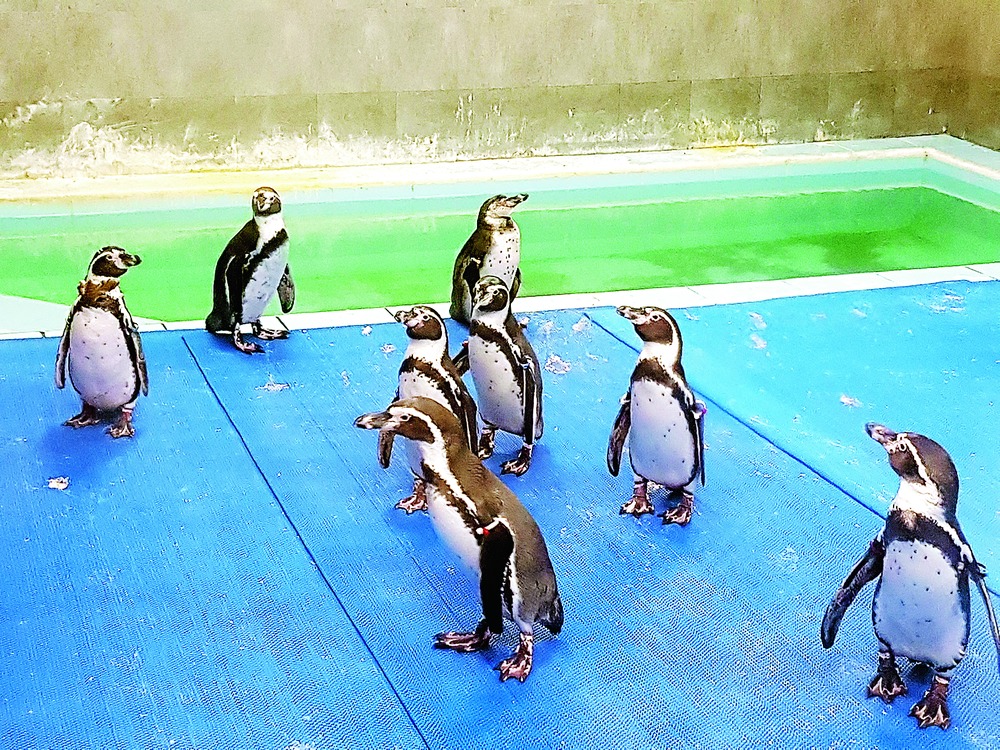

They are monogamous. Love fish. Have a bit of a potty obsession. Make very anxious parents. Don't have much of a physique and from certain angles you'd think they were wearing monkey caps and socks.
We are talking about the Humboldt penguins recently acquired from South Korea by Veermata Jijabai Bhonsle Udyan and Zoo, or Mumbai's Byculla Zoo.
Activists are worried how the birds will take to India. Nearly everyone is critiquing the Brihanmumbai Municipal Corporation (BMC) for spending crores on an exotic species. But then, the Shiv Sena and BJP-controlled BMC has a hefty annual budget. And the imported birds have found an influential cheerleader: son of Sena chief Uddhav Thackeray, Aaditya.
Humboldt penguins are a "vulnerable" species native to South America. But these eight young 'uns - three males and five females - are not from Peru or Chile. They have been transported from Seoul's Coex Aquarium.
It took longer than an eight-hour flight to get the birds here. The plan, it seems, was hatched in 2011 and announced by the civic body after the 2012 civic elections.
The proposal was submitted by BMC to the Central Zoo Authority (CZA). It was then run past the wildlife department, the chief wildlife warden of Maharashtra, the animal husbandry department, the directorate-general of foreign trade, customs and so on. "It took six months to get all approvals," says Dr Sanjay Tripathi, director of Byculla Zoo.
"The CZA has a norm that states not more than 10 per cent of an Indian zoo collection should consist of non-native species. Theoretically, one could ask for anything, but the principal issue is of morality and of the animal's requirements," says Shubhobroto Ghosh, author of the Indian Zoo Inquiry Report: A Review of Conditions in the Zoos of India (2006).
The birds have arrived but apparently without a management plan. "We have followed the guidelines prescribed by the TAG (Taxon Advisory Group) under AZA Survival Plan," says Tripathi. AZA is the independent accrediting organisation for the zoos and aquariums in the US and the world. TAGs are composed of expert advisors who help to identify, manage and support AZA's animal management programmes.

But Nikunj Sharma, the government affairs liaison of PETA India, one of the many organisations vehemently opposed to the Humboldt acquisition, is outraged. "Penguins in Mumbai? Just the phrase sounds ridiculous."
But there are counters to him. "Penguins have been kept in zoos and aquariums for over 100 years and thrive when they are in proper facilities. Humboldt penguins are adapted to temperate conditions and do well in temperatures up to 26°Celsius," Tom Schneider tells The Telegraph. Schneider chairs the TAG penguins group for North America, which has developed the recommendations for captive penguins.
It seems nature also does its bit - the pink patches on the Humboldt's face, feet and wings help it stay cool.
But are these exotic penguins something we can even afford? "The expense of these animals is a grave concern... they cost crores," says Shweta Sood, senior campaign manager of Federation of Indian Animal Protection Organisations. Tripathi admits that it is "a little expensive" - Rs 6 crore for installation of indoor facilities and another Rs 6 crore for the maintenance agency hired to take care of the birds. But the BMC says it can pick up the tab.
Ghosh's problem with the import is different. "It lacks justification on grounds of conservation and education," he says.
The birds are currently in a quarantine facility inside the zoo premises, gorging on Bombay duck, eel, anchovies, sardines and multivitamins (to reduce stress). The actual penguin exhibit will be an indoor facility of 1,700 square feet with a pool, rock works, different areas for feeding and nesting.
In the wild, Humboldt penguins build their nests out of the poop of sea birds. In captivity they are provided nesting boxes. Humboldt pairs apparently become extremely territorial during this time, and this leads to aggressive competition for nesting burrows, explains Mark Myers, curator of birds and invertebrates at Woodland Park Zoo in Seattle, US. "To alleviate this, we built an excessive number of nest burrows; each has multiple points of access to the nest entrance. This eliminated the chance that one pair would occupy or defend more than one burrow..."
Myers adds, "They are very prone to respiratory fungal infections... Penguins also tend to eat foreign objects, especially shiny objects like coins, hair pins. If visitors throw things, it's very likely a penguin will eat them."
At the Byculla Zoo the penguins will be in a glass enclosure. Penguins, if maintained well, don't do badly in captivity. Missy is a King penguin housed at the Birdland Parks and Gardens in the UK. At 39, she is believed to be one of the oldest penguins alive today. The head keeper of Birdland, Alistair Keen, says, "She was captured by a fisherman and brought to us for care. The vets could not stitch her chin back together. She still has a hole there."
But can the Byculla Zoo pull it off long term? Experts remain skeptical. Sood says the effort has been in the news for all the wrong reasons. Sharma says that PETA investigators had visited more than 30 zoos throughout India since 2005 and found "appalling neglect, decrepit facilities and animal suffering on a massive scale".
Repeated mails to the CZA about the capability of zoos in India to pull off a project such as this, elicited no reply. Ghosh issues a reminder from the Alipore Zoo in Calcutta. It once had polar bears. "Ram Brahma Sanyal, the author of the world's first zoo management book in 1892, was curator at the time (1877 to 1908). He realised what a bad fit that was and wrote about it. Even 114 years later some of our zoo directors need to realise this. No matter what the motivation, each and every species cannot be catered to successfully in captivity."
The penguins of Byculla don't have a name yet. The Coex had tagged each bird with a distinctive colour and the practice has stuck. No one seems to be considering a naming ceremony either. No point naming the chicks before something hatches.
Rare species
we imported and let suffer
AFRICAN ELEPHANT
From Zimbabwe to Delhi Zoo in 1998
Shankar was one of the two African elephants gifted
Status update: After his mate died, he was shifted to the Asian elephant enclosure. He was chained and beaten. His situation has improved of late, but Shankar’s captivity is far from ideal
Observation: It would have been better to send him to Mysore Zoo, where there are two other African elephants. But since he was a diplomatic gift this has not been
facilitated
WHITE RHINO
From US to Guwahati Zoo in 1974
Mohan, the White rhino
Status update: He has lived alone for at least 20 years
Observation: There were white rhinos in Mysore Zoo and he could have been integrated with them. The white rhinos of Mysore Zoo are dead now
RED KANGAROO
From the Czech Republic to Alipore Zoo, Calcutta, in 2011
Four of them were brought over. The fifth, Joey, was born in captivity in 2012
Status update: Joey died in 2015. The fifth such death since 2011; authorities have decided against keeping Red kangaroos in future
Observation: They were dogged by lack of good care
GIRAFFE
From Cologne Zoo, Germany, to Alipore Zoo, Calcutta, in 1986
Two giraffes, Sagar and Uttara; the current giraffe colony has descended from them
Status update: Presently the colony is experiencing lack of space
Observation: The conservation benefits of this captive colony are dubious
GORILLA
From a zoo in Ireland to Mysore Zoo in 1995
Prior to his stay in Ireland, Polo had lived for a bit in a zoo in Germany
Status Update: He died in 2014
Observation: He should have been sent to a zoo where he could have had company, but Mysore Zoo was not willing to give him away because he was the only gorilla in captivity in India.
Source: Shubhobroto Ghosh, author of the Indian Zoo Inquiry Report and the book Dreaming in Calcutta and Channel Islands