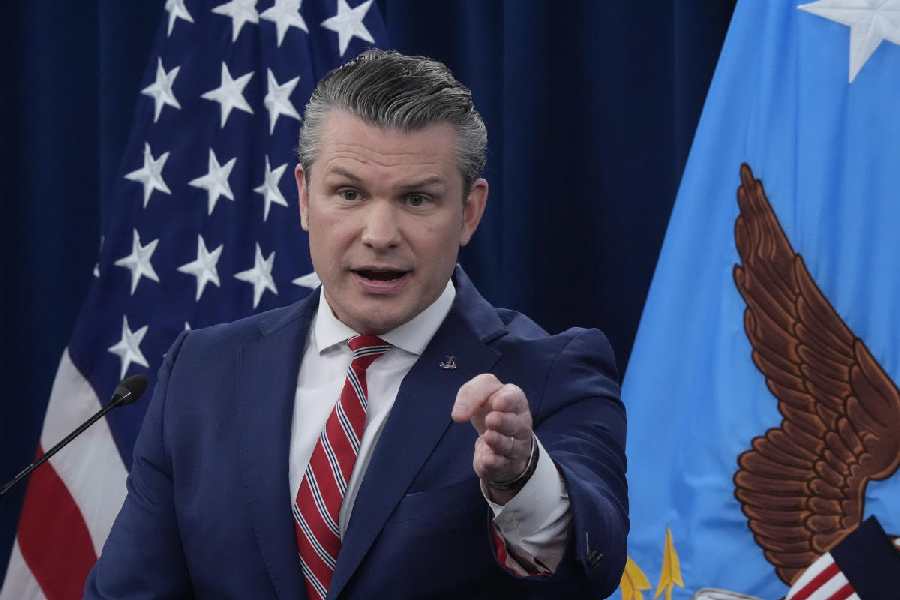
Defence Secretary Pete Hegseth faced intense questioning from Republican and Democratic lawmakers on Tuesday over the Trump administration’s strategy in the Iran war, amid concerns over the conflict’s nearly USD 29 billion cost and its impact on diminishing US weapons stockpiles.
“I take issue with the characterisation that munitions are depleted in a public forum. That’s not true,” Hegseth said, insisting the military still had enough missile defence systems and munitions for the current conflict as well as future wars.
Lawmakers from both parties repeatedly pressed Hegseth and Joint Chiefs Chairman Gen. Dan Caine on whether the US military was adequately prepared for a prolonged high-intensity conflict and whether the administration had a clear endgame for the war.
Appearing before Congress, Hegseth adopted a noticeably softer tone compared to his confrontational testimony at hearings earlier this month. He avoided direct criticism of lawmakers and instead highlighted the administration’s efforts to ramp up weapons production and strengthen military capabilities.
The hearings, held by the House and Senate Appropriations subcommittees overseeing defence spending, focused on the Trump administration’s proposed USD 1.5 trillion military budget for 2027 — the largest in US history. But discussions quickly shifted to the Iran conflict and the political fallout from surging fuel prices ahead of the midterm elections.
Rep Rosa DeLauro, the top Democrat on the House Appropriations Committee, accused the administration of lacking a coherent strategy for the war.
“The question must be answered at the end of this crisis: What have we accomplished and at what cost?” DeLauro said. “The rationale shifts, the objectives change. The end game is ill-defined when it is defined at all.”
Republican Rep Ken Calvert, chairman of the defence appropriations subcommittee, also raised concerns over the war’s impact on military funding and weapons reserves.
“Questions persist about whether we are building the depth and resilience required for a high-end conflict,” Calvert said.
Minnesota Democrat Betty McCollum asked whether the Pentagon had a strategy to scale back troop deployments in the Middle East if Congress eventually succeeds in efforts to halt the war.
“We have a plan to escalate if necessary,” Hegseth responded. “We have a plan to retrograde if necessary. We have a plan to shift assets.”
He declined to publicly discuss operational details, while maintaining that concerns about depleted stockpiles had been “unhelpfully overstated.” Hegseth added that defence manufacturers had been instructed to “build more and build faster,” blaming weak industrial capacity on previous administrations and extensive US aid to Ukraine.
Pentagon comptroller Jay Hurst told lawmakers that the cost of the Iran war has now risen to about USD 29 billion. Roughly USD 24 billion of that amount is linked to replacing and repairing munitions, while the remainder covers operational expenses tied to deployed US forces. The updated estimate is higher than the USD 25 billion figure Hurst presented less than two weeks ago.
The Trump administration is also facing growing pressure from the economic fallout of the conflict after Iran effectively shut down the Strait of Hormuz, a critical global shipping route through which around 20 per cent of the world’s oil supply normally passes. In response, US forces have blockaded Iranian ports, while both sides have exchanged attacks at sea, including strikes on Tehran-linked oil tankers.
President Donald Trump said Monday that ceasefire prospects were on “massive life support” and sharply criticised Iran’s latest proposal over its nuclear programme.
“I would call it the weakest right now after reading that piece of garbage they sent us,” Trump said.
Trump has also proposed suspending the federal gas tax to help Americans cope with soaring fuel prices, although he has argued that higher energy costs are justified if they prevent Iran from obtaining nuclear weapons.
The Senate hearing later Tuesday was expected to include scrutiny from Republican Sen Susan Collins of Maine, who previously joined Democrats in backing an unsuccessful effort to limit the conflict, citing the need for a clearer strategy to end the war.
Alaska Republican Sen Lisa Murkowski, while opposing recent war powers resolutions, has also called for congressional authorisation to define the war’s limits and objectives.
At the same time, Hegseth is expected to receive support from influential Republicans including Senate subcommittee chairman Sen Mitch McConnell and Sen Lindsey Graham, one of Congress’s strongest advocates of the Iran war.