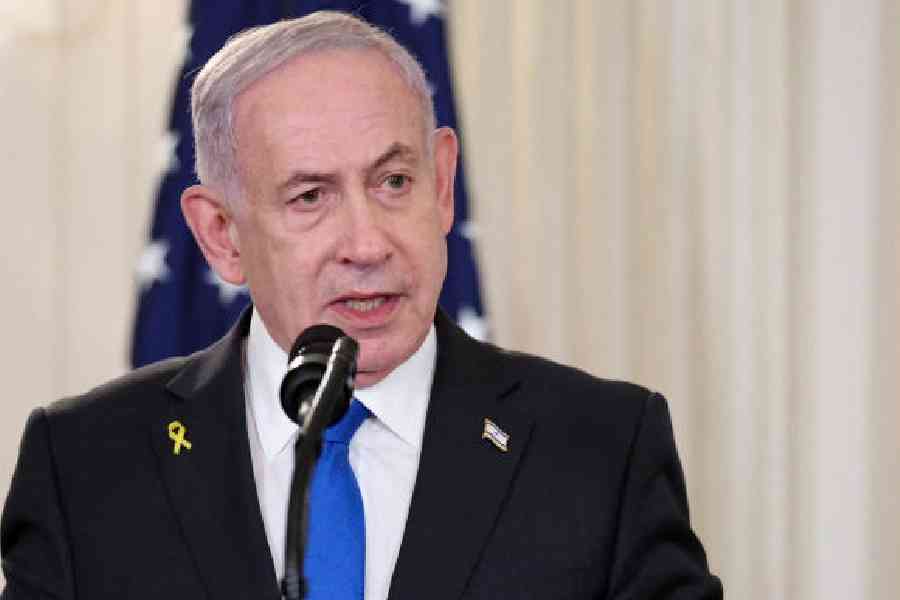
Israeli attacks on Iran have been targeting the country’s internal security services as part of Prime Minister Benjamin Netanyahu’s strategy to destabilise the authoritarian government and create the conditions for a popular uprising.
Israel has already killed Iran’s Supreme Leader, Ayatollah Ali Khamenei, and announced on Tuesday that it killed the country’s top security official, Ali Larijani. Israeli defence minister Israel Katz said Iranian intelligence minister Esmail Khatib had been killed in an overnight strike. Iran later confirmed the development.
Beyond that, the Israeli military has been heavily bombing the security forces that have quashed wave after wave of anti-government protests in Iran.
Some former Israeli military officials dismissed Netanyahu’s strategy as unrealistic, arguing that Iran’s internal security services are too deeply entrenched and powerful. Other experts, however, argue that Israel should try to bring about a change in leadership, while acknowledging that airstrikes alone will not be enough without a popular uprising.
Netanyahu has said that Israel’s air campaign has delivered “crushing blows” to Iran’s security apparatus and will create “optimal” conditions for Iranians to oust their government.
“I’m telling the Iranian people,” Netanyahu said at a news conference last week. “The moment you can come out for freedom is getting closer. We are standing beside you and helping you. But at the end of the day, it’s up to you.”
Even if Israel managed to weaken Iran’s internal forces significantly, there is no certainty that government opponents would rise up again after a crackdown by authorities killed thousands in December and January.
At the start of the war, Israel and the US both stated their desire to lay the groundwork for regime change. But last week, US President Donald Trump acknowledged that a popular uprising didn’t seem imminent. “They say if anybody protests, we’re going to kill you in the streets,” he told Fox News on Friday. “I think that’s a big hurdle to climb for people that don’t have weapons.”
And Trump is the only one likely to determine how long the war will last.
In the past two decades, Iranians have risked their lives to demonstrate against their government and stand up for freedoms. In the war’s early days, many celebrated the death of Ayatollah Khamenei, who was the Supreme Leader for 36 years and systematically quashed dissent with lethal force and mass arrests.
More recently, Ahmadreza Radan, Iran’s police chief, threatened harsh retribution against anyone who dared demonstrate against the government. “From now on, if someone acts at the enemy’s behest, we will no longer consider them protesters or anything of the sort,” he said in an interview with Iranian TV earlier this month. “We will regard them as the enemy and we will treat them as we treat the enemy.”
On Friday, thousands of Iranians participated in a government-sponsored rally against the US and Israel, illustrating the government’s remaining sway over at least part of the population.
In the more than two weeks since the war began, Israel has launched dozens of strikes on the main Iranian security services that cracked down on protesters before the war, especially the Basij — a volunteer militia affiliated with the powerful Revolutionary Guards force, according to Israeli military officials.
The strikes have hit Basij command centres and checkpoints, the Israeli military said. They have also targeted other repressive agencies, such as the ministry of intelligence.
On Tuesday, Israeli strikes also killed the commander of the Basij, Gholamreza Soleimani, according to the military. US strikes have heavily targeted the command and intelligence facilities of the Revolutionary Guards, a powerful military force that protects the authoritarian rulers.
Brig. Gen. Eran Ortal, a former senior Israeli military official, said there were shortcomings in Netanyahu’s Iran strategy, but he did not dismiss it.
“The logic is that the internal collapse of the regime, which has already started, will be accelerated if these suppression forces are weakened,” said Gen. Ortal, who served as the commander of the Dado Centre for Interdisciplinary Military Thinking, a research group in the Israeli military.
He said the rank and file of the Basij — estimated at roughly one million members — rely on ordersfrom their commanders rather than taking the initiative. Breaking the chain of command could make it difficult for them to function effectively, he added.
Raz Zimmt, the director of the Iran programme at the Institute for National Security Studies in Tel Aviv, said that if Iran’s internal security forces failed to quash protests, it could encourage more people to join and lead to defections among lower-ranking members of the ruling system.
Some analysts, however, remain sceptical about the likelihood of a new uprising, citing persistent government control and the mixed public sentiment. “There’s enormous hatred of the Islamic republic,” said Vali Nasr, a professor of Middle East studies at Johns Hopkins University. “But now there’s also considerable hatred of the United States and Israel and considerable worry about the future of the country itself.”
Iranians were caught between their government and the US and Israel, he said.
Lt Col Shahar Koifman, who was the head of the military intelligence directorate’s Iran desk until 2022, also cast doubt that a revolt against the rulers was in the offing.
“The Basij is a very large group of people with a lot of machine guns and they will not give up. They and their families depend on it,” he said. “Unfortunately, they are highly effective in their violent measures against the protests.”
Lt Col Koifman said Israel should stay focused on more achievable goals like degrading Iran’s missile capabilities, nuclear programme, and regional proxies.
During his tenure, he said, the Israeli security establishment never seriously considered regime change, believing that it was an unrealistic outcome. “The regime will emerge from this event scarred but alive,” he predicted.
New York Times News Service