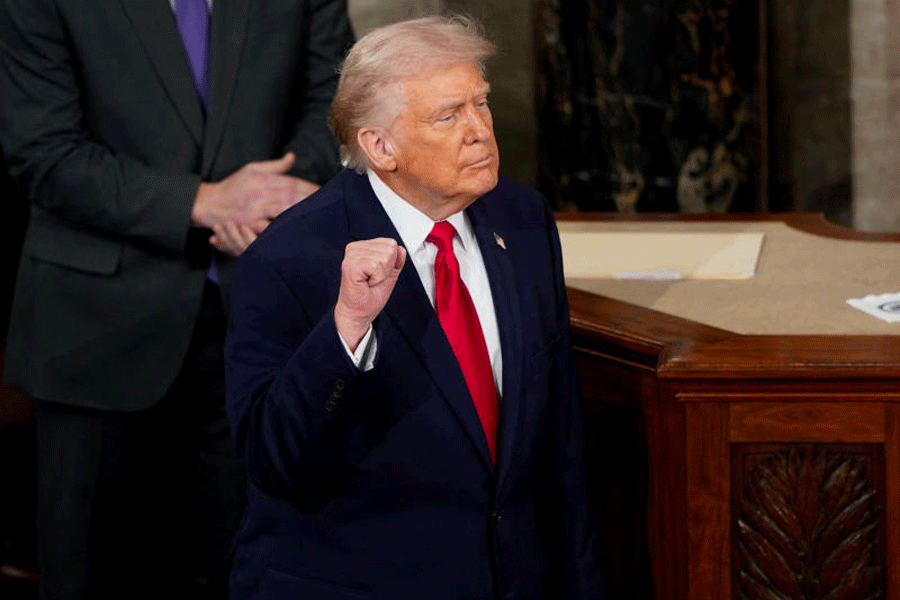
Six American service members were killed, and US military jets were shot out of the sky. Investors are bracing for market turmoil, fearing prolonged disruption to oil supplies. US President Donald Trump says the military campaign against Iran could extend for weeks, and secretary of state Marco Rubio said on Monday that “the hardest hits are yet to come from the US military”.
With his decision on Friday to authorise war against Iran, Trump is taking the biggest gamble of his presidency, risking the lives of American troops, more deaths and instability in the world’s most volatile region, and his own political standing.
Trump, facing declining approval ratings and staring down the possibility that Republicans will lose control of Congress in the midterms, plunged the US into what is shaping up to be its most expansive military conflict since the 2003 invasion of Iraq.
In just over a year since taking office, Trump has authorised military action in seven nations, even after he repeatedly promised American voters that he would end, not start, wars. During his inaugural address, he said his “proudest legacy will be that of a peacemaker”.
Even as he has struggled to provide a clear endgame for the military campaign, Trump has portrayed the operation as a resounding success. He has acknowledged the US casualties as a cost of war but has spent more effort on boasting about the killing of Ayatollah Ali Khamenei, Iran’s supreme leader, the destruction of military targets across the country, and his commitment to keeping Iran from ever being able to produce a nuclear weapon.
But interventions in West Asia have bedevilled generations of American Presidents. Conflicts there scarred the legacies of Presidents George W. Bush, who led the country into lengthy wars in Iraq and Afghanistan that came to be deeply unpopular, and Jimmy Carter, whose failed operation in 1980 to rescue American hostages in Iran has been top of mind for Trump.
Now it is Trump who is orchestrating a rapidly expanding military effort in a region whose history and religious and factional politics make it an especially complex battleground.
“Presidents are reluctant to engage in these situations unless we are provoked, attacked directly,” said Barbara Perry, a presidential historian at the University of Virginia’s Miller Centre. “Then there is usually a rally around the flag effect. You’re not going to have that now.”
While a handful of prominent voices in his movement have publicly denounced the decision to go to war, Trump’s base appears to be standing by him, for now. Still, some of the President’s allies privately worry that there is little political upside to the attacks on Iran and huge downsides, particularly the loss of US troops and rising cost of oil.
Democrats have seized on the strikes to paint Trump as more focused in foreign intervention than addressing Americans’ economic worries at home.
“Trump sold voters on a ‘pro-peace’ vision of himself as an America First candidate, yet in under 13 months, he has ordered strikes on seven foreign nations and plunged our country into more open-ended conflict using taxpayer dollars,” Ken Martin, the chair of the Democratic National Committee, said in a statement. “While he’s distracted by foreign conflicts and shiny ballrooms, Trump has failed to deliver on his promise to bring costs down for working families, who are paying more every day because of Trump’s actions.”
Early polling after the attacks show most voters are not in favour of them. A CNN poll found 59 per cent of Americans disapprove of Trump’s decision to launch strikes against Iran, and Reuters-Ipsos poll found that only 27 per cent of Americans approve of the military campaign.
Should the conflict go badly or Iran descend into turmoil, it could leave Republican candidates in the midterm elections faced with difficult choices about whether to distance themselves from Trump on the issue.
And the war poses challenging questions for those looking to lead the party in the future, complicating the “America First” ideology at the core of the movement.
“This is not what we thought MAGA was supposed to be,” wrote former Representative Marjorie Taylor Greene, the Georgia Republican who broke with Trump last year and then resigned from Congress, in a social media post. “Shame!”
In a subsequent post, Greene called the Trump administration a “bunch of sick liars”, punctuating it with an expletive. “We voted for America First and ZERO wars,” she wrote.
New York Times News Service