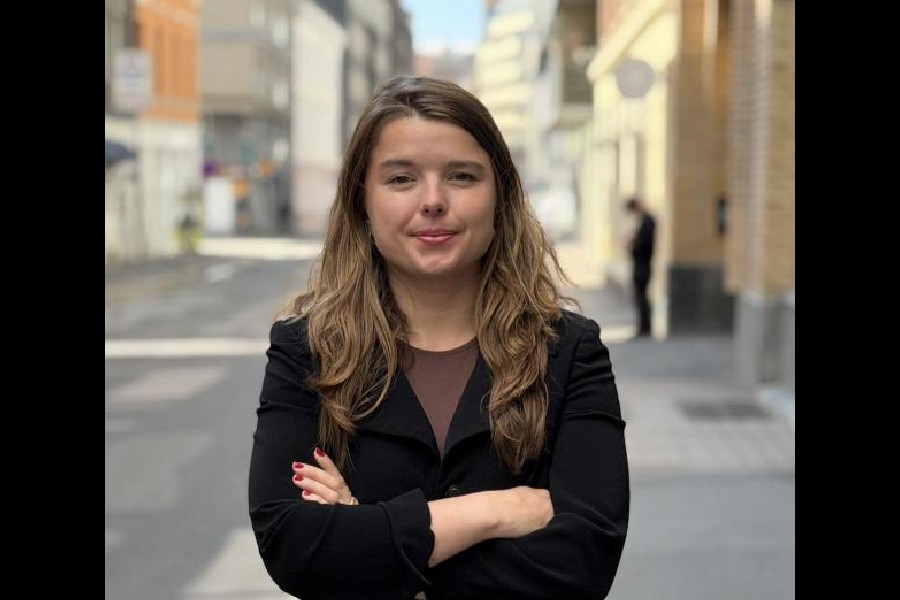
Helle Lyng Svendsen would love to visit India. But the twenty-something Norwegian journalist is unsure if “India would welcome me at this point”.
She laughed as she said this to The Telegraph over a video call from Oslo on Sunday morning.
Svendsen, who represents the Oslo-based newspaper Dagsavisen, found herself suddenly catapulted to global fame — and exposed to vilification in India — last week after questioning Prime Minister Narendra Modi about his reluctance to take media queries.
“Prime Minister Modi, why don’t you take some questions from the freest press in the world?” she had asked him after his joint press statement with his Norwegian counterpart in Oslo on May 18.
(While Norway tops the World Press Freedom Index, India ranks 157 among 180 countries.)
Modi walked away without responding.
The backlash was swift.
“After Modi left the country... I started getting really kicked out of Instagram.... Suddenly that same night, I was suspended from Instagram and from Facebook,” Svendsen said.
“I think it’s so fascinating how fast that went, that the state visit is over and then suddenly they lock my accounts, and in just a few hours they’re able to... make such a powerful technology company as Meta just suspend that account.”
She added: “I’ve never experienced anything like this.”
Svendsen said her accounts had since been off and on; restored now and suspended again. She doesn’t know exactly why, but one of the ways such digital retribution can be triggered is a large number of users complaining against an account for alleged copyright violation or misinformation deemed likely to cause widespread panic or public disorder, among others.
In India, she has been lambasted in TV studios and on social media with charges of showboating, lack of area expertise, leveraging the encounter for personal online fame — even of being an enemy agent.
‘Close’ encounter
Svendsen had directed her query at Modi as he began walking away from the joint media appearance in a small, tightly packed room. She dismissed suggestions that the Prime Minister did not hear her.
“I’m sure that he heard me... unless he has some (auditory) health issues, which I would not be aware of,” she said.
“I was not that far away from him.... I was sitting second row in a very small room, and he was just walking out when I asked that question. So, we were so close.”
What would she have asked Modi had he stopped to answer?
“I would want to tap into the human rights situation (in India),” she said.
She would have asked: “What are the areas of improvement in your country? Will you commit to trying to improve some of the human rights violation situations that are going on, and how will you do it? Will you roll out initiatives for change? Take the criticism that is coming from within your country and also international organisations?”
She would have also asked the Prime Minister, who has not held a single unscripted domestic media interaction in 12 years: “Will you start to take critical questions from the press at press conferences in India, also the independent journalists of India that are committed to doing real work and truthful reporting? Why don’t you take questions from them?”
Svendsen got to ask at least one of these questions — about India’s human rights record — to external affairs ministry (West) secretary Sibi George at a later media interaction.
The query drew a long lecture from George on the past glories of Indian “civilisation” — its invention of zero and chess included. That 11-minute clip caused more furore in India.
Not about ‘me’
Svendsen blames that partly on the Indian media.
“It was not me that made this about me,” she said. “It was the Indian media, some of the people that now are criticising me, that made this story about me,” she said.
“Instead of... ‘Modi pressed on press freedom in Norway’, they decided to make it about the journalist.”
Svendsen has since had a brief interaction with Indian leader of the Opposition Rahul Gandhi on social media.
She laughed when told how the saffron ecosystem had used it to label her a “Congress proxy”, a “George Soros-funded agent”, even a “foreign spy with the aim of weakening India”.
“I don’t have an opinion on him,” she said of Rahul. “India is a country now where it seems a one-party situation could unfold in the future; so there’s a lot of weight on his shoulders as well. But I would also ask him critical questions.”
Despite the trolling, Svendsen noted that her inbox was also flooded with messages of solidarity from Indians — both from India and abroad.
“Even today, I’m getting three to four messages every minute on Instagram, of (Indian) people thanking me,” she said.
So, which world leader, in her experience, is the easiest to ask tough questions to?
“My initial thought would be (US) President Donald Trump. Because he’ll just take questions about everything, every day throughout the day,” she laughed.
“I asked President Trump a few questions, when I was covering our Prime Minister’s visit to the US. That’s also a difficult situation, because it’s a heated environment and he takes questions, but you can’t follow up....”
‘Open’ society
How about politicians in her own country, which has consistently topped the World Press Freedom Index?
“Politicians in Norway, even when there’s a crisis around them, even when their whole life is blowing up, there’s a big political scandal... even at those types of times, these politicians will do interviews with the press, often several in a day,” she said.
She cited how former Norwegian Prime Minister Erna Solberg once navigated a severe media storm by granting 14 interviews in a single day to both large and small outlets.
“That’s just the type of stuff that can happen in a country where everyone prioritises democracy.”
Svendsen — who normally spends her weeks analysing Norwegian labour markets and local policy shifts — is surprised that other international correspondents present at the summit did not build on the momentum of her questions to Modi or George.
“I had hoped that when the Indian Prime Minister left the stage that someone else — some of those who are a lot more senior, well-known — could try to challenge him as well,” she said.
“I think that would have been valuable too, to see that there are more journalists showing solidarity with our colleagues in India that are kept from asking the tough questions.”
Svendsen does not see herself as a hero — only as a professional journalist doing her job. And she knows that many others face a lot heavier odds than her.
“I just literally did my job from a privileged corner of the world. You guys in India are the ones doing the hard work, the really heavy lifting. You gotta remember that.”
Would she consider coming to India?
“I don’t know if India would welcome me at this point,” she laughed.
“I would definitely want to come and report. But if that isn’t a possibility, I would love to come to just experience the culture, the history, the people. There’s a lot of power in that too.”