 |
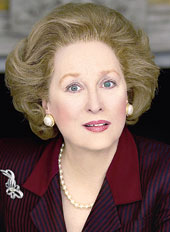
| Meryl Streep as Margaret Thatcher in a scene from The Iron Lady. (AP) |
London, April 8: Margaret Thatcher’s death today in London at the age of 87 was not unexpected since the former Prime Minister had been in poor health for several years but nevertheless her passing can only be likened to the crash of a giant banyan tree.
As the Union flag slipped to half mast over 10, Downing Street, and many other official buildings across the land, David Cameron was not exaggerating when he said: “Margaret Thatcher succeeded against all the odds. The real thing is she didn't just lead our country; she saved our country. I believe she will go down as the greatest British peacetime prime minister.”
Not everyone will agree with this assessment for Lady Thatcher, as she became, was a controversial politician who often divided public opinion (for example, on the question of a poll tax) but on balance she will probably go down as Britain’s most important leader since Winston Churchill.
On a day filled with spring sunshine, someone placed a lone daffodil at the foot of her statue in the House of Commons. It was an understated but eloquent British gesture. She will be remembered, firstly, as Britain’s first — and to date — only woman Prime Minister.
She was constantly reminded of a comment she made in 1974: “It will be years and — not in my time — before a woman will lead the party or become prime minister.”
She took on the hard Left unions and reformed trade union laws; she beat striking miners; privatised many state undertakings such as British Rail and British Telecom and created a new generation of ordinary shareholders. She sold council houses so that a property owning working class came into being for the first time.
In 1982, the Argentine military made the greatest mistake of all in underestimating what they thought was just another blonde. When the Falkland Islands were captured by Argentina, Thatcher ignored the advice from her own over cautious military commanders and sent her fleet half way across the world to recover what she maintained was British territory.
Thatcher was Prime Minister for eleven and a half years from May 1979, when she defeated the Labour Prime Minister James Callaghan, until November 1990 when she was forced to stand down by Tory MPs who felt her day was done. But she won three general elections — in 1979, 1983 and 1987 — and, as she often liked to point out, was never rejected by the electorate.
Thatcher was succeeded as Tory prime minister by Sir John Major who today called his predecessor a “true force of nature”.
Tony Blair, too, won three elections and was Labour prime minister from 1997-2007 but his reputation has been damaged by the Iraq war. Today, Blair was generous in his tribute: “Margaret Thatcher was a towering political figure. Very few leaders get to change not only the political landscape of their country but of the world. Margaret was such a leader. Her global impact was vast. And some of the changes she made in Britain were, in certain respects at least, retained by the 1997 Labour government, and came to be implemented by governments around the world. As a person she was kind and generous spirited and was always immensely supportive to me as Prime Minister although we came from opposite sides of politics. Even if you disagreed with her as I did on certain issues and occasionally strongly, you could not disrespect her character or her contribution to Britain's national life. She will be sadly missed.'
There was even a message from the Queen.
A Buckingham Palace spokesman said: 'The Queen was sad to hear the news of the death of Baroness Thatcher. Her Majesty will be sending a private message of sympathy to the family.'
That Thatcher had been unwell in recent years was no secret. Her dementia was portrayed by Meryl Streep in an Oscar winning performance in The Iron Lady.
The description, which was given to her by the Russians, delighted her. In 1976, she revelled in the expression the Kremlin had invented for her: 'I stand before you tonight in my green chiffon evening gown, my face softly made up, my fair hair gently waved. The Iron Lady of the Western World? Me? A cold war warrior? Well, yes — if that is how they wish to interpret my defence of values and freedoms fundamental to our way of life.'
Thatcher had recently been staying at the Ritz Hotel and recovering from a minor operation. Her spokesman, Lord Bell, said in a brief statement: 'It is with great sadness that Mark and Carol Thatcher announced that their mother Baroness Thatcher died peacefully following a stroke this morning.'
Her husband, Sir Denis Thatcher, who was the subject of an affectionate caricature in the Private Eye satirical magazine, died in 2003. They are survived by their 59-year-old twin children, Sir Mark Thatcher, a businessman who must have been something of a disappointment to his high achieving parents, and Carol Thatcher, a journalist who was unfulfilled in love and has never married.
Behind the scenes, Thatcher's long illness has allowed the authorities to plan her funeral in great detail — and run the arrangements past her. It may come as a surprise to many she has chosen to be cremated. The spokesman for 10, Downing Street, disclosed: 'We can announce that, with the Queen's consent, Lady Thatcher will receive a ceremonial funeral with military honours. The service will be held at St Paul's Cathedral. A wide and diverse range of people and groups with connections to Lady Thatcher will be invited. The service will be followed by a private cremation. All the arrangements being put in place are in line with wishes of Lady Thatcher's family.'
Since she is not receiving a state funeral, her body will not lie in state. But she will be accorded the same status as Diana, Princess of Wales, and the Queen Mother. In other words, Britain will put on quite a show with world leaders flying in for the occasion. The streets between Westminster and St Paul's Cathedral will be cleared for the procession.Today, the Union flag has been lowered over Buckingham Palace and other royal residences including Clarence House, the Prince of Wales's London home.
Margaret Hilda Thatcher was born on 13 October 1925 in Grantham, Lincolnshire, the daughter of Alfred Roberts, a grocer, and his wife, Beatrice.
'Well, of course, I just owe almost everything to my own father. I really do,' she said later. 'He brought me up to believe all the things that I do believe.'
She studied natural sciences at Somerville College, Oxford, and became only the third female president of the Oxford University Conservative Association. After graduating she moved to Colchester where she worked for a plastics company and became involved with the local Conservative Party organisation.
In 1951 she married a divorced businessman, Denis Thatcher, and began studying for the Bar exams. She qualified as a barrister in 1953, the year in which her twins Mark and Carol were born.
Thatcher found it hard as a woman to get a seat in the Commons but in power she made use of the fact she had not been born to wealth and privilege.
She tried, unsuccessfully, to gain selection as a candidate in 1955, but finally entered Parliament for the safe Conservative seat of Finchley at the 1959 general election. When Ted Heath entered Downing Street in 1970, she was promoted to the cabinet as education secretary with a brief to implement spending cuts in her department.
Heath never forgave Thatcher for challenging him for the party leadership in 1975 after he had lost to Harold Wilson in 1974.
When she went into Heath's office to inform him of her decision, he did not even bother to look up.
'You'll lose,' he said. 'Good day to you.'
To everyone's surprise, she defeated Heath on the first ballot, forcing his resignation, and she saw off Willie Whitelaw, a Tory grandee, on the second ballot to become the first woman to lead a major British political party. She coined the sentence: 'Every woman needs a Willie.'
She entered Downing Street in 1979 with a mission to repair the country's finances. In 1984, the IRA attempted to blow up half the cabinet, Thatcher included, by exploding bombs inside the Grand Hotel in Brighton where the Tory ministers were staying for their party conference.
Five people were killed, others were injured but Thatcher survived and addressed her party - and the nation - a few hours later about 'the scale of the outrage in which we have all shared. And the fact we are gathered here, now, shocked but composed and determined, is a sign not only that this attack has failed, but that all attempts to destroy democracy by terrorism will fail.'
She was often called the 'only man in her cabinet' and gave rise to the expression 'handbagging' the opposition. On a tv show, Splitting Image, her puppet was shown cowing her cabinet ministers with her swinging handbag.
She was also associated with a way of politics known as 'Thatcherism', which she saw as the common sense approach of the average housewife: 'Any woman who understands the problems of running a home will be nearer to understanding the problems of running a country.'
Twist 'n' turms
In a 1980 speech to her party, Margaret Thatcher had dismissed those
suggesting a “U-turn” in her economic policies by uttering one of her most
famous quotes. “You turn if you like, the lady’s not for turning,” she said, playing on the title of Christopher Fry’s popular play, The Lady’s Not for Burning.
Thirty years later, when a bout of the ’flu caused her to miss an 85th birthday party arranged by Prime Minister David Cameron in Downing Street, the then Baroness Thatcher was ready to provide a further twist. “The Lady’s not for returning,” said her wry apology.
Indian trick
“Godman” Chandraswamy, then aged about 25, had arrived in London in 1975 and got Indian deputy high commissioner K. Natwar Singh to fix a meeting with Margaret Thatcher.
Since Chandraswamy spoke no English, Natwar translated. Chandraswamy got Thatcher to write down questions on five strips of paper, which she did “with scarcely camouflaged irritation”. By the time he had correctly predicted her fourth, Thatcher had “begun to consider Chandraswamy a holy man indeed”, says Natwar.
Thatcher asked for a second meeting. She was delighted to be told she would become Prime Minister “in three or four years” and remain in the post for “either nine,
11 or 13 years”.
She did become Prime Minister and held the post for a little over 11 years.