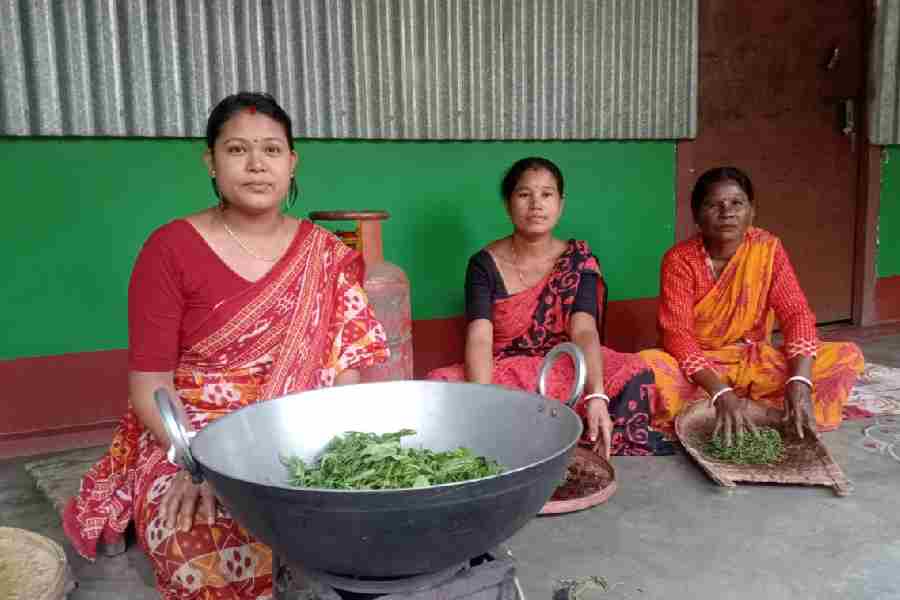
Women associated with self-help groups and farmer-producer organisations (FPOs) across north Bengal are preparing to take their handmade specialty teas to the European market.
These teas are backed by training programmes that focus on sustainable cultivation, quality standards and business development.
The initiative comes at a time when demand for handmade and specialty teas is growing in Europe. The organisations working with small tea growers have started training women engaged in tea-making to meet the stringent requirements for exports.
Bijoygopal Chakraborty, the president of the Confederation of Indian Small Tea Growers’ Associations (Cista), said that women from self-help groups in Jalpaiguri, Cooch Behar, North Dinajpur and Darjeeling hills were producing handmade teas.
Seven FPOs in Jalpaiguri and Cooch Behar and four FPOs in the hills currently involve women in producing specialty teas.
“These women make four varieties of tea — green, white, black orthodox and oolong. We want to help them build sustainable businesses and access international markets,” Chakraborty said.
Sources said that experts associated with specialised agencies have started training programmes to help women understand governance, financial discipline and marketing.
“A three-day training programme was recently conducted for them. During the training, participants were apprised about export-related standards and certification requirements,” said sources.
Chakraborty also stated that the push towards exports comes with challenges. “European buyers insist on strict quality controls, including pesticide-free production and compliance with certification norms. Trainers teach participants how to reduce the use of chemical fertilizers and pesticides and adopt environment-friendly cultivation practices,” he said.
He said that one of the most promising examples has emerged from Jamtala in Mainaguri block of Jalpaiguri, where 23 women have formed a group to produce handmade specialty teas.
“Their products have already attracted attention at exhibitions and showcases in different parts of India. The group’s teas, including green tea, white tea and orthodox varieties, recently received appreciation at events in Delhi and Calcutta,” he added.
A member of the group said that the training has made them understand not only tea-making but also marketing.
Organisations involved in the initiative now see the UK and some more European countries as destinations for these teas, sources said. Efforts are underway to connect producers with buyers and create a business model to support long-term exports.
“At the same time, steps are being taken to improve sustainability in tea cultivation. Small tea growers and their organisations have stressed the need to increase organic carbon in the soil to improve productivity and soil health,” said a source.
“As part of a pilot project, a machine will soon be installed at a self-help group-run tea factory in Bhotpatty in Mainaguri. The machine will convert corn cobs and pruned tea branches into biochar to enrich the soil with organic carbon,” the source added.
Cista president Chakraborty said that producer groups have started working on a system under which packets of specialty tea would bear QR codes.
“Consumers who scan the code can know where the tea was grown, who produced it and details about the manufacturing process,” he said.
“If they can meet export standards and maintain quality, north Bengal’s handmade specialty teas could soon find a place on shelves in the UK and Europe, creating a new source of income for rural women and small tea-growing communities,” he added.